Laurel Oak Problems in Tallahassee — What to Do
Dropping branches, thinning crown, dark patches on the bark? You’re not imagining it — the laurel oaks planted across Tallahassee in the 1960s and 70s are hitting the end of their natural lifespan on the same clock. Call now and we’ll connect you with a vetted, ISA-certified local pro for an honest verdict.
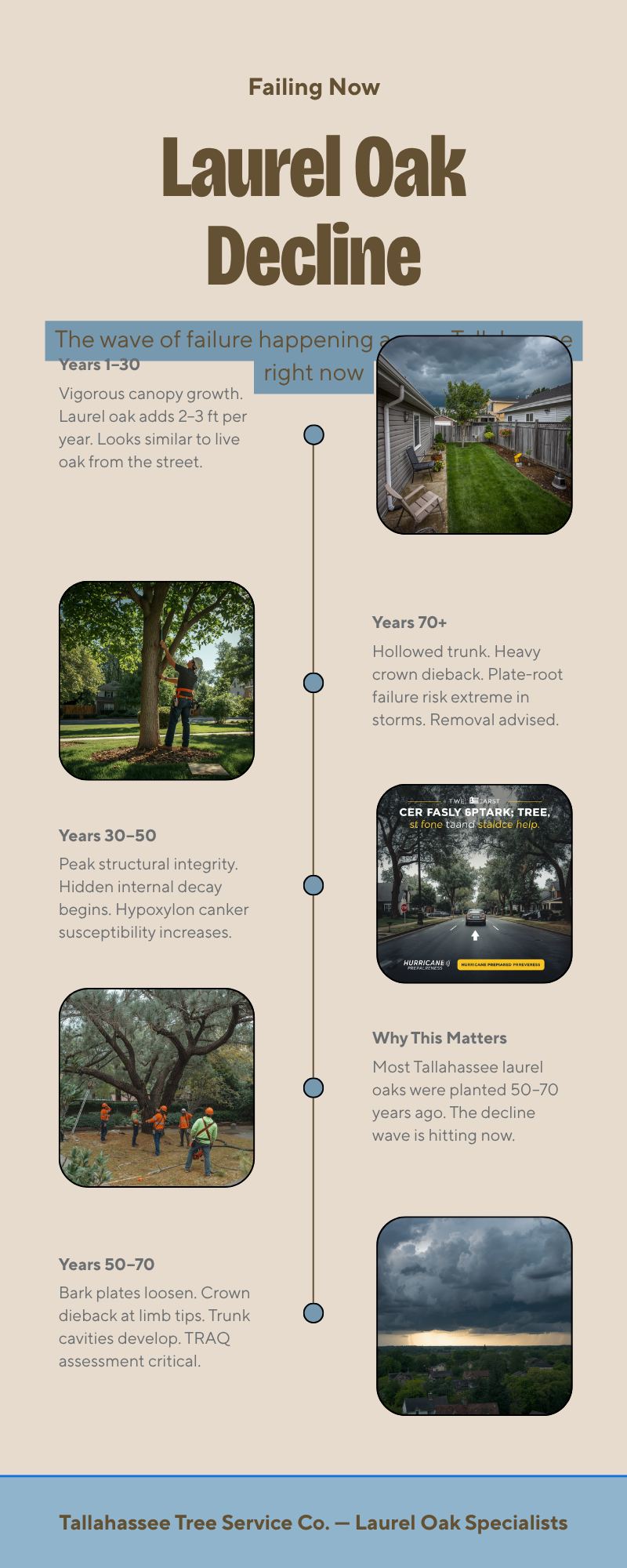
📞 Call Now — (858) 319-0022Limb over a roof or driveway already cracking? Treat that as urgent — keep people and cars out from under it.Here’s the uncomfortable truth about laurel oaks: they were the builder’s favorite shade tree during Tallahassee’s postwar growth spurts because they grow fast, look like a live oak to a buyer, and cost less. The trade-off nobody mentioned at planting time is the lifespan — a laurel oak runs 40 to 60 good years, not 300. The trees that went in with the subdivisions in Killearn, Betton Hills, Indianhead, and the 1960s–70s ring around Midtown are now 50-plus years old, all at once. That’s why it can feel like every street has one coming apart at the same time. It’s not a disease outbreak — it’s a planting wave reaching its expiration window together.
How to tell a laurel oak from a live oak (it matters a lot)
The two get confused constantly, and the care answer is opposite. A live oak has a wide, spreading crown, limbs that sweep low and horizontal, and small rounded leathery leaves — and it’s built to outlive your grandchildren. A laurel oak grows tall and upright with a denser, more vertical crown, longer glossy leaves, and smoother bark when young. If the tree shot up fast, holds its leaves high, and is now 50–80 feet of trunk over your roof — assume laurel oak until a pro says otherwise. Care advice for one is malpractice for the other: a declining live oak is usually worth saving; a declining laurel oak usually is not.
The four problems that actually take laurel oaks down
1 · Hypoxylon canker (Biscogniauxia)
The signature laurel oak killer in North Florida. It’s a fungus that lives quietly in healthy trees and switches to attack mode when the tree is stressed — drought, root damage, age. The tell: patches of bark sloughing off the trunk or major limbs, exposing a crusty layer underneath that goes from silvery-tan to charcoal black, like the bark was scorched. By the time hypoxylon is visible, the wood behind it is already structurally compromised and the conversation is about removal timing, not treatment — there is no cure once it’s fruiting.
2 · End-of-lifespan decline
Even without a nameable disease, a 55-year-old laurel oak winds down visibly: the crown thins from the top down, dead limbs accumulate faster than the tree sheds them, epicormic sprouts (panic shoots) pop along the trunk, and each spring’s releaf comes in weaker than the last. Decline isn’t linear — a tree can look 80 percent fine and be two summers from hazardous.
3 · Storm-induced structural failure
Laurel oak wood is noticeably weaker and more decay-prone than live oak wood, and the species’ taller, denser crown catches more wind. UF/IFAS wind-resistance ratings put it near the bottom of the big shade oaks. The classic failure is a major limb or co-dominant trunk letting go in an ordinary summer thunderstorm — often revealing a hollow, decayed core that looked solid from outside.
4 · Root and butt rot
Mushrooms or shelf-like conks at the base of a laurel oak are fruiting bodies of decay fungi already working the structural roots or lower trunk. Pair that with a new lean or soil heave on one side and the tree has become a physics problem with a countdown attached.
Bark sloughing, conks at the base, or big deadwood over a target? That’s past the wait-and-see stage — get an ISA-certified set of eyes on it this season.
📞 Call Now — (858) 319-0022Vetted local pros — availability depends on independent provider schedules and demand.*Monitor, prune, or remove? The honest decision framework
| What the tree shows | Reasonable call | Why |
|---|---|---|
| Full crown, minor deadwood, no trunk symptoms, no targets under it | Monitor | A healthy middle-aged laurel oak in an open yard can be left to live out its span. Re-check every year or two. |
| Thinning top, moderate deadwood, over lawn or fence | Prune + monitor | Crown cleaning buys usable years when the failure consequence is low. See tree pruning. |
| Hypoxylon patches, conks, hollow sound, or major dieback — anywhere near a house, driveway, or line | Plan removal | Structural wood is already going. Scheduled removal is a controlled job; the storm version involves whatever it lands on. See laurel oak removal. |
| New lean, cracked union, or limb hung up after a storm | Urgent | That’s an active failure in progress — treat it like the emergency it is via emergency tree service. |
One more honest note: spending heavily to “save” a laurel oak at year 55 is usually paying to delay the same removal at year 58. That money nearly always does more good as a removal-and-replant budget — the replacement species guide covers what to put in its place so the next generation gets a 300-year tree instead of another 50-year one.
Permits and paperwork
Inside city limits, most mature laurel oaks are past the size threshold where removal needs a permit — but a documented hazardous or declining tree makes the application straightforward. Photos of hypoxylon patches, conks, and major deadwood do the persuading. Unincorporated Leon County parcels run different thresholds. The pro you’re matched with flags what applies, or start with the Tallahassee tree permit guide.
How getting matched works
What shapes the quote on a declining laurel oak
- How far the decay has progressed: a structurally sound tree can be climbed and pieced down; a hypoxylon-riddled one may need a crane or lift because the wood can’t be trusted to hold a climber.
- Height and targets: laurel oaks run tall, and most of the 1960s plantings stand over roofs, fences, and service drops.
- Access: backyard trees behind pool cages and fences mean rigging and carrying instead of dropping and loading.
- Deadwood volume and debris: a declining crown sheds a surprising tonnage.
- Stump strategy: grinding below grade closes the book; skipping it leaves a rot plate and a replant obstacle. See stump grinding.
Frequently asked questions
How long do laurel oaks live in Tallahassee?
Plan around 40 to 60 years. A well-sited tree on good soil can stretch past that, but decay usually starts working the core decades before the crown looks bad.
What are the black or silvery patches on my laurel oak’s trunk?
Where bark has sloughed off and the surface underneath looks silvery-tan to charcoal and crusty, that’s the classic presentation of hypoxylon canker. There’s no treatment once it’s visible — it’s a removal-timing conversation.
Can a declining laurel oak be saved?
Early-stage stress from a fixable cause (root damage, drought) can sometimes be stabilized. But genuine end-of-lifespan decline and active hypoxylon can’t be reversed — pruning just manages risk while you plan the removal on your schedule.
Is my tree a laurel oak or a live oak?
Tall and upright with long glossy leaves and a high dense crown: laurel oak. Wide and spreading with low horizontal limbs and small rounded leaves: live oak. The distinction changes everything — get it confirmed before making decisions. Live oak owners should read the live oak care guide instead.
Do I need a permit to remove a declining laurel oak?
Usually yes inside city limits once the trunk passes the size threshold — but hazard documentation makes approval straightforward, and the pro handles the flagging. County parcels run separate rules.
Why are so many laurel oaks in my neighborhood failing at once?
They were planted at the same time. Killearn, Betton Hills, and the Midtown ring got their laurel oaks with the subdivisions in the 1960s and 70s, so the whole cohort is hitting its 50-to-60-year window together.
What should I plant after removing a laurel oak?
Something with a longer clock: live oak if you have the room, or southern magnolia, American elm, or bald cypress for tighter or wetter sites. The best trees to plant guide ranks the options.
Related Tallahassee tree services
Laurel Oak Removal
Dead Tree Removal
Hazardous Tree Removal
Tree Risk Assessment
Tree Disease Treatment
Tree Permit Guide
Live Oak Care
Best Trees to Plant
Get a straight answer before storm season decides for you.
Call now and we’ll connect you with a vetted, ISA-certified Tallahassee pro for an honest monitor-prune-remove verdict on your laurel oak. Free to use, no obligation, no sign-up.
📞 Call Now — (858) 319-0022Tallahassee Tree Service is a free referral service. Tallahassee Tree Service is not a licensed tree service provider and does not directly provide tree care services. All work is performed by independent, licensed and insured third-party providers in your area. Calls and form submissions placed through this site may be connected with a participating provider, and you may be contacted by that provider regarding your request. Same-day, emergency, and 24/7 availability are not guaranteed and depend on provider schedules, location, and demand. Service availability, pricing, licensing, and final response times are determined solely by the providers. It is the responsibility of the homeowner to verify that the hired contractor furnishes the necessary license and insurance required for the work being performed. All persons depicted in a photo or video are actors or models and not contractors listed on Tallahassee Tree Service.