24/7 Emergency Tree Service in Tallahassee, FL
Oak through the roofline in Betton Hills at 2 a.m. Pine across the driveway in Woodville after a squall line. Call now any hour and we’ll connect you with a vetted, licensed and insured Tallahassee-area emergency arborist — life-safety situations are triaged first.
📞 Call Now — (858) 319-0022Middle of the night? Call now — the request goes out any hour, no waiting for business hours.A tree failure in Leon County is rarely a slow-motion event. It happens when a squall line rolls up the Big Bend, when saturated Orangeburg clay finally lets go of a root plate, or when a laurel oak that has been quietly hollowing out for fifteen years meets a 55-mph gust. Hermine in 2016, Michael in 2018, the May 10 2024 EF-2 tornadoes and Helene later that year all taught Tallahassee the same lesson: the tree comes down at the worst possible hour, and what happens in the next sixty minutes decides how expensive the next six months are.
This page is the practical version of that hour. What actually counts as an emergency, what a competent crew does first when it rolls up, what your insurance carrier will demand later, and how to describe your situation clearly when you call so the right rig gets routed to you instead of the wrong one.
What counts as an emergency tree call in Leon County
Not every downed tree is an emergency, and treating everything as one slows down the people who genuinely need help first. Adjusters, dispatchers and ISA-certified arborists all draw the line in roughly the same place. Three categories clear the bar for after-hours dispatch:
Active life-safety hazard. A tree resting on an occupied house. A trunk across a vehicle with someone inside. A leaning trunk with audible fiber cracking, or soil visibly heaving on the far side of the lean — that is a root plate failing in real time. A hung-up limb suspended over a doorway, walkway or play set that can release without warning.
Active access blockage. A trunk across the only driveway with vehicles trapped behind it. A tree across a private road or a shared easement. Anything resting on the electrical service drop to the house — that one starts with the utility, not the saw.
Active property damage in progress. A limb punched through the roof deck with rain still falling. A trunk on a detached garage or a pool cage that is deforming further as you watch. Water getting into a Tallahassee attic in July does more damage overnight than the tree did on impact.
Everything else — a tree that came down in the yard and hit nothing, a lean you just noticed on a dry day, a big limb already on the ground — is still worth submitting, but it goes into the priority queue rather than the middle-of-the-night queue.
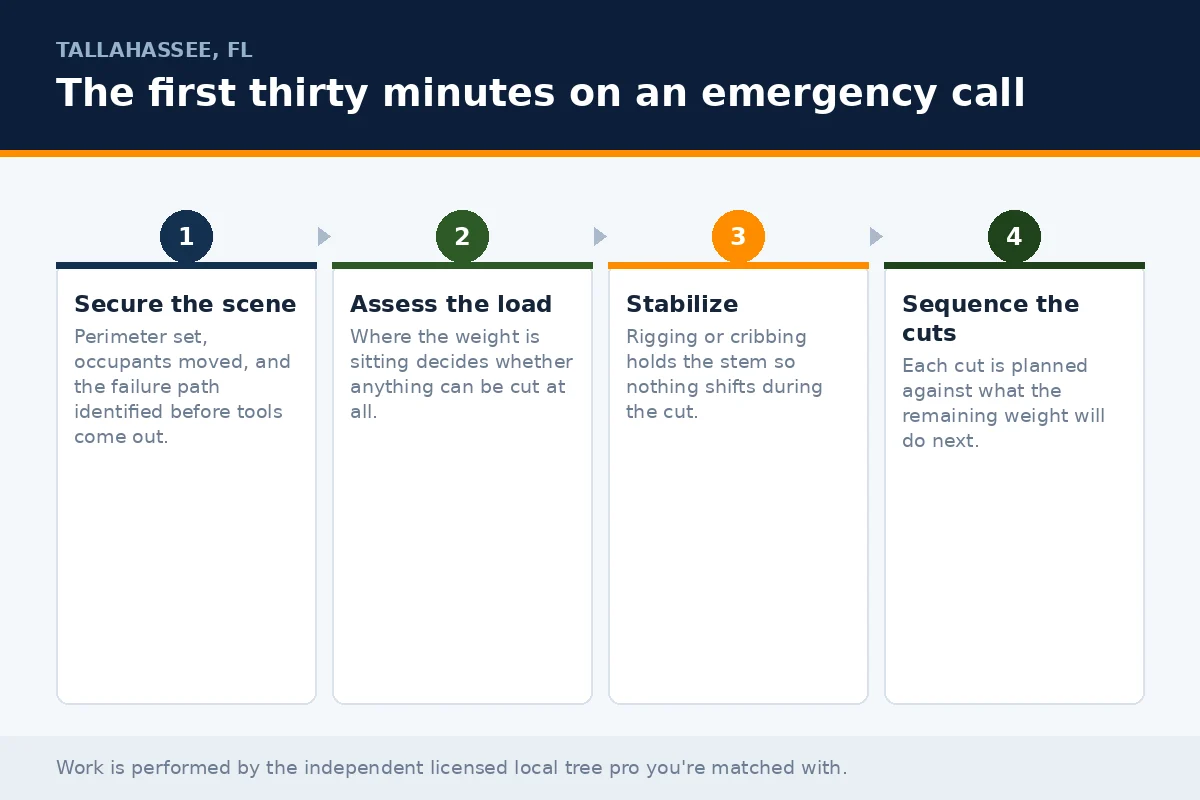
What a competent crew does in the first thirty minutes
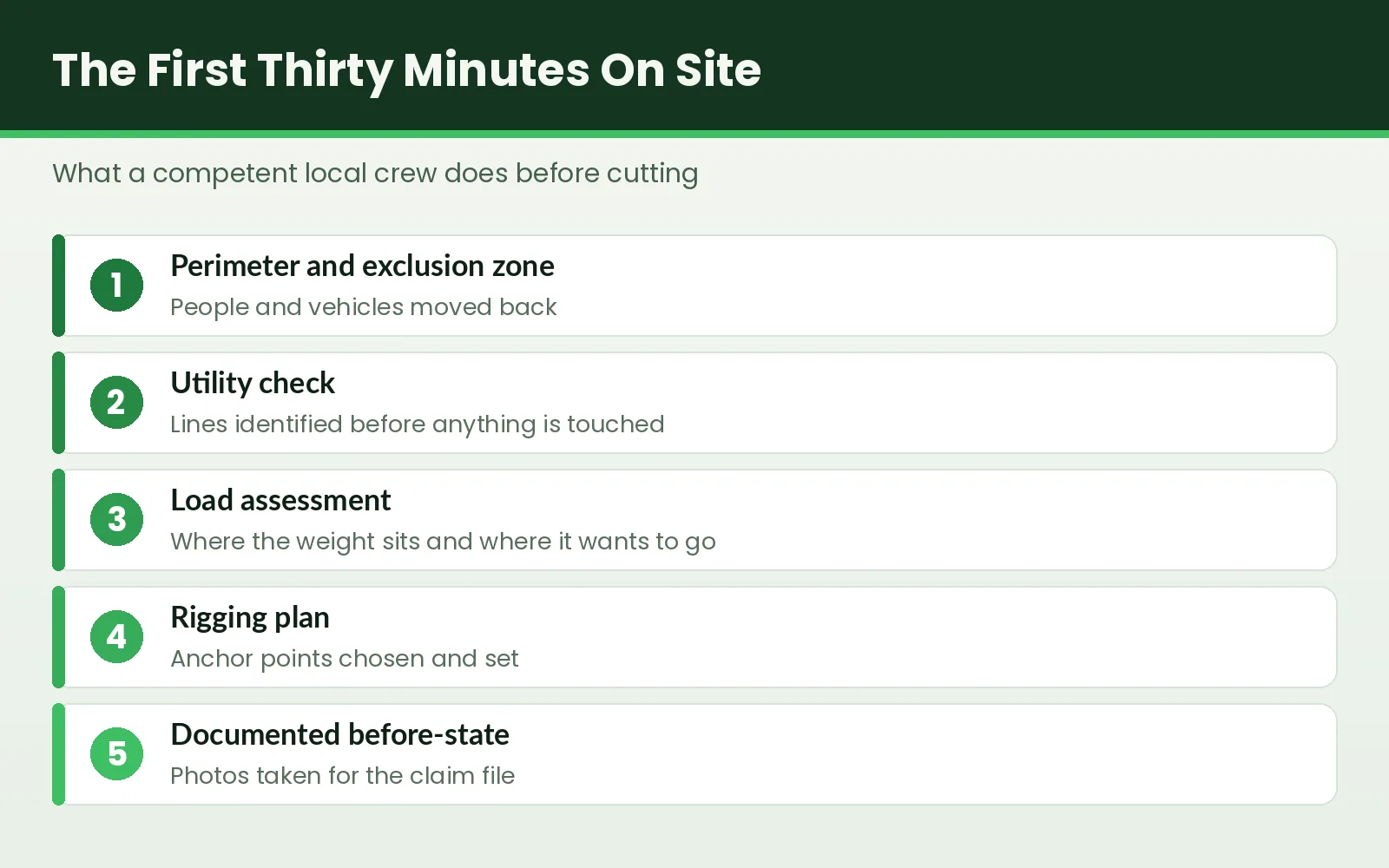
The first half hour on site sets up everything after it — the cleanup, the claim, and whether anybody gets hurt. The arborists we dispatch work a recognizable sequence, and it is worth knowing so you can tell whether the outfit standing in your yard is the real thing.
What drives the scope of an emergency tree job
There is no honest flat figure for emergency work, and anyone who quotes one over the phone before seeing the tree is guessing. What follows are the factors that move a job in this market — typical local-market drivers, not our prices. The pro you are matched with walks the site and gives the binding written quote.
| Factor | Why it moves the number in Tallahassee |
|---|---|
| What the tree is resting on | A trunk on soft ground is a cutting job. A trunk on a load-bearing roof is a rigging job — every piece has to be lifted away, not dropped. |
| Crane vs. climb | Two-story homes under mature canopy in Midtown and Los Robles often can’t take a crane down the side yard, so the work goes vertical and slow. |
| Species and wood weight | Live oak is dense and heavy per foot. Water oak and laurel oak shatter and hang up. Pine runs long and springy under tension. |
| Utility involvement | If the tree is on the service drop, nothing cuts until the line is de-energized. That waiting time is real and outside anyone’s control. |
| Hour and demand | After a named storm, every rig in the Big Bend is committed. Scarcity in the days after Idalia or Helene is a genuine market factor. |
| Debris volume | Chipping on site versus hauling a full canopy out through a narrow Betton Hills side yard changes the hours substantially. |
Tree on the house right now, or a trunk you can hear cracking? Get everyone out of the affected rooms first, then submit — life-safety requests are triaged ahead of everything else in the queue.
📞 Call Now — (858) 319-0022Vetted local pros — availability depends on independent provider schedules, location and demand.*What to do right now if a tree is on your house
- Get everyone out of the affected rooms. Limbs do not all fall when the tree does. Secondary drops are what hurt people.
- Kill power to that side of the house at the breaker if the tree is anywhere near the service drop, attic wiring or the air handler.
- Stay out from under a hung-up limb. A limb caught in the canopy is loaded like a spring, and it releases on its own schedule.
- Call now and describe the situation plainly. Hazard requests get triaged first.
- Photograph everything before anything moves — inside and outside, wide and close, timestamped by your phone automatically.
- Open the claim with your carrier once people are safe. The date-of-loss timestamp matters more than having the claim number tonight.
Before you call — how to describe it
The clearer the description, the better the match, because a bucket truck and a crane are not interchangeable. Three things carry most of the weight:
- What it landed on. “On the roof over the bedroom” routes very differently than “across the back fence.”
- Roughly how big and what species. “The big mossy oak” and “a pine” tell an arborist nearly everything about weight, rigging and hazard.
- Whether a power line is involved. Say so immediately — line-clearance rules change the whole sequence and the utility usually has to move first.
If you are outside the city limits, mention it. Leon County Chapter 10 environmental rules and City of Tallahassee §5-83 tree provisions are not identical, and a hazard tree in a Canopy Road Protection Zone has its own paperwork trail even in an emergency.
What your insurance carrier will want later
Documentation is not optional if you intend to claim the work. Homeowner carriers in Florida consistently ask for the same package, and a legitimate licensed and insured arborist produces it as a matter of routine:
- Date-stamped photographs of the tree on the structure, taken before any cutting.
- Photographs of the fracture face — a clean sudden break reads as storm damage; a punky, discolored one reads as long-standing decay, which carriers often deny.
- An itemized written scope covering removal, debris haul-off, stump work and any tarping or board-up labor.
- A current certificate of insurance showing general liability and workers’ compensation.
- A written assessment of any remaining trees that now present elevated risk.
Under Florida Statute §163.045 a documented hazard-tree determination from a qualified arborist also carries weight with local permitting. Verify any pro’s credentials yourself — check the ISA credential registry and confirm licensing and insurance directly with FDACS before work begins. Our insurance coverage guide walks through what carriers pay for and what they refuse.
After the emergency — keeping it from happening twice
Failures cluster. When one canopy tree goes over, the trees that sheltered behind it are suddenly exposed to wind they never grew to handle, and the soil around their root plates has usually loosened too. The findings that come up over and over on Tallahassee post-storm walk-throughs:
- Codominant leaders with included bark — the classic water-oak splitting geometry, and the next failure in waiting.
- Root heave on the neighboring tree that nobody looked at because the fallen one had everyone’s attention.
- Crown imbalance on whatever was standing downwind of the tree that just came down.
- Deadwood two seasons overdue, visible only from up in the canopy, which is exactly where a homeowner never looks.
The right move afterward is a proper look at what is left standing: a tree risk assessment before the next season, and hurricane tree prep done before June rather than during the cone. If there is still a trunk and a canopy on the ground, storm cleanup and debris removal is a separate scope from the emergency cut itself.
Frequently asked questions
Is the dispatch really available overnight?
Yes — you can submit a request at any hour and it enters the queue immediately, with life-safety situations triaged ahead of routine work. What nobody can honestly promise is an arrival time: availability depends on independent provider schedules, your location and how many other failures happened in the same storm.
How much does emergency tree work cost in Tallahassee?
It is scoped to the specific failure. What the tree landed on, whether a crane can reach it, species and wood weight, utility involvement, and debris volume all move the number, so a phone figure would be a guess. The local pro you are matched with inspects the site and gives you a binding written quote before any saw starts. Our removal cost guide breaks the drivers down.
Will homeowners insurance pay for it?
Generally yes when the tree damaged a covered structure, and generally no when it fell in the yard and hit nothing. Carriers also push back when the fracture face shows long-standing decay rather than storm force. Photograph everything before anything is cut.
The tree is on a power line. What now?
Treat every line as energized, keep everyone well back, and contact the utility — City of Tallahassee Utilities or Talquin Electric depending on your address — before anything else. No legitimate arborist cuts into a power-bearing limb until the line is de-energized. Submit your ZIP in parallel so a crew can be lined up for the moment the utility clears it.
A limb is hung up in the canopy but hasn’t fallen. Is that urgent?
Yes. A suspended limb is stored energy with no schedule. Keep people and vehicles out from under it, do not try to pull it down with a rope from the ground, and get a rigged removal — see tree branch removal.
My tree is leaning more than it was last month. Emergency or not?
If soil is cracking or lifting on the side opposite the lean, treat it as a failure already in progress and keep the fall zone clear. If the lean is old and the root plate looks undisturbed, it is urgent but not overnight — the leaning tree guide walks through the difference.
Related Tallahassee tree services
Emergency Tree Service
24-Hour Tree Service
Storm Damage Tree Removal
Fallen Tree Removal
Tree On Roof Removal
Storm Cleanup
Hurricane Tree Prep
Tallahassee Arborist
Tree down and it can’t wait until morning?
Call now and we’ll connect you with a vetted, licensed and insured Tallahassee-area emergency arborist. Free to use, no obligation, no sign-up.
📞 Call Now — (858) 319-0022Tallahassee Tree Service is a free referral service. Tallahassee Tree Service is not a licensed tree service provider and does not directly provide tree care services. All work is performed by independent, licensed and insured third-party providers in your area. Calls and form submissions placed through this site may be connected with a participating provider, and you may be contacted by that provider regarding your request. Same-day, emergency, and 24/7 availability are not guaranteed and depend on provider schedules, location, and demand. Service availability, pricing, licensing, and final response times are determined solely by the providers. It is the responsibility of the homeowner to verify that the hired contractor furnishes the necessary license and insurance required for the work being performed. All persons depicted in a photo or video are actors or models and not contractors listed on Tallahassee Tree Service.