Fallen Tree Removal in Tallahassee, FL
Across the driveway. On the roof. Through the back fence with the swing set somewhere underneath. The next 24 hours matter more than the next 24 days — for the claim, for what doesn’t get damaged worse, and for who ends up owning the wood. Call now any hour and we’ll connect you with a vetted, licensed and insured local arborist who works fallen trees.
📞 Call Now — (858) 319-0022Read the first-hour checklist below, then call now — the request goes out any hour.This page is the Leon County version of what to do when a tree is down: the first hour, what your insurance will and will not pay for, why your neighbor’s tree is usually not your neighbor’s problem, how the power company fits in, who owns the wood, and what actually drives the cleanup cost once the adrenaline wears off. Specific to the species that fail here and the storms that take them down.
The first hour — before you contact anyone
There is a short checklist that decides how the next two weeks go. Skip it and you pay for it on the insurance side, the safety side, or both.
1. Get everyone away from the tree
A “fallen” tree is rarely fully fallen. Most of the weight is usually hung up on something — a roof, a fence, another tree, a tangle of its own branches — and it can shift without warning. The kids who want to climb on it cannot climb on it. Pets go inside. If the tree is on or near the house, stay out of the rooms beneath it until someone qualified says it is safe.
2. Check for power lines — this one is not optional
If the tree has pulled down a line, struck a line, or is leaning against one, the ground around it can be energized and the tree itself can carry current. Stay at least 35 feet back and contact the utility before any tree company: City of Tallahassee Utilities inside the city limits, Talquin Electric for Killearn Lakes, Crawfordville and most of Wakulla County, or Duke Energy in parts of southern Leon. They will de-energize or send a crew. No legitimate arborist touches a tree on a live line, and the wait for the utility is real and outside anyone’s control.
3. Photograph everything before anything moves
Wide shots showing the tree, the damage and the surroundings. Close-ups of every structural contact point — where the trunk hit the roof, where a branch went through a window, the root plate if it uprooted. Shoot the inside of the house through any opening. Take five times more photos than you think you need. These images are the only record of the original condition your adjuster will ever see, and phone photos are exactly what adjusters work from every day.
4. Open the claim before any cleanup happens
Get a claim number today. You do not need the adjuster on site yet — you need the file open so cleanup costs can be tracked against it. Most Florida HO-3 policies cap tree-removal coverage at a policy-specific dollar limit, and only when a covered structure was damaged. That cap is real and rarely flexible, but it only applies if the claim exists. Do not let anyone tell you “we’ll bill insurance” before a claim number exists.
5. Tarp the roof if it is open and rain is coming
If the tree is still resting on the roof, adding a tarp underneath it complicates the removal and may not stop water anyway. But once a section is off and a hole is exposed, tarp immediately. Continued water damage from delayed mitigation is excluded under many policies — carriers expect you to act. Many arborists tarp as part of the job; some bill it separately. Confirm before work starts.
6. Then call now
Fallen-tree work is not the same as scheduled removal. It needs specific equipment — crane, rigging, sometimes a knuckle-boom for branches lying on a structure — and not every tree outfit has that on the truck on a Sunday night. Tell us the situation and we route it to a pro who does.
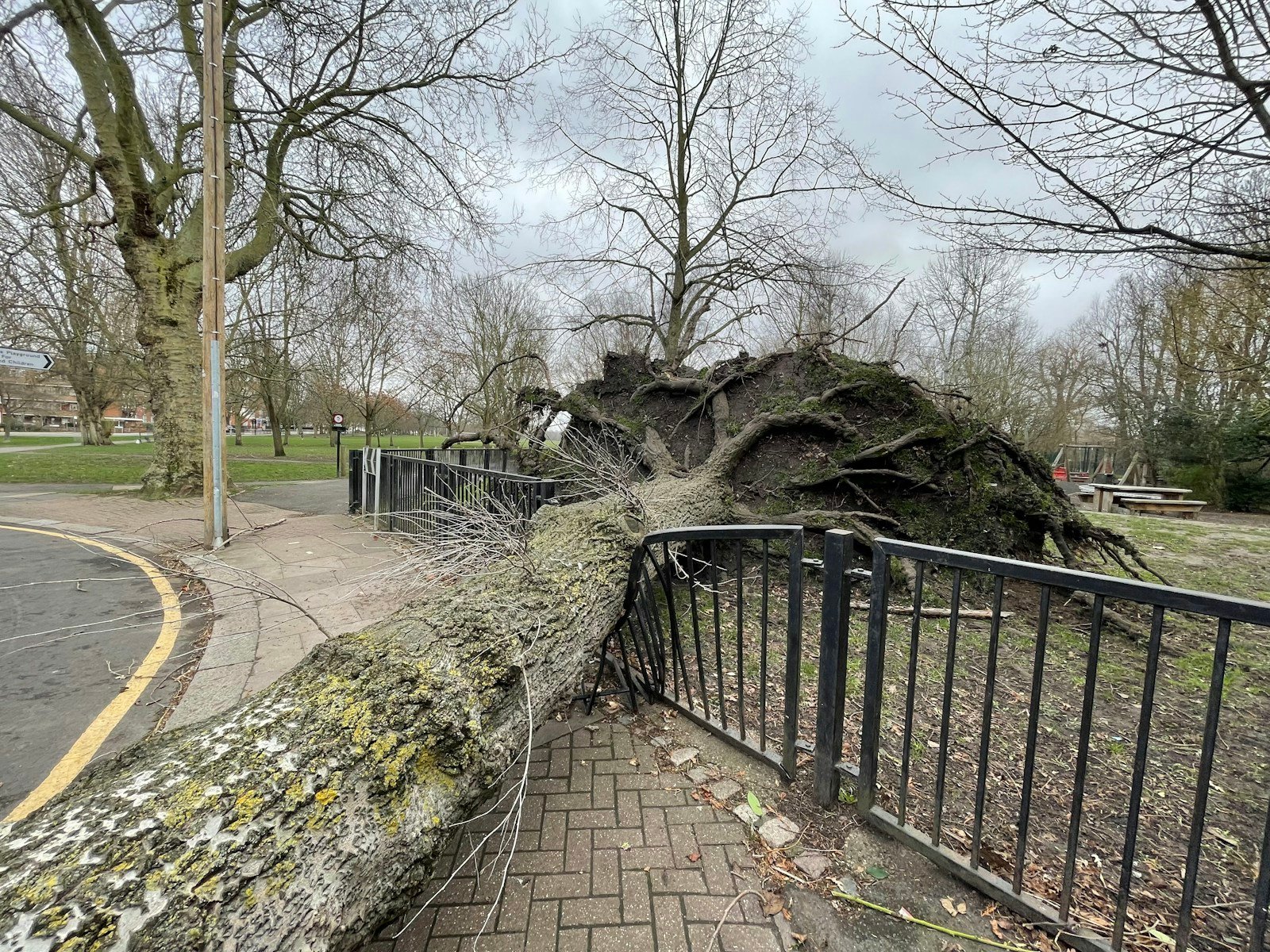
Tree on the house, or a trunk still under tension? Get people clear of the fall zone first, then submit — life-safety requests are triaged ahead of everything else in the queue.
📞 Call Now — (858) 319-0022Vetted local pros — availability depends on independent provider schedules, location and demand.*Whose tree is it? Florida law on fallen-tree liability
This is the question that surprises almost everyone. If the neighbor’s tree falls into your yard, the instinct is “that’s on them.” In Florida, that instinct is usually wrong.
Florida courts apply the act-of-God doctrine to trees. If a healthy tree on your neighbor’s property comes down in a hurricane, a tornado, or a routine high-wind event, your own insurance handles your damage — not theirs. The failure was not caused by anything the neighbor did or failed to do, and acts of God are nobody’s legal fault.
Where liability does attach is the obvious-hazard exception. If the tree was visibly dead, visibly hollow, leaning hard, or shedding limbs for months — anything a reasonable observer could see coming — and the owner was put on notice and did nothing, the picture changes. The proof bar is high: you have to show the hazard was visible, that they knew or should have known, and that they had reasonable time to act.
Practically: file your own claim, document the tree’s pre-cleanup condition with photographs, and only pursue the neighbor if the tree was an obvious standing hazard. Most Tallahassee fallen-tree disputes end with each homeowner’s carrier handling that homeowner’s damage. The reverse holds too — if your tree lands in their yard, their carrier handles it unless yours was an obvious pre-existing hazard. Some people pay anyway out of neighborliness. That is a choice, not a legal duty.
One important Florida wrinkle: under Florida Statute §163.045 (as amended in 2022), a homeowner on a single-family residential lot can remove a documented hazard tree without a permit, provided they have a written determination from an ISA-certified arborist or a Florida-licensed landscape architect. That same letter is exactly what you would want on file before a tree fails, if you are worried about a neighbor’s tree. Getting a risk assessment in writing on a suspect tree now is the smartest move available.
What insurance pays for — and what it will not
| Generally covered under a Florida HO-3 | Generally not covered |
|---|---|
| Damage to the insured structure the tree hit — roof, walls, windows, attached garage | The tree itself. The standing timber you lost has no coverage value. |
| Contents damaged by the tree or by water entering through the penetration | Removal of a tree that fell without hitting an insured structure — the trunk lying across the yard |
| Additional living expenses if the house is uninhabitable during repairs | Landscaping, which most policies sublimit to a small percentage of dwelling coverage |
| Debris removal of the tree off the structure, capped at a policy-specific limit | Fences, which usually fall under “other structures” with their own lower sublimit |
The driveway rule almost nobody uses
Many Florida policies extend tree-removal coverage when the tree (a) struck an insured structure, (b) blocks a driveway and prevents vehicle access, or (c) blocks a ramp used by a disabled occupant. That middle path is the most-missed coverage in the whole policy. If a trunk is across your driveway and the car is trapped behind it, removal of that specific tree may be covered up to the cap even though nothing structural was hit. Ask your carrier about it by name.
Hurricane deductibles and the named-storm trigger
Most Florida policies carry a separate hurricane deductible — commonly 2% to 5% of the dwelling coverage. On a lot of Tallahassee homes that is a meaningful sum out of pocket before a dollar of coverage applies, and for a single tree on a roof the hurricane deductible can exceed the entire claim. Worth doing that math before you file.
Crucially, hurricane deductibles typically apply only during a named-storm event. A tornado outside of a named storm — like the three that hit on May 10, 2024, including two EF-2s at 115 mph — usually triggers the standard wind/hail deductible instead, which is far lower. That distinction is worth thousands. See our insurance coverage guide.
What actually falls in Tallahassee, and why
Fallen-tree patterns here repeat. Knowing them helps you triage your own situation and describe it accurately.
| Species | How it fails | Where |
|---|---|---|
| Laurel oak (Quercus laurifolia) | Hollows from the inside starting around 50–70 years. A full, healthy-looking crown can sit on a trunk that is half decayed, and it lets go all at once. UF/IFAS ST549 notes poor decay compartmentalization and poor hurricane survival. | Betton Hills, Myers Park, Indianhead Acres, Lafayette Park — the post-war plantings all hitting end-of-life together. Most “tree on house” calls in this city are laurel oaks. |
| Water oak (Quercus nigra) | Same biology, shorter clock — often hollow by 40. Goes in spring storms more than fall hurricanes: wet clay plus a gust pops the trunk at the weakest point. UF/IFAS ST553 does not recommend it for urban planting. | Throughout the older neighborhoods, mixed in with the laurel oaks. |
| Loblolly pine | Snaps mid-trunk rather than uprooting. Roughly 36% snapped during Hurricane Ivan in 2004; longleaf survived that same storm at over 90%. | Back lots across Killearn, Bradfordville, southern Leon and Wakulla. A pine snapped mid-trunk is almost always a loblolly. |
The Cody Scarp decides how they come down
North of the scarp — Killearn, Bradfordville, Betton Hills, Midtown, Myers Park, Indianhead Acres — the soil is red Orangeburg clay. Saturated clay loses shear strength and trees uproot whole, the root plate tipping up like a hinged carpet. South of the scarp — SouthWood, Apalachee Ridge, Woodville, Crawfordville — the soil is sandier. It holds trees less firmly to begin with but drains fast, so failures there skew toward mid-trunk snaps under gust loading rather than whole-tree uproots. Which one you have changes the cleanup: an uprooted tree leaves a crater and a root plate to deal with; a snapped one leaves a standing spar.
The storms that wrote the pattern
The May 10, 2024 outbreak put three confirmed tornadoes through Tallahassee, including two EF-2s, with NWS Tallahassee-confirmed paths across Railroad Square, FSU, TCC (roughly 400 trees down on that campus alone), Myers Park, Capital City Country Club and Indianhead Acres. The lesson: neighborhoods with no hurricane-damage history can still take catastrophic tree damage. Hurricane Helene in September 2024 came ashore east of the Aucilla at Category 4 strength; Tallahassee itself saw a 67 mph peak gust at TLH, while the worst of it landed on Crawfordville and Wakulla County. It was the second major hurricane in the Big Bend inside thirteen months and it held every arborist in the region at capacity for weeks. If you are calling after an event like that, expect a queue — and know that carriers do not penalize delayed mitigation during named-storm events.
How getting matched works
What drives the cost of a fallen-tree job
Emergency work costs more than scheduled work — it always has. These are the typical local-market drivers, not our prices; the pro you are matched with inspects the site and gives you the binding written quote.
| Factor | Why it moves the number |
|---|---|
| How much of the tree is on a structure | Wood on a roof has to be lifted away piece by piece, not dropped. More structure contact means more rigging hours. |
| Whether a crane can reach it | Plenty of Killearn Estates and Myers Park backyards cannot take a crane. That work goes vertical, on ropes, and slowly. |
| Debris volume and fracture pattern | A 70-foot pine down in one piece is roughly half the work of the same pine shattered into fourteen sections. |
| Uprooted vs. snapped | An uprooted tree leaves a root plate and a crater to backfill. A snapped one leaves a spar that still has to come down. |
| Hour and demand | After a named storm, every rig in the Big Bend is committed. Scarcity in the days after Idalia or Helene is a genuine market factor. |
| Power-line involvement | The utility handles the line at no charge to you — but nothing else moves until they clear it, and that waiting time is outside anyone’s control. |
Who owns the wood once the tree is down?
The default Florida rule is that you own what is on your property — including a tree that arrived from next door. Once it is on your land it is yours: keep it, split it, give it away, have it hauled. The neighbor has no claim to come retrieve it.
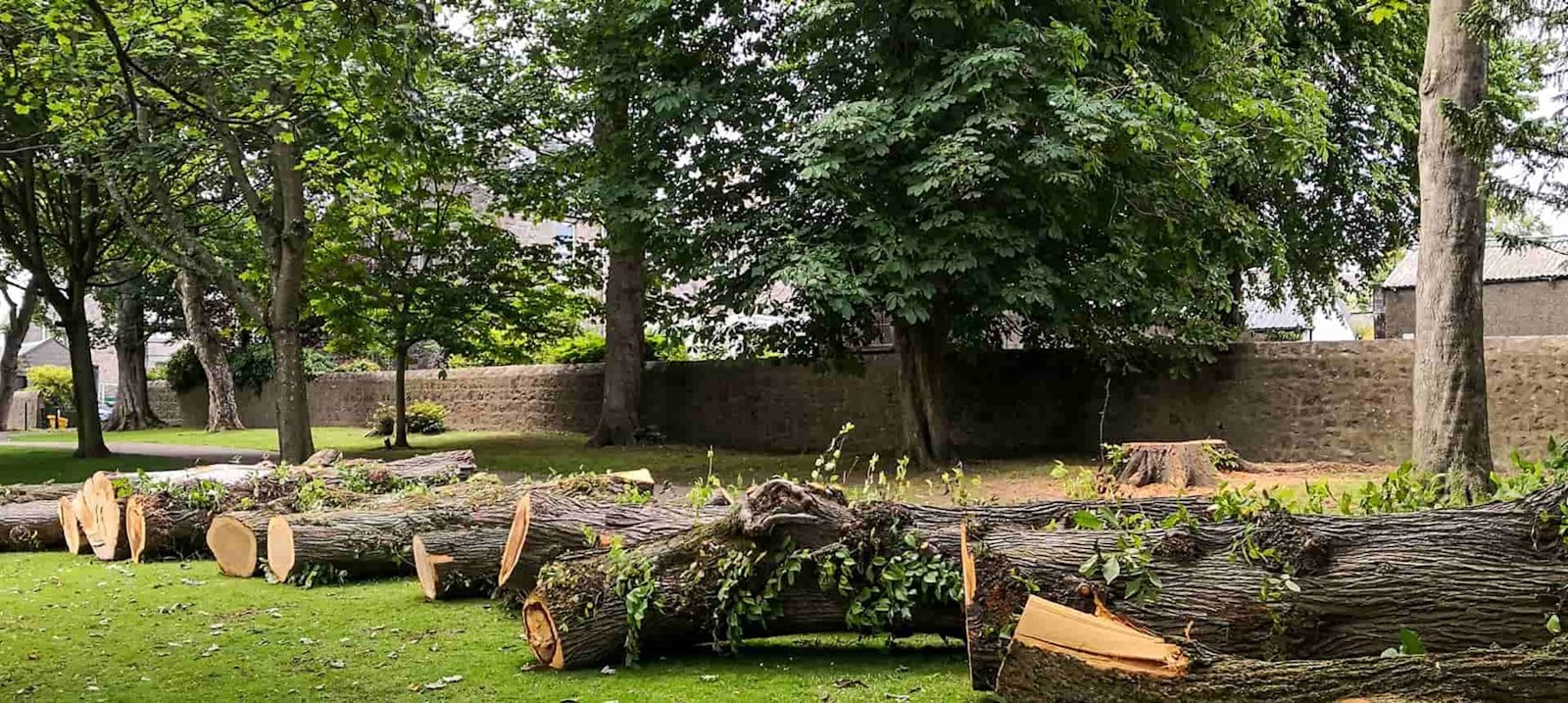
Plenty of homeowners want the wood. Tallahassee live oak is genuinely good firewood; sweetgum and maple are workable for hobbyists; big oak rounds find takers among turners and carvers. A crew can leave the rounds bucked to length and stacked at the curb instead of hauling them out, and that usually comes with a small reduction in the bill since it saves them the haul. Say so before the work starts. Once it is through the chipper, the decision has been made for you.
If you want none of it, the cleanup scope normally includes hauling everything — chips, rounds and brush — off to a yard-waste facility or a chipping operation. See tree debris removal and stump grinding for the parts of the job that outlive the emergency.
Before you call — how to describe it
- What did it land on? Roof, driveway, fence, open yard, vehicle, neighbor’s property.
- Roughly what size and species? “A big mossy oak” and “a pine” tell an arborist most of what they need about weight and rigging.
- Uprooted or snapped? A tipped root plate and a broken trunk are different jobs.
- Is a power line involved? Say it first. Everything else waits on the utility.
- Is anything still under tension? A limb bent against a fence or a trunk hung in another tree is stored energy.
Frequently asked questions
Can I cut it up myself with my chainsaw?
A small tree lying in the yard with no structure contact, no power line, and no tension in the wood — sure, if you have run a saw before. A tree on a roof, a tree hung up in another tree, a partially uprooted trunk still under load, or anything near a line — no. Wood under tension springs violently when it is cut in the wrong place, and DIY storm-cleanup chainsaw injuries are common and severe.
Do I need a permit for emergency removal?
No. Florida Statute §163.045 allows removal of a documented hazard tree on a single-family residential lot without a permit, and the City of Tallahassee’s §5-83 carries the same exemption. A tree on the house comes off now. Non-emergency removals afterward go through the normal process — see the permit guide.
The root ball pulled up and left a hole. Now what?
Standard practice is to grind whatever stump remains, backfill the depression with topsoil or sand depending on the soil, and seed or sod it. Fill is often a separate line item — confirm it in the scope. Sandy SouthWood-area soil backfills easily; a crater in Killearn red clay tends to hold its shape and needs more deliberate compaction.
How fast can someone get to a tree on my house?
Requests go into the queue immediately at any hour, and life-safety situations are triaged first. Nobody can honestly promise an arrival time: availability depends on independent provider schedules, your location, and how many other failures happened in the same storm. After a named storm, every rig in the region is committed and the queue is real.
Can the arborist bill my insurance directly?
Sometimes. A few pros have direct-bill relationships with the larger carriers; most bill the homeowner, who then submits to insurance. Ask early. Direct billing is usually slower but spares you the cash-flow hit.
My tree fell on my neighbor’s property. Do I owe them?
Generally no. Their carrier handles their damage unless your tree was an obvious pre-existing hazard you were on notice about and ignored. Calling them, being decent about it, and passing along the pro you used is etiquette — not a legal obligation.
Related Tallahassee tree services
Emergency Tree Service
Storm Damage Tree Removal
Tree On Roof Removal
Storm Cleanup
Tree Debris Removal
Stump Grinding
Insurance Coverage Guide
Tree Risk Assessment
Tree down? Get it handled properly.
Call now and we’ll connect you with a vetted, licensed and insured Tallahassee-area arborist who works fallen trees. Free to use, no obligation, no sign-up.
📞 Call Now — (858) 319-0022Tallahassee Tree Service is a free referral service. Tallahassee Tree Service is not a licensed tree service provider and does not directly provide tree care services. All work is performed by independent, licensed and insured third-party providers in your area. Calls and form submissions placed through this site may be connected with a participating provider, and you may be contacted by that provider regarding your request. Same-day, emergency, and 24/7 availability are not guaranteed and depend on provider schedules, location, and demand. Service availability, pricing, licensing, and final response times are determined solely by the providers. It is the responsibility of the homeowner to verify that the hired contractor furnishes the necessary license and insurance required for the work being performed. All persons depicted in a photo or video are actors or models and not contractors listed on Tallahassee Tree Service.