Storm Damage Tree Removal in Tallahassee, FL
After the wind passes, the cleanup begins. Call now and we’ll connect you with a vetted, insured local pro who removes storm-downed trees, clears debris, and documents the scene for your insurer.
📞 Call Now — (858) 319-0022
Tree down right now? Call now — 24/7 dispatch line*
Quick answer
After a storm, call now to get matched with a local, insured arborist who documents the damage for your insurance claim before removal begins — photos, a written scope, and debris-haul details. Coverage spans Leon, Wakulla, Gadsden and Jefferson counties, and storm-response calls are prioritized over routine scheduling.
Before you start: if a tree is on a power line, contact your utility first and keep everyone clear — ANSI Z133 prohibits crews from touching energized conductors until the line is confirmed dead. If anyone is hurt or you smell gas, call 911.
Tallahassee’s storm record is its own argument for local crews: Hermine, Michael, Idalia, the May 2024 EF-2 tornado outbreak (399 broken utility poles — more than Hermine, Irma, and Michael combined), and Helene each buried Leon County in downed oaks and snapped pines. Storm-damage removal is different from a planned takedown: trees are under load, tangled in structures or lines, and the order of cuts matters for safety. The pros we dispatch work these jobs methodically — relieve tension, make safe, then remove. For the full local storm history and species wind-failure data behind those numbers, see our Tallahassee Storm & Hurricane Tree-Damage Reference.
Local note: Florida’s hurricane season runs June 1 through November 30, and NOAA’s National Hurricane Center climatology data shows why late summer and fall are consistently when the Big Bend region sees its heaviest storm activity — and why tree-service call volume in Tallahassee tracks the same pattern.
Documenting the job for your insurance claim
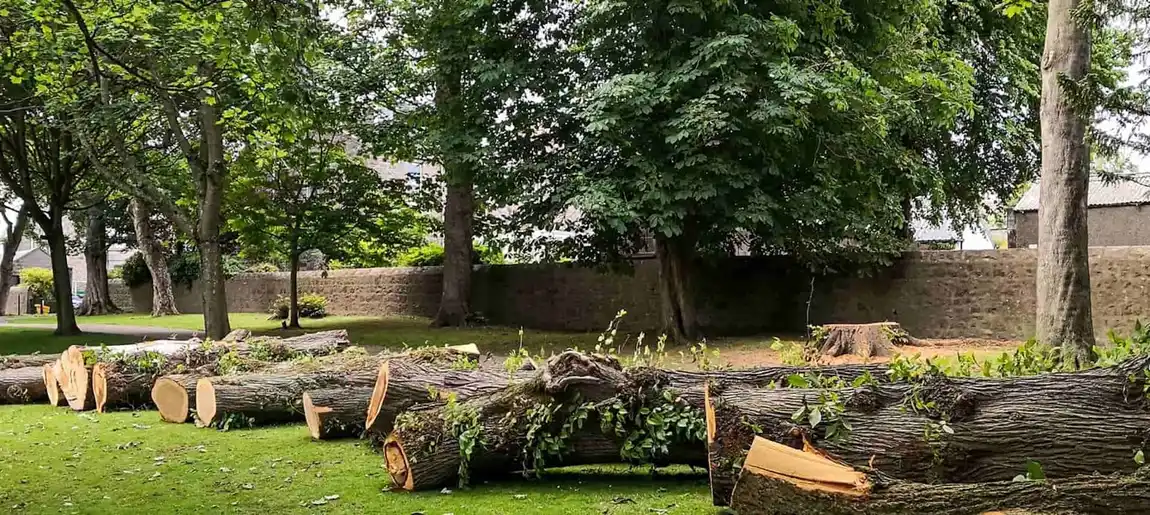
Florida homeowners policies generally cover tree removal when a fallen tree has damaged a covered structure, with a debris-removal sublimit around by quote–by quote. The difference between a smooth claim and a denied one is documentation: before-and-after photos, the cause of failure, what the tree struck, and an itemized scope. The pros we dispatch capture that on-site so you have what your adjuster needs. Details: storm insurance claims and when removal is covered.
Tree down right now? Call now to get in front of the dispatch queue faster — describe what fell, where, and what it hit.
24/7 dispatch line — availability depends on independent provider schedules and demand.*
What it costs
Storm work is typically priced higher than a routine removal because of the load, access, and risk — often about 1.5× standard, with crane or live-line proximity 2–3×. Whole-yard cleanup is usually quoted by debris volume. Your matched pro provides a written, itemized estimate. See emergency removal cost. To reduce the odds of a repeat next season, see our free Tallahassee Hurricane & Storm Tree-Prep Guide.
How getting matched works
Frequently asked questions
Who do I call first after a storm — the tree service or my insurer?
If there’s a safety hazard (line down, gas, structural collapse), call 911 and your utility first. Otherwise, get the scene documented and made safe, then file with your insurer. The pro you’re matched with can photograph and itemize the damage to support your claim.
Will insurance pay for storm tree removal?
Typically only when the tree damaged a covered structure, subject to a debris sublimit (often by quote–by quote) and your hurricane deductible. A tree that fell in the yard hitting nothing is usually not covered. Documentation improves your odds.
How soon can storm damage be cleared?
Life-safety situations are triaged first. After a widespread event, demand spikes across the region and scheduling depends on conditions — timing is prioritized but not guaranteed.
What documentation do I need for an insurance claim on a fallen tree?
Before-and-after photos of the tree and whatever it struck, the apparent cause (wind, root failure, a snapped limb), a written itemized scope of the removal and debris haul, and the date and rough time of the storm event. The pro you’re matched with can capture the photos and scope on-site so you’re not trying to reconstruct it later for your adjuster.
A tree just fell on my house — what do I do first?
Get everyone out of the affected rooms and keep people away from any part of the tree touching a power line. If you smell gas, hear popping, or see arcing, call 911 and your utility immediately and stay clear until they confirm it’s safe. Once the scene is safe, call now or call the dispatch line so a pro can assess the structure, stabilize the tree, and start documenting for your insurer.
Who removes a tree that’s tangled in a power line?
Not a tree crew acting alone. ANSI Z133 prohibits tree work on or near energized conductors until the utility confirms the line is de-energized. Contact your utility — City of Tallahassee Utilities, Talquin Electric, or Duke Energy Florida depending on your address — first, then the arborist we dispatch can safely remove the tree once the line is cleared or the utility is on-site to coordinate.
My neighbor’s tree fell on my property — who’s responsible?
In Florida, responsibility generally follows where the tree lands rather than whose yard it grew in: if a neighbor’s healthy tree falls onto your property in a storm, your own homeowners policy typically handles the removal and any damage, subject to your deductible and coverage. That can change if the neighbor knew the tree was hazardous and failed to address it. Either way, the pro you’re matched with can document the scene and boundary so both insurers have what they need.
Related Tallahassee tree services
Hurricane & Storm Tree-Prep Guide
Storm & Hurricane Tree-Damage Data Reference
Emergency Tree Service
Storm Cleanup
Fallen Tree Removal
Roof Tree Removal
Hurricane Tree Prep
Storm Insurance Claims
Tree Removal
Debris Removal
Storm took a tree down?
Call now and we’ll connect you with a vetted, insured local pro who removes it and documents it for your claim.
📞 Call Now — (858) 319-0022
24/7 dispatch line*
Tallahassee Tree Service Co. is a free dispatch and referral service. We are not a tree-service contractor and do not perform tree work ourselves. When you call, we connect you with an independent, licensed and insured local tree-care professional who carries their own license and insurance and provides any binding quote. Price information anywhere on this site is typical local-market information for planning only; people or scenes in images are illustrative.
References to “24/7,” “same-day,” or “emergency” describe call-handling and dispatch availability. Actual on-site response times depend on the independent professional’s schedule, crew availability, and weather, and are not guaranteed.