Tallahassee Hurricane & Storm Tree-Prep Guide
A practical, locally researched reference for getting Tallahassee’s trees — and the people living under them — through hurricane season. Which species fail, how to spot a hazard tree, a printable prep checklist, what the City and County actually require, and what to do before, during, and after a storm. Built from public research by UF/IFAS, NWS Tallahassee, and City and County code. Free to read, print, and share — HOAs, neighborhood associations, and community groups are welcome to link to or distribute this page.
Tallahassee lives under its trees. Live oaks arch over the canopy roads, laurel oaks tower over Midtown and Betton Hills, and pine stands ring the newer subdivisions from Buck Lake to Ox Bottom. That canopy is why people love this town — and it is also why hurricane season here is a tree problem before it is anything else. When storms knock out power in Leon County, falling trees and limbs on lines are a leading cause.
The Big Bend has been reminded of this repeatedly: Hurricane Hermine (2016) crossed the coast near St. Marks and put trees into lines and roofs across the capital; Hurricane Michael (2018) devastated the counties just west of us; Hurricane Idalia (2023) came ashore at Keaton Beach; the May 2024 tornado outbreak tore a path across town with almost no warning; and Hurricane Helene (2024) made landfall in the Big Bend near Perry as a major hurricane. None of those storms was the “big one” for Tallahassee proper — and each still meant weeks of chainsaws. For a closer look at how each of these storms compares locally, see our Tallahassee & Leon County Tree Storm-Risk Report.
The encouraging part, backed by University of Florida research after every major Florida hurricane since Andrew: most tree failures are predictable, and many are preventable. Trees with visible defects, over-mature short-lived species, and improperly pruned trees fail first. Healthy, well-pruned, wind-resistant species mostly stand. This guide walks you through exactly what that means for a Tallahassee yard, season by season and storm by storm.
Which Tallahassee trees are high-risk in a hurricane?
After Hurricanes Erin, Opal, Ivan, Dennis, and Katrina, University of Florida researchers surveyed thousands of trees across the Florida Panhandle and coastal plain and ranked species by how well they survived hurricane winds. The pattern in that research (Duryea & Kampf, UF/IFAS) is remarkably consistent with what arborists see on the ground here after every storm:
| Species (common in Tallahassee) | Wind resistance (UF/IFAS) | How it typically fails here |
|---|---|---|
| Live oak | Highest | Rarely fails whole; sheds small limbs. Heavy over-extended horizontal limbs over roofs are the main concern — reduce end-weight, never top. |
| Southern magnolia | Highest | Holds well. Failures usually trace to root damage from construction or saturated ground. |
| Bald cypress | Highest | One of the strongest performers in wind studies, even in wet soil. |
| Sabal (cabbage) palm | High | Bends and survives. Do not over-trim fronds — “hurricane cuts” weaken palms rather than protect them. |
| Dogwood, crape myrtle, hollies | Highest | Small stature keeps loads low. Crape myrtles fail mainly when repeatedly topped. |
| Sweetgum | Medium-high | Generally stands; sheds limbs. Watch for trunk decay in older trees. |
| Loblolly, slash & longleaf pine | Medium-low | Tall pines snap mid-trunk in sustained wind or uproot in saturated soil. Beetle-weakened and construction-damaged pines go first. |
| Laurel oak | Lowest | The Big Bend’s signature storm casualty. Fast-growing, short-lived, decay-prone — many Tallahassee laurel oaks planted mid-century are now past their sound years and fail at the trunk or root plate. |
| Water oak | Lowest | Hidden trunk and root decay; drops massive leaders or uproots whole. Often looks full and green right up until it fails. |
| Pecan | Lowest | Brittle wood; sheds large limbs in even moderate storms. |
| Sand pine, Bradford pear, Chinese tallow | Lowest | Sand pine uproots; Bradford pear splits at its weak forks; tallow is brittle (and invasive). |
Source: UF/IFAS wind-resistance research from the Trees and Hurricanes series — see Selecting Coastal Plain Species for Wind Resistance and Wind and Trees: Lessons Learned from Hurricanes. Ratings describe healthy trees — a defective live oak can still be more dangerous than a sound laurel oak, which is why the inspection below matters more than the species label.
How to spot a hazard tree: the 10-minute yard walk
Twice a year — once in winter when deciduous trees are bare, once in late spring before storm season peaks — walk your property and look at each large tree from trunk to crown. You are looking for these warning signs, or get a faster guided read with our free Tree Risk & Storm Damage Assessment Tool:
When it stops being a checklist item and becomes an emergency: a new lean over a house or road, soil actively cracking at the base, a large limb split but still attached over an occupied area, or any tree into power lines. Keep people out from under it and get a professional assessment immediately — and if a line is involved, treat it as energized and stay away. See our emergency tree service page for what dispatch looks like after dark.
If any tree earns a flag on your walk, the next step is a proper look by a credentialed professional — our tree risk assessment page explains what an ISA-certified inspection covers. Some structurally weak but healthy trees can be preserved with hardware instead of removal; see cabling and bracing.
The Tallahassee storm-prep timeline
Atlantic hurricane season runs June 1 through November 30, and the Big Bend’s historical peak threat window is August through early October. Working backward from that, here is the calendar the arborists in our network actually work from:
- December – February (dormant season): Structural pruning of live oaks and other hardwoods — big cuts seal best now, and crews can see the architecture with leaves down. This is the season for major end-weight reduction over roofs.
- March – April: Do your spring hazard walk (above). Book risk assessments for anything flagged — spring is when reputable arborists still have calendar space.
- May: The practical deadline. Removals of condemned trees, deadwooding, and crown cleaning should be done before June. After the first named storm threatens, every tree company in Leon County books out and prices reflect demand.
- June 1 (season opens): Finish the “72-hours-out” items you can do early: know your insurance coverage, photograph your trees and house, and save your key contacts.
- August – mid-October (local peak): Watch the National Hurricane Center and NWS Tallahassee. When a storm enters the Gulf, run the 72-hour checklist below. Do not attempt last-minute pruning with a storm inbound — half-finished tree work and staged debris become projectiles.
- November 30 (season closes): Post-season review: note what shed, what leaned, what worried you. Winter is the time to fix it — and to replant smart. Our tree planting guide covers wind-resistant native choices.
The printable storm-prep checklist
Print this section and stick it on the refrigerator or share it at your next HOA or neighborhood association meeting. Boxes are tickable on screen, too.
Well before the season (winter–May)
72 hours before a storm
During the storm
After the storm
Before, during, and after: what actually happens
When a storm is inbound
Once NWS Tallahassee puts Leon County in a watch, your tree options are already fixed — whatever pruning happened over the winter is your protection. The 72-hour window is about your yard, not your trees: secure loose objects, clear drainage, move cars, and document. If you have a known hazard tree you ran out of time on, plan around it — sleep on the far side of the house from it.
During
Most tree strikes on homes here happen in two ways: whole-tree failure of saturated-soil pines and over-mature laurel/water oaks, and large-limb failure from unpruned hardwoods. Rain-soaked ground is the multiplier — a storm that drops ten inches of rain before its peak wind uproots trees that a dry-ground wind of the same speed would not. That is exactly what UF/IFAS wind research documents, and it is why slow, wet storms fell so many Tallahassee trees.
After
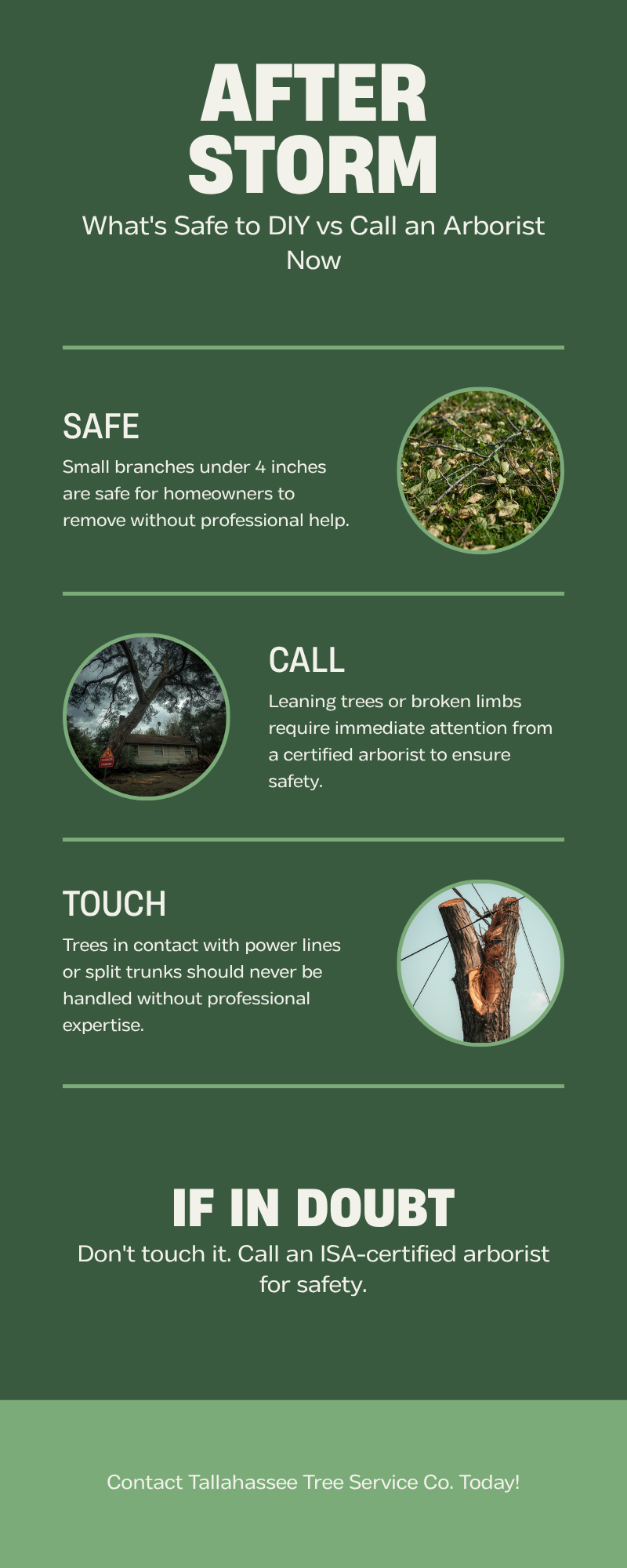
The first 48 hours after a storm are the most dangerous phase of the whole event: energized lines under debris, trees under tension, saturated ground still dropping weakened trees in calm air, and inexperienced chainsaw use. Utility and road-clearing crews handle trees on public rights-of-way; trees on your home, fence, or driveway are yours to arrange. Our hurricane tree damage guide covers post-storm triage and insurance step by step, and fallen tree removal covers who pays when a neighbor’s tree crosses the line.
Permits, ordinances & insurance: the paperwork side
City of Tallahassee
Inside city limits, removal of regulated trees on private property generally requires City approval under the Land Development Code’s tree and landscape standards (§5-83, Tree removal, encroachment, landscape and mitigation standards). The full text is public in the City of Tallahassee Code of Ordinances, and permits run through Growth Management’s applications and permits. Trees in the public right-of-way — typically the strip between sidewalk and curb — are the City’s to maintain and remove. Our public-vs-private tree guide walks through how to tell whose tree is whose.
The state-law exception for dangerous trees
Florida Statute §163.045 allows a residential property owner to remove a tree without a local permit when an ISA-certified arborist or Florida-licensed landscape architect documents that the tree poses an unacceptable risk to people or structures. After a storm — or when your hazard walk turns up a failing tree — that written documentation is the key that unlocks fast, lawful removal. Keep a copy with your insurance file.
Unincorporated Leon County
Outside city limits (Woodville, Fort Braden, much of the northeast), tree protection falls under the Leon County Land Development Code instead — different rules, same principle: check before you cut, especially for large canopy trees.
Insurance basics
In broad terms — policies vary, read yours: homeowners insurance generally responds when a tree strikes a covered structure (house, garage, fence), covering damage plus removal of the tree from the structure. A tree that falls harmlessly in the yard is often limited or excluded. Whose tree it was matters less than people assume — your policy typically handles trees that land on your property regardless of where they were rooted, unless the neighbor was demonstrably negligent about a known hazard. Document everything, before and after. More detail: what insurance pays for and insurance tree removal.
Local ground truth: why the same wind fells different trees across town
Tallahassee sits on the Cody Scarp, the ancient shoreline that divides the red-clay highlands from the coastal lowlands. North of the scarp — Killearn, Betton Hills, Midtown, Ox Bottom — Orangeburg-series clay soils grip roots well and grow massive, heavy-limbed oaks; the storm risk there is mostly limb failure over roofs, which pruning addresses. South of the scarp — Woodville, Apalachee Ridge, the Southside — thinner sandy soils over karst limestone anchor roots less securely, so whole-tree windthrow of pines and water oaks is the bigger threat, and it spikes when the ground is saturated. Same storm, different failure modes, different prep — which is why a generic national checklist only gets you so far in this county.
Official resources worth bookmarking
These are the primary public sources this guide draws on. They are free, authoritative, and kept current by the agencies themselves — link them from your HOA newsletter, neighborhood site, or community prep page.
Local forecasts, watches and warnings for the Big Bend, and storm-event summaries.
Track forecasts, cones, and advisories for every Atlantic system.
Local shelter, sandbag, debris, and post-storm recovery information.
Statewide plan-and-prepare guidance and disaster resources.
The research behind wind-resistance ratings, pruning for storms, and post-storm tree recovery.
Tree ordinance text (§5-83) and Growth Management permit applications.
Frequently asked questions
When should I trim my trees before hurricane season in Tallahassee?
Major structural pruning of oaks and other hardwoods is best done in the dormant season (roughly December through February), when large cuts seal well. Deadwooding and light crown cleaning can continue into spring — but plan for all storm-prep pruning to be finished before June 1, when the season opens and demand surges.
Which trees fail most often in Tallahassee storms?
UF/IFAS hurricane research puts laurel oak, water oak, pecan, and sand pine in its lowest wind-resistance group, and tall loblolly and slash pines fail frequently in saturated soil. Live oak, southern magnolia, bald cypress, and sabal palm are among the strongest performers. A tree’s condition matters as much as its species — decay, cracks, or root damage can bring down even a strong species.
Do I need a permit to remove a tree in Tallahassee?
Often, yes. Inside city limits, regulated-tree removal on private property generally requires City approval under Land Development Code §5-83. The main exception is Florida Statute §163.045: with written documentation from an ISA-certified arborist or licensed landscape architect that a tree poses an unacceptable risk, a residential owner may remove it without a local permit. Unincorporated Leon County has its own rules under the county Land Development Code.
Will homeowners insurance pay for tree removal after a hurricane?
Generally, when a tree damages a covered structure, the policy responds to the damage and the removal of the tree from the structure. Trees that fall without hitting anything are often subject to small limits or excluded. Policies differ — read yours before the season, and photograph your property so you can document any claim.
Should I top my trees to make them shorter before a storm?
No. Topping is the single most damaging thing commonly done to trees in the name of storm safety. The regrowth that follows is weakly attached and fails at high rates in wind, and the large open wounds invite decay. Proper storm preparation is selective end-weight reduction, crown cleaning, and deadwooding to ANSI A300 standards — see our topping alternatives page.
What should I do if a tree falls on my house during a storm?
Move everyone out of the affected part of the house immediately. Call 911 if anyone is hurt, you smell gas, or lines are down. Do not go onto the roof or under the tree in the dark or in wind. Once conditions are safe: photograph everything, make reasonable temporary protections like tarping, notify your insurer, and arrange professional removal — storm-loaded trees on structures are high-risk cutting that calls for trained arborists, often with a crane.
Who handles a tree that falls across my street or into power lines?
Trees blocking public roads and rights-of-way are cleared by City or County crews, and trees in lines are the utility’s to make safe first — report them and stay well away, since a downed line can energize the whole tree and the wet ground around it. Trees on your house, fence, or driveway are the homeowner’s to arrange once it is safe.
Can a leaning tree be saved, or does it have to come down?
It depends on whether the lean is new. A tree that grew leaning may be structurally fine; a new lean with disturbed soil means root failure in progress and is an emergency. In between, some valuable trees with correctable defects can be preserved with cabling and bracing rather than removed — an ISA-certified assessment sorts the three cases. See our leaning tree decision guide.
Found something on your walk-through you’d like a professional to look at — a lean, a crack, a widow-maker over the driveway? Enter your ZIP and we’ll connect you with a licensed, insured local arborist for an assessment before the season peaks.
Free referral — independent, licensed & insured local providers. Availability varies by schedule and demand.
Related guides on this site
Hurricane tree prep services
Hurricane season hub 2026
Storm cleanup
Storm damage tree removal
Emergency tree service
Hurricane tree damage & insurance
Tree risk assessment
Cabling & bracing
Leaning tree guide
Dead tree removal
City vs. private trees
Insurance coverage guide
Embed this free checklist on your site
HOAs, neighborhood sites, and local blogs are welcome to embed this checklist free — just copy the code below onto your page. Attribution back to this guide is built in.
Tallahassee Tree Service is a free referral service. Tallahassee Tree Service is not a licensed tree service provider and does not directly provide tree care services. All work is performed by independent, licensed and insured third-party providers in your area. Calls and form submissions placed through this site may be connected with a participating provider, and you may be contacted by that provider regarding your request. Same-day, emergency, and 24/7 availability are not guaranteed and depend on provider schedules, location, and demand. Service availability, pricing, licensing, and final response times are determined solely by the providers. It is the responsibility of the homeowner to verify that the hired contractor furnishes the necessary license and insurance required for the work being performed. All persons depicted in a photo or video are actors or models and not contractors listed on Tallahassee Tree Service.
This guide is general educational information, not engineering, legal, or insurance advice. Ordinances and statutes are summarized for convenience — verify current requirements with the City of Tallahassee, Leon County, and the official sources linked above before removing any tree.