Sweetgum (Liquidambar styraciflua) is one of Tallahassee’s most-disliked-but-most-common residential trees. The species is fast-growing, attractive in fall (one of the few reliably red-leaved trees in North Florida), and structurally adequate for storms. But it produces an extraordinary volume of spiky 1-to-1.5-inch seed balls that drop from late summer through winter, accumulating in yards, mulch beds, and driveways. For Tallahassee homeowners with mature sweetgums, fall and winter cleanup is the routine maintenance the species demands — or, sometimes, the reason the species comes down. Here’s the species guide.
Why Sweetgum Balls Are Such a Problem
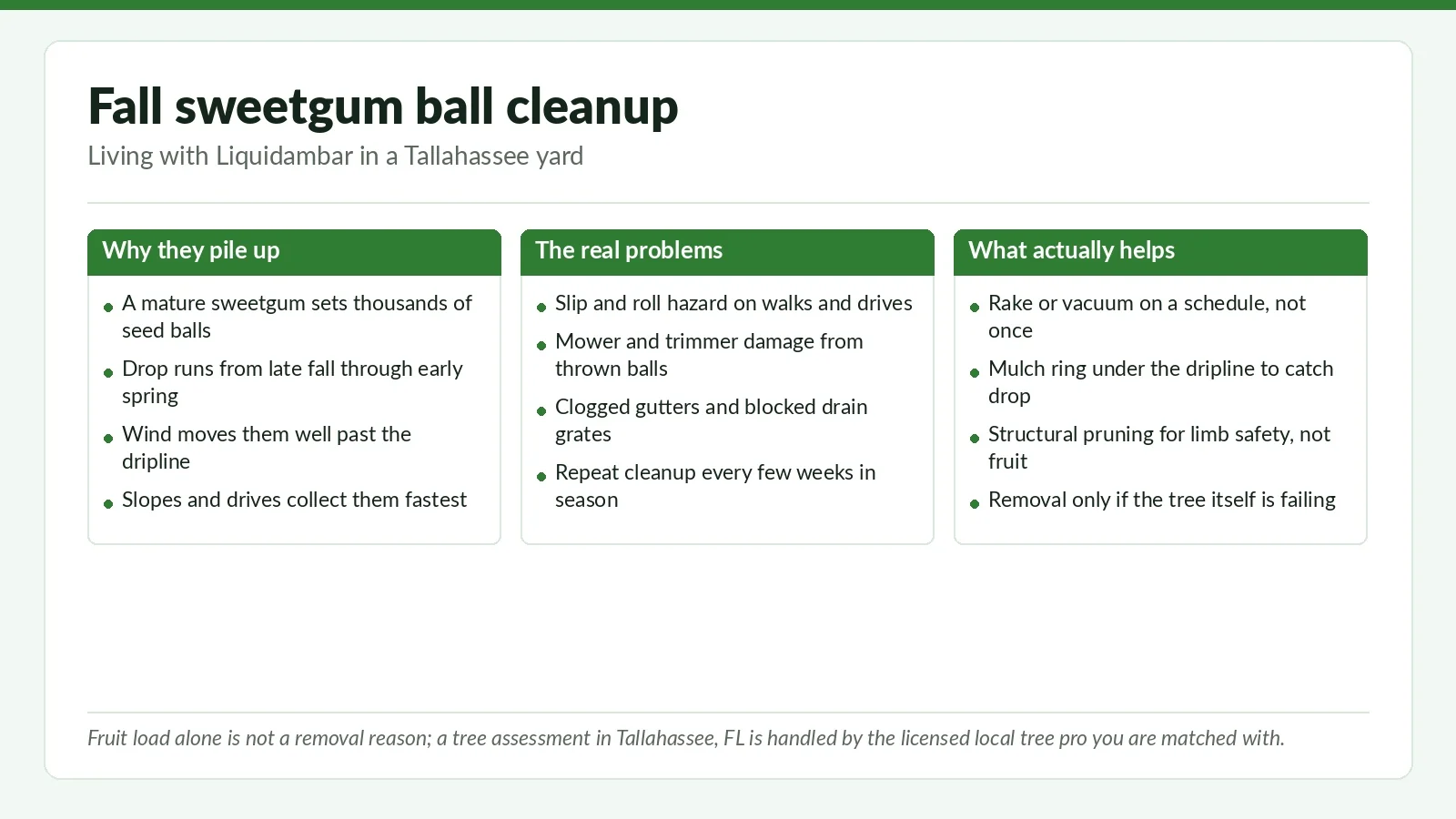
A mature sweetgum produces thousands to tens of thousands of seed balls per year. The balls are 1–1.5 inches in diameter, woody, spiky on the surface, and remarkably durable — a fallen sweetgum ball can persist intact on the ground for a year or more. They are uncomfortable to step on barefoot, painful to slip on, hard on lawn mowers, and difficult to rake because the spikes catch in everything they touch.
The biological reason is reproductive strategy. Sweetgum produces seeds in large quantities to overcome high mortality in seedling stages. Most seeds inside each ball never germinate — only a few seedlings establish per parent tree per year — but the species spreads its bets by producing massive quantities. The result is a yard maintenance burden that lasts the tree’s lifetime.
The Tallahassee Drop Calendar
Sweetgum ball drop in Tallahassee starts in late summer (typically August) and continues through winter. Heavy drop concentrates from October through February. The drop is gradual — there’s never a single “drop the balls all at once” event, which means cleanup is a year-round chore on lots with mature sweetgums.
Wind events accelerate drop. After a tropical storm or any significant wind, sweetgum lots will have a fresh layer of balls covering the yard. Heavy rain knocks balls loose. Even on calm days, sweetgum balls drop continuously throughout the active season.
Cleanup Approaches
For Tallahassee homeowners committed to keeping a mature sweetgum, three cleanup approaches work in combination:
Rake and bag during peak drop. Heavy raking with a metal rake (the spikes catch in plastic-tine rakes) into yard waste bags or carts. Most Tallahassee curbside yard-waste programs accept sweetgum balls. Weekly raking during October–January manages the volume.
Mulch the lawn area. Some homeowners convert the area under a sweetgum from grass to a thick mulch bed. Mulch absorbs the balls into the layer, and the seasonal cleanup becomes raking mulch + balls together once or twice a year. Less aesthetic for some lots but dramatically less maintenance.
Leaf-blower technique. Powerful leaf blowers can move sweetgum balls into piles for easier collection. Backpack blowers handle this better than handheld units. Wear eye protection — flying spiky seed balls are not gentle.
Removal: When the Tree Comes Down
For many Tallahassee homeowners, the cleanup burden eventually drives the decision to remove the tree. Sweetgum removal proceeds as standard tree work. Pricing follows the height-tier matrix: a 60-foot sweetgum runs $680–$1,300 standard removal, plus stump grinding at $3 per inch. See our tree removal cost page.
Permit status: sweetgum is Category A under City of Tallahassee §5-83. Non-patriarch sweetgums up to 36 inches DBH on single-family residential lots can be removed without a permit. Above that or for Canopy Road Protection Zone parcels, permits apply. In unincorporated Leon County, sweetgum is not specifically called out under §10-4.362.
Sweetgum is a Florida-native species and removal is often replaced with native plantings under HOA covenants. Better choices for a similar form and growth rate without the ball burden include Shumard oak, swamp white oak, or red maple — all native Florida species. See our sweetgum tree service page.
“Fruitless” Sweetgum Cultivars — The Truth
Several “fruitless” or “low-fruiting” sweetgum cultivars are sold commercially: ‘Rotundiloba’, ‘Cherokee’, and others. Marketing materials claim dramatically reduced or zero seed ball production. The reality is more nuanced.
‘Rotundiloba’ (the most-promoted “fruitless” cultivar) does produce significantly fewer seed balls than the species type, but “fewer” is not “none.” Mature ‘Rotundiloba’ specimens still produce balls, just at a lower rate. The leaf shape is also subtly different (more rounded lobes, hence the name) which some homeowners find less attractive than typical sweetgum foliage.
For new plantings, the fruitless cultivars are worth considering. For replacing an existing mature sweetgum with a fruitless cultivar, the new tree takes 10–20 years to reach mature size — typically not a useful tradeoff. Most Tallahassee homeowners replacing a mature sweetgum choose a different species entirely.
Pruning and Care for Sweetgums You’re Keeping
Sweetgums respond well to ANSI A300 pruning. The best windows are November through February (dormant season) and mid-summer. Standard cuts: dead-wood removal, structural pruning of any co-dominant unions, and clearance pruning for structures or right-of-way. Avoid topping — sweetgums respond poorly and the cut creates dense water-sprout regrowth.
Sweetgums are generally pest- and disease-resistant in North Florida. Occasional issues include sweetgum webworm (cosmetic, no treatment warranted on healthy trees), and rarely Botryosphaeria canker on stressed specimens. Drought tolerance is moderate — see our summer drought watering guide.
Authority reference: UF/IFAS EDIS publishes the Florida sweetgum fact sheet (ST359) covering species biology, cultivars, and management.
Sweetgum Service — Tallahassee
Sweetgum pruning, removal, stump grinding, and replacement planting consultation. ISA-certified arborists in our network handle the species across Killearn, Bradfordville, Midtown, SouthWood, and all of Leon County.
Call (850) 820-2166 — Mon–Sat 7am–7pm. Free sweetgum assessments.
Frequently Asked Questions
When do sweetgum balls drop in Tallahassee?
Late summer through winter, with peak drop October through February. Drop is continuous, not a single event. Wind and rain accelerate drop volume.
Are there sweetgum cultivars that don’t produce balls?
“Fruitless” cultivars like ‘Rotundiloba’ produce significantly fewer balls but not zero. For new plantings, worth considering. For replacing a mature sweetgum, most homeowners choose a different species entirely.
How much does sweetgum removal cost in Tallahassee?
Standard height-tier pricing applies. A 60-foot sweetgum runs $680–$1,300 standard removal plus stump grinding at $3 per inch. Add 1.5× for emergency dispatch or up to 2–3× for crane work or live-line proximity.
Do I need a permit to remove a sweetgum in Tallahassee?
Inside City of Tallahassee limits, non-patriarch sweetgums up to 36 inches DBH on single-family residential lots can be removed without a §5-83 permit. Above that or for Canopy Road Protection Zone parcels, permits apply.
What should I plant to replace a removed sweetgum?
Native alternatives include Shumard oak, swamp white oak, or red maple. All offer similar form and growth rate without the seed ball burden. See our professional tree planting page for site-specific recommendations.