Every Tallahassee winter, the same scene plays out across Killearn driveways, Midtown front yards, and SouthWood entries: landscaping crews show up and top crepe myrtles back to thick knuckles, leaving stubs that look like coat racks. The practice is so widespread that it has a name — “crepe murder” — and so misunderstood that even some professional landscapers still do it on autopilot. Done right, crepe myrtle pruning is simple, light, and produces years of healthy bloom on a structurally sound tree. Done wrong, it damages the tree and creates the dense water-sprout regrowth that requires repeating the same destructive cuts every year. Here’s the right approach.
What Crepe Myrtle Wants
Crepe myrtle (Lagerstroemia indica and hybrid Lagerstroemia × fauriei) is a small-to-medium ornamental tree native to Asia, naturalized across the southeastern U.S. The species blooms on new wood — flowers form on the current season’s growth rather than on last year’s branches. This biology is the source of much of the confusion: because the tree blooms on new wood, pruning encourages bloom, leading to the mistaken belief that more pruning = more flowers. In reality, the species blooms abundantly without aggressive pruning at all.
A naturally-grown crepe myrtle develops a graceful multi-stem form with smooth, mottled bark that exfoliates in patches — one of the species’ best ornamental features. The bark itself is a winter visual asset, often as attractive as the summer blooms. Topping destroys the bark display along with the natural form.
Storm damage or a tree on your house? Call now.
Stay out of rooms under the tree and keep clear of downed lines — report those to the power company first. Then call and we’ll connect you with a local tree crew that handles storm work.
📞 Call (858) 319-0022Free 24/7 dispatch line · availability varies by storm volume
The Right Pruning Window
Late winter is the right pruning window in Tallahassee — typically late January through early March, while the tree is still dormant but before bud break. Pruning earlier (December–early January) is acceptable; pruning later, after the new growth has started, stresses the tree and reduces bloom.
Avoid summer pruning except for dead-wood removal or minor shaping. Summer cuts during active growth can reduce bloom and create pest-attractive wounds. Avoid fall pruning — fresh cuts in fall trigger growth flushes that don’t harden off before winter, increasing freeze damage risk.
The 25 Percent Rule
ANSI A300 standards limit single-event crown reduction on any tree to no more than 25 percent. Crepe myrtle is no exception. Annual pruning should remove at most 25 percent of the live crown — and on healthy mature trees, often much less.
What that looks like in practice on a typical Tallahassee crepe myrtle:
Remove dead branches entirely. Easy call — dead wood doesn’t contribute to bloom or structure.
Remove crossing branches that rub against each other or against the main trunks. These create wounds and structural weakness.
Remove suckers from the base. Crepe myrtle is famously prone to suckering. Suckers compete with the main stems and crowd the base. Removal at ground level is appropriate annually.
Lightly thin small-twig growth inside the canopy. Improves air circulation, reduces aphid and powdery-mildew pressure.
Shape the outer canopy lightly to maintain form. Cut back to outward-facing buds. Avoid heading cuts (cutting branches mid-length to no specific bud) — these create the dense water-sprout regrowth that mimics topping.
That’s it. No knuckle stubs, no coat-rack tops, no taking the tree back to “main framework” every year. See our crepe myrtle trimming page.
Why “Crepe Murder” Hurts the Tree
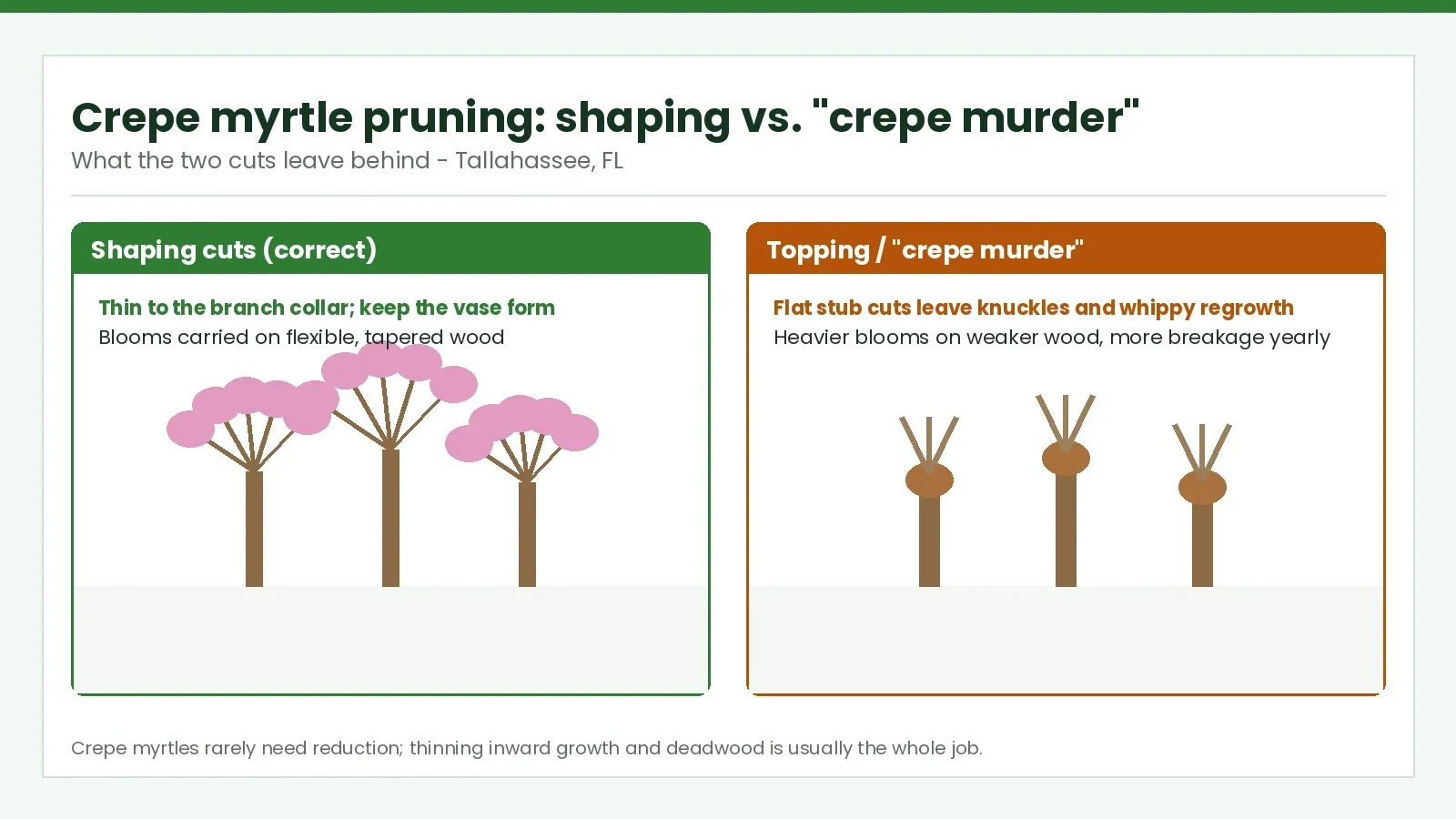
The traditional “crepe murder” approach — topping the tree back to thick knuckles each winter — creates four specific problems:
1. Water-sprout regrowth. Each topping cut produces a cluster of fast-growing, weakly-attached sprouts. The sprouts grow back larger than what was removed, requiring another topping the following year. The cycle compounds.
2. Disrupted bloom. Heavy topping delays bloom by 2–4 weeks and can reduce overall bloom volume on the regrown canopy.
3. Wound and decay risk. Each topping cut is a wound. Repeated wounding over years creates progressive decay at the cut sites. Mature topped trees develop internal rot that can eventually cause structural failure.
4. Ruined bark display. The smooth mottled bark that develops on older trunks is one of the species’ best features. Topping prevents the bark from maturing on the cut limbs.
Restoration Pruning for Previously-Topped Crepe Myrtles
If your crepe myrtle has been “crepe murdered” for years, restoration is possible but takes time. The protocol over 3–5 years: stop topping immediately, allow the water sprouts to develop, select 3–5 of the best-positioned new shoots from each knuckle as new structural framework, remove the remaining water sprouts, and progressively prune the new framework into a natural form. The tree never quite reaches the structure it would have developed if never topped, but it can restore a reasonable form. The arborists in our network include restoration pruning as a service line.
Pest and Disease Watch
Crepe myrtle in Tallahassee faces three notable pest and disease pressures. Powdery mildew (white powdery coating on leaves and shoots) is the most common — favored by humid weather and dense canopy. Treatment is improving air circulation through proper pruning and, if needed, fungicide application.
Aphids cause sticky honeydew on leaves, which then supports sooty mold growth. The aphids themselves are usually controlled by beneficial insects; treatment is rarely needed. Crepe myrtle bark scale is a newer concern in Florida — small white scales on the bark and twigs — and can warrant horticultural oil treatment during the crawler stage. See our tree disease treatment page.
Replacement Planting Considerations
Some Tallahassee homeowners conclude that the species’ resprout aggressiveness and ongoing care needs outweigh the bloom display, and choose removal and replacement. Native flowering alternatives include Eastern redbud, fringe tree (Chionanthus virginicus), and yaupon holly (small specimens). For a similar bloom display in a more structurally durable tree, consider ‘Natchez’, ‘Tuscarora’, or ‘Catawba’ crepe myrtle cultivars planted with proper spacing and never topped.
Authority reference: UF/IFAS EDIS publishes the Florida crepe myrtle fact sheet (ENH-358) covering species biology, cultivar selection, and the explicit recommendation against topping.
Crepe Myrtle Pruning — Tallahassee
ANSI A300 standard pruning, restoration pruning for previously-topped trees, pest and disease diagnosis. Call now on our homepage to be connected with an ISA-certified local arborist for a crepe myrtle assessment.
Call now on our homepage to be connected with an ISA-certified local arborist — dispatch coordination is available around the clock; actual on-site scheduling depends on the independent provider’s availability and is not guaranteed.
Frequently Asked Questions
When should I prune my crepe myrtle in Tallahassee?
Late January through early March, while still dormant but before bud break. Avoid summer and fall pruning except for dead-wood removal.
Should I top my crepe myrtle each year?
No. Topping (“crepe murder”) creates water-sprout regrowth, delays bloom, causes progressive decay, and destroys the bark display. ANSI A300 limits annual crown reduction to no more than 25 percent.
Will my topped crepe myrtle still bloom?
Yes, but typically 2–4 weeks late and on weakly-attached water sprouts. The tree blooms despite the topping, not because of it. The species blooms abundantly with no topping at all.
Can I restore a previously-topped crepe myrtle?
Yes, over 3–5 years. Stop topping, allow water sprouts to develop, select 3–5 best-positioned shoots from each knuckle as new framework, remove the rest, and progressively prune into a natural form. The arborists in our network handle restoration pruning.
What pests should I watch for on crepe myrtles?
Powdery mildew (white coating on leaves), aphids (with associated honeydew and sooty mold), and crepe myrtle bark scale (small white scales on bark). See our crepe myrtle service page for diagnostic walks.