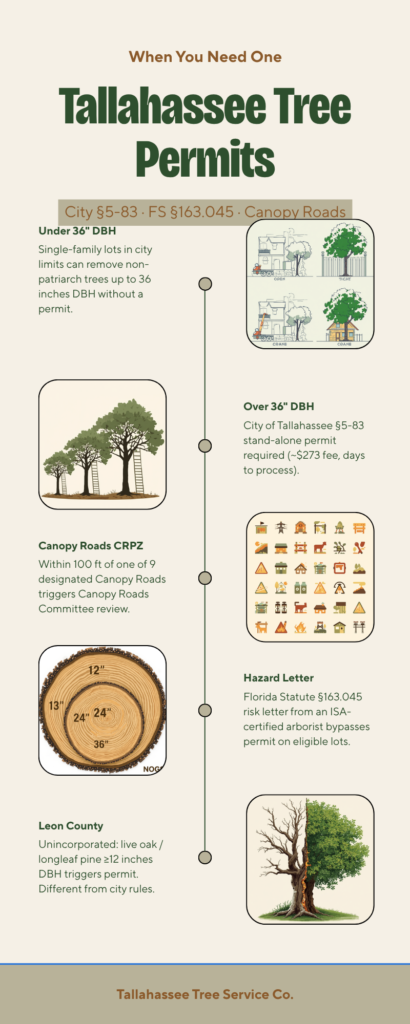
One of the most-misunderstood elements of Tallahassee tree regulation is the Canopy Road Protection Zone — the 100-foot buffer along each of the nine designated Canopy Roads where additional review applies before any tree work. Homeowners on these stretches frequently learn about the CRPZ only after a contractor flags a permit issue, and by then the easy path is gone. Here’s what the CRPZ actually requires, which roads are covered, what triggers Canopy Roads Citizens Committee review, and the §163.045 shortcut for genuine hazards.
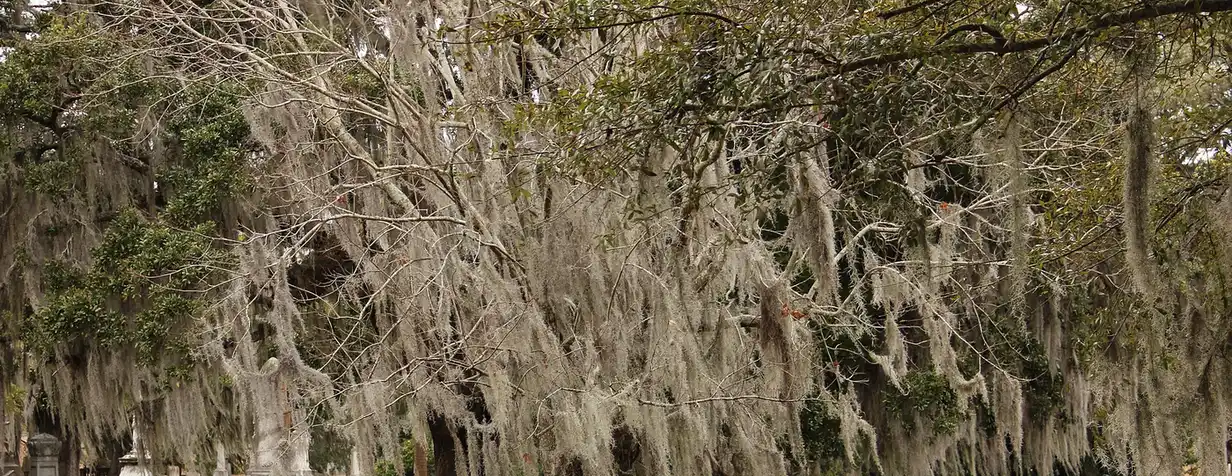
The Nine Designated Canopy Roads
Leon County recognizes nine Canopy Roads totaling roughly 78 miles. Each road has historical, ecological, or aesthetic significance worth preserving. The list:
Old Bainbridge Road. North Meridian Road. Centerville Road. Old Centerville Road. Miccosukee Road. Moccasin Gap Road. Sunny Hill Road. Pisgah Church Road. Old St. Augustine Road.
If any part of your property sits within 100 feet of the centerline of any of these roads, the Canopy Road Protection Zone applies to that portion of your lot regardless of species, DBH, or distance from the road. Many lots in Killearn (Centerville Road), parts of Bradfordville (Centerville, Miccosukee), and rural Leon County corridors are CRPZ-affected at least partially.
Storm damage or a tree on your house? Call now.
Stay out of rooms under the tree and keep clear of downed lines — report those to the power company first. Then call and we’ll connect you with a local tree crew that handles storm work.
📞 Call (858) 319-0022Free 24/7 dispatch line · availability varies by storm volume
What the 100-Foot Rule Means
The CRPZ extends 100 feet from the centerline of each designated Canopy Road. This is measured perpendicular to the road centerline, not the lot line. Within that zone, any tree work — routine trim, emergency removal, storm cleanup — triggers Canopy Roads Citizens Committee (CRCC) review unless an exemption applies.
The CRCC is an advisory body that reviews tree-work proposals for impact on the protected canopy. CRCC review typically adds 30–60 days to project timelines and can result in conditional approval, modification requirements, or denial. The review applies to any work within the zone — not just removal, but also significant pruning, especially of mature canopy trees.
What Triggers CRCC Review
Within the CRPZ, the trigger threshold is broader than §5-83 outside the zone. Work that triggers review includes:
Removal of any tree 8 inches DBH or greater. Significant pruning (more than 25 percent canopy reduction) on canopy-contributing trees. Removal of multiple trees on a single project. Site work that requires root-zone disturbance for canopy trees. New construction or grade changes within the zone affecting canopy trees.
Routine maintenance — dead-wood removal, minor pruning, mulch ring installation, sabal palm trimming — generally does not trigger review. The threshold is significant work that could affect the canopy character of the road. When in doubt, the conservative path is to ask before proceeding.
The §163.045 Shortcut for Hazard Trees
Florida Statute §163.045 provides a critical exemption that applies within the CRPZ on single-family detached residential property. Under the statute, local government — including the CRCC — cannot require a permit, fee, or mitigation for tree removal when the owner holds written documentation from an ISA-certified arborist stating the tree poses an “unacceptable risk” per ANSI/ISA Tree Risk Assessment BMP, Second Edition (2017).
This is the fastest legal path for emergency tree removal within the CRPZ. A TRAQ-certified arborist evaluation typically takes hours; a CRCC review process takes weeks. For genuine hazards — trees with structural failure indicators, soil heaving, lightning damage, or post-storm compromised integrity — the §163.045 letter is the right tool. The arborists in our network include this documentation on eligible hazard jobs.
What §163.045 does not cover: HOA common areas, commercial property, multifamily, rights-of-way, or aesthetic-only removal. If the tree is healthy and the homeowner just wants it gone, the statute doesn’t apply and CRCC review is required. See our tree risk assessment page.
What CRCC Review Looks Like in Practice
For non-hazard work that requires CRCC review, the process typically involves: a written application to City of Tallahassee Growth Management or Leon County Development Services, an arborist report describing the proposed work and impact, photographs of the trees and site, and CRCC committee review at a public meeting.
The committee evaluates whether the proposed work preserves the canopy character. Outcomes include: approval, approval with conditions (e.g., replacement plantings, reduced scope), denial, or request for revised proposal. ISA-certified arborists familiar with Tallahassee CRCC standards prepare applications that anticipate committee concerns and improve approval likelihood.
The City’s permit fee for stand-alone tree-removal permits applies on top of CRCC review when permits are also required. Expect both fees for over-threshold removals in the CRPZ.
Storm-Damage Cleanup Within the CRPZ
After named storms, CRPZ-area homeowners face the same emergency tree removal needs as the rest of Leon County, but the regulatory layer adds complexity. The City of Tallahassee historically issues emergency-action provisions during declared disasters that allow time-critical removals to proceed with post-event documentation rather than pre-event review. The §163.045 risk-letter path also applies and is the fastest formal route.
For homeowners along Canopy Roads after a major event, the priority sequence is: life-safety triage first, photo documentation second, ISA arborist assessment third (with §163.045 letter prepared for hazard trees), removal scheduling fourth. See our storm cleanup page.
Verification — Find Out If Your Lot Is CRPZ
The single best step before any tree work near a designated Canopy Road is to verify CRPZ status with the City of Tallahassee Growth Management office at (850) 891-6586 or Leon County Development Services at (850) 606-1300. Parcel-specific CRPZ designation is available from these offices and is not always intuitive from looking at the property. A lot fronting a side street that runs into a Canopy Road may still have CRPZ coverage on portions of the lot.
The arborists in our network confirm CRPZ status as part of the pre-work assessment on Canopy Road area properties. See the Tallahassee tree permit guide for the full permit-and-CRCC walkthrough.
Authority reference: the City of Tallahassee publishes the Canopy Roads ordinance and CRCC review procedures through City Growth Management.
Canopy Road Tree Service — Tallahassee
ISA-certified arborists familiar with CRPZ rules across all nine designated Canopy Roads. CRCC application preparation, §163.045 risk letters for eligible hazards, permit handling, storm response.
Call now on our homepage to be connected with an ISA-certified local arborist for a CRPZ assessment. Dispatch coverage runs Mon–Sat 7am–7pm; actual on-site scheduling depends on the independent provider’s availability and is not guaranteed.
Frequently Asked Questions
Which Tallahassee roads are designated Canopy Roads?
Nine roads: Old Bainbridge, North Meridian, Centerville, Old Centerville, Miccosukee, Moccasin Gap, Sunny Hill, Pisgah Church, and Old St. Augustine. Properties within 100 feet of any centerline carry CRPZ designation on the affected portion of the lot.
How do I know if my lot is in a Canopy Road Protection Zone?
Verify with City of Tallahassee Growth Management at (850) 891-6586 or Leon County Development Services at (850) 606-1300. Parcel-specific CRPZ status is available from these offices.
What triggers Canopy Roads Citizens Committee review?
Removal of any tree 8 inches DBH or greater, significant pruning (more than 25 percent reduction) on canopy trees, multi-tree removal projects, and root-zone disturbance for canopy trees. Routine maintenance below these thresholds generally doesn’t trigger review.
Can I skip CRCC review for a hazard tree?
Yes, in narrow circumstances. Florida Statute §163.045 bars local government from requiring a permit, fee, or mitigation when a TRAQ-certified arborist documents “unacceptable risk” per ANSI/ISA Tree Risk Assessment BMP. The statute applies only to single-family detached residential property and only to genuine hazards.
How long does CRCC review take?
Typically 30–60 days from complete application to committee decision. The §163.045 risk-letter path takes hours for eligible hazard trees. For non-hazard work, plan well ahead of any project deadline. See our tree permit guide for full timeline expectations.