Crane Tree Removal in Tallahassee, FL
When a tree is too big, too dead, or too close to the house to take apart by climbing, a crane is not an upsell — it is the safe method, and on the right tree it is the faster and cheaper one. Call now and we’ll connect you with a vetted, insured local pro who can tell you whether yours is a crane job.
📞 Call Now — (858) 319-0022Told you need a crane and not sure it is true? Call now for a second read, any hour.Most Tallahassee removals do not need a crane. A climber, a rope, and a chipper handle the majority of what comes down in Leon County. But there is a category of tree — usually a mature live oak with 50 feet of spread hanging over a roof, or an 80-foot loblolly that died standing and is now too brittle to put a human in — where climbing is the wrong tool, and a crane is the responsible one.
This page explains how to tell the difference, so you know whether the crane line item on your quote is a legitimate necessity or somebody padding the number.
Five situations where a crane is the right call
| Situation | Why climbing is the wrong answer |
|---|---|
| The tree is dead or structurally hollow | Nobody should be tied into wood that cannot be trusted. A crane keeps the climber’s weight and the load out of the failing structure. This is the most common crane trigger on a beetle-killed pine or a hollow laurel oak. |
| Sections have to go up and over the house | There is no rigging path down through the canopy. The only way out is up, across, and into the drop zone. |
| No room to lower limbs | Pool cage on one side, fence and neighbor on the other, driveway underneath. Nowhere to land anything. |
| Hard lean toward a structure | Dismantling from above under crane control removes the guessing about which way the load wants to go. |
| Massive spread on a heritage live oak | Limbs weighing as much as a small car, 40 feet out over a roofline. Rope rigging that load is possible, and it is slow, and every pick is a risk. |
How a crane removal actually works
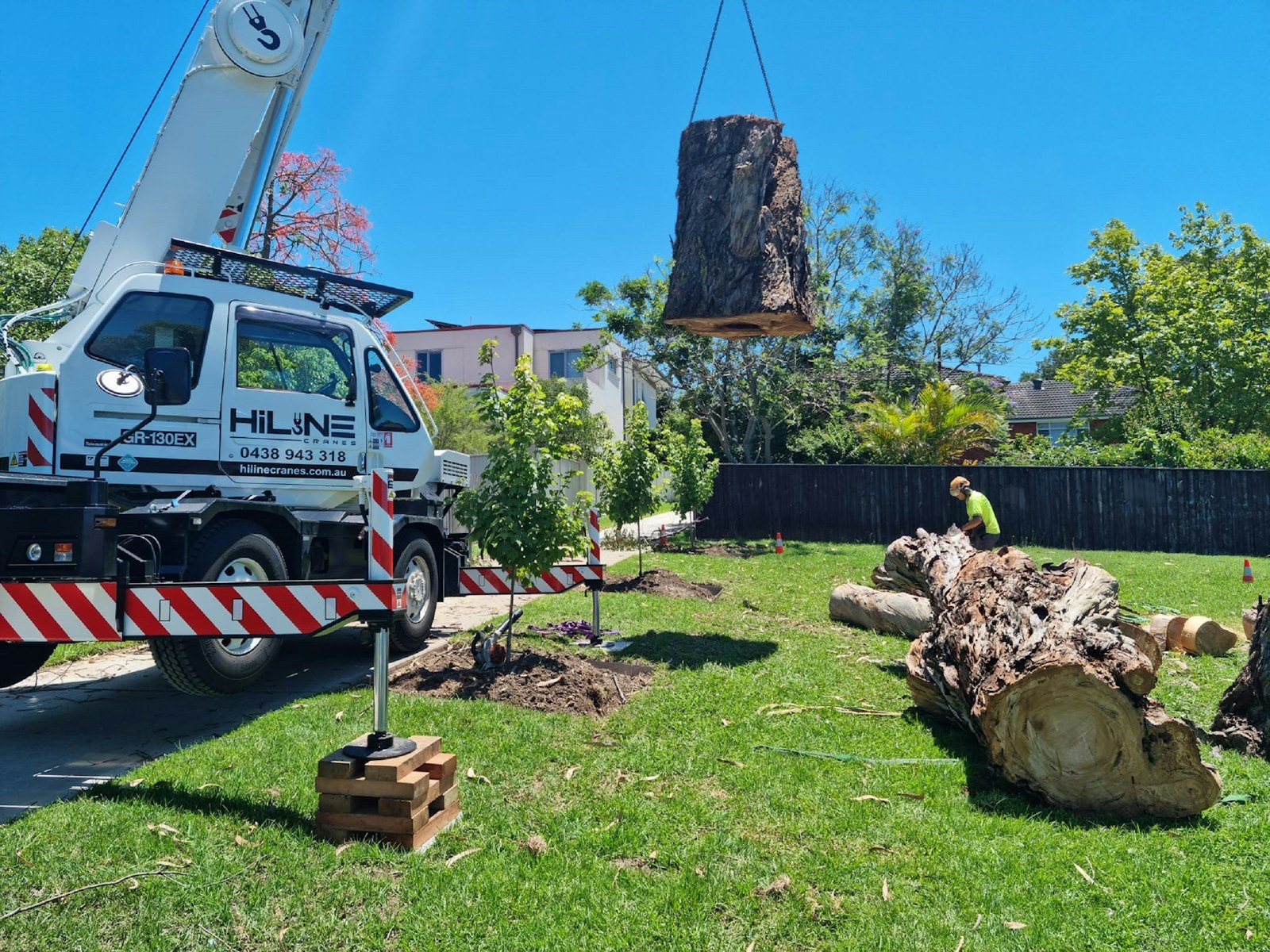
The sequence is simple and it repeats: the crane sets a pick point on a section, takes the load so the piece is held in the air, the climber or bucket operator makes the cut, and the crane swings the section clear to the drop zone. Nothing falls. Nothing swings through the canopy hoping the rigging holds. From the top down, the tree comes apart in controlled lifts.
Because each pick removes a big piece rather than a limb at a time, a tree that would take a climbing crew two days can come down in a morning. That is the whole economic argument — and it is why on a large, complex tree the crane number often lands at or below the all-climbing number, even with the crane and operator on the bill.
Tallahassee makes crane setup harder than it looks
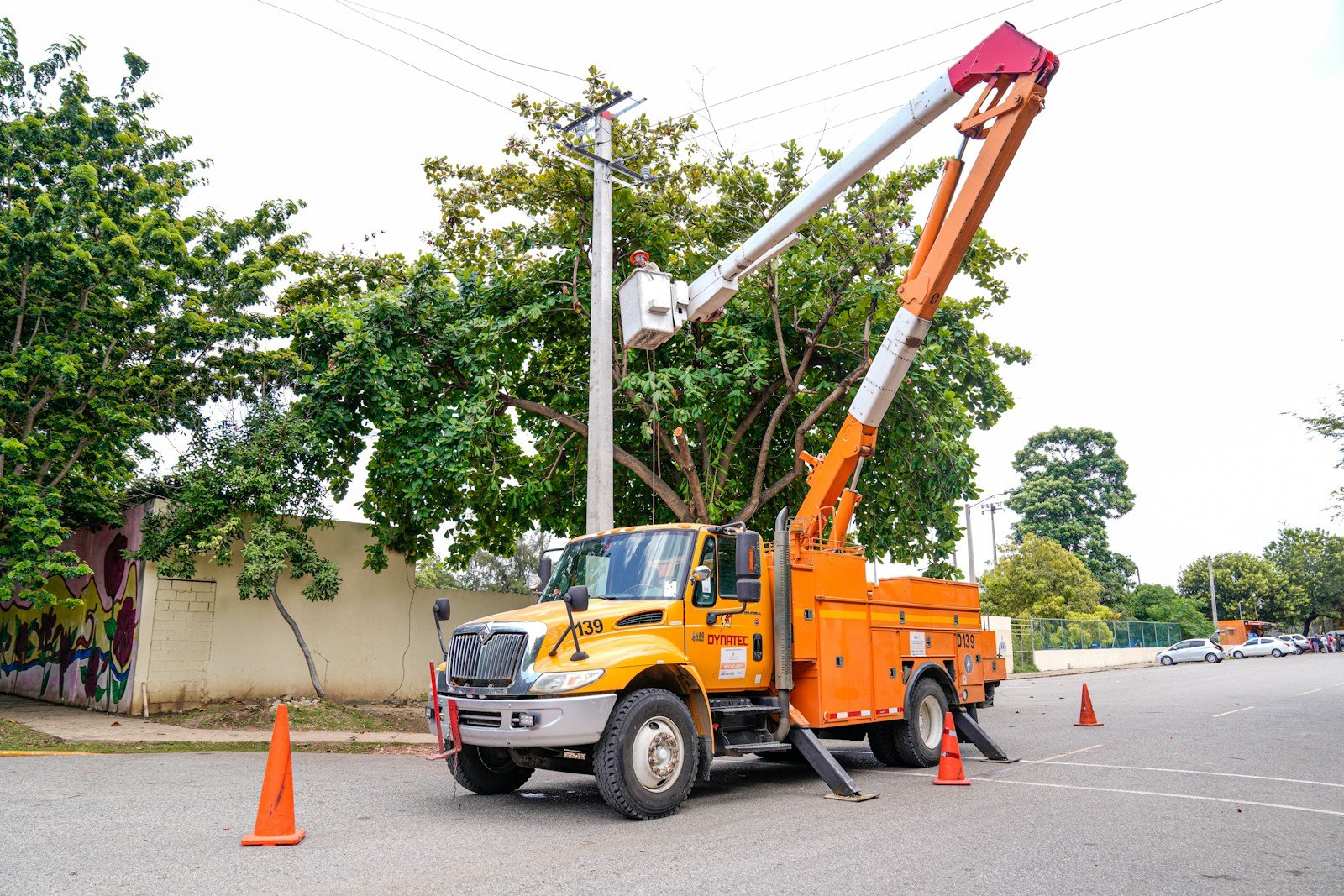
Our lots and our canopy fight the crane in specific ways:
- Narrow, tree-lined streets. On the Canopy Roads and in Midtown, the overhead canopy that makes the street beautiful is also the thing the boom has to work around.
- Overhead service drops. Nearly every older neighborhood has a drop crossing the yard. That determines where the crane can sit and where it can swing.
- Soft or sloped ground. Outriggers need bearing. South of the Cody Scarp, sandy ground over karst; north of it, clay that turns to soup after a week of rain. Mats are frequently part of the plan.
- Septic, irrigation, and drain fields. An outrigger pad over a drain field is an expensive mistake. Flag it before the truck rolls.
- Street closure. If the outriggers take a lane, the crew coordinates the closure with the City. That is a scheduling item, not an afterthought.
Dead pine or hollow oak leaning over the house right now? That is a priority-dispatch situation — and it is exactly the tree nobody should be climbing.
📞 Call Now — (858) 319-0022Vetted local pros — availability depends on independent provider schedules and demand.*How getting matched works
What drives the cost of a crane removal
| Factor | Why it moves the number |
|---|---|
| Crane size needed | Reach and capacity are set by the tree’s weight and how far the machine has to sit from it. Farther away means a bigger machine. |
| Setup difficulty | Mats, tight streets, and long booms all add hours before a single cut happens. |
| Street closure | Coordination with the City is time, and it constrains the schedule. |
| Tree weight and section count | Live oak is dense. More picks, heavier picks, longer day. |
| Debris volume | A mature oak is many truckloads. Chipping and hauling is a real line item. |
| Stump and cleanup | In or out of scope? Say which you want — see stump grinding. |
Typical local-market ranges for removals sit on the Tallahassee tree removal cost page — market ranges, not our prices. The pro you are matched with gives the binding written quote after seeing the setup.
Before the crane arrives — what the crew needs from you
- Clear vehicles from the driveway and the street near the setup spot.
- Point out the septic tank, drain field, irrigation lines, and any soft ground.
- Flag underground utilities and low-voltage runs.
- Agree on where the debris drop zone and the chipper will sit.
- Move patio furniture, grills, and anything under the swing path.
Frequently asked questions
Is crane removal more expensive than climbing?
Not always. On a large or hazardous tree, the crane finishes in a fraction of the time a climbing dismantle would take, so the total can land at or below an all-climbing approach. On a small, easy-access tree, climbing is clearly cheaper. The on-site assessment decides.
When is a crane genuinely required?
When the tree is dead or hollow enough that nobody should be tied into it, when there is no rigging path to lower limbs, or when sections have to travel up and over a structure to get out. In those cases the crane is the responsible method.
Will the crane tear up my yard?
A careful crew plans for it: outrigger mats to spread the load, staged setup off soft ground, and a swing path that keeps weight off the lawn where possible. Some ground disturbance at the setup pad is normal on a big lift. Flag septic and irrigation in advance and it is usually manageable.
Do crane jobs need a permit?
The removal follows the same tree-permit rules as any other — City §5-83 for protected trees, Canopy Road zones, and Leon County Chapter 10 outside the city. Separately, if the outriggers block a public lane the crew coordinates a street closure with the City. Two different questions.
Can a crane get to a back-yard tree?
Sometimes, with enough boom and a setup spot in the street or driveway. Sometimes not, and then it is a climbing job whether anyone likes it or not. Reach falls off fast with distance, which is why the machine that can reach your back yard may be much larger than the tree alone would suggest.
Is a crane the answer after a tree hits the house?
Often, yes — lifting the trunk off a roof under control is safer than cutting it in place. That is a tree-on-roof situation and it gets triaged as an emergency. Photograph everything for the insurance claim before anything moves.
Related Tallahassee tree services
Tree Removal
Hazardous Tree Removal
Dead Tree Removal
Tree on Roof Removal
Emergency Tree Service
Storm Cleanup
Stump Grinding
Tree Removal Cost
Find out if yours is actually a crane job
Call now and we’ll connect you with a vetted, insured Tallahassee-area tree pro. Free to use, no obligation, no sign-up.
📞 Call Now — (858) 319-0022Tallahassee Tree Service is a free referral service. Tallahassee Tree Service is not a licensed tree service provider and does not directly provide tree care services. All work is performed by independent, licensed and insured third-party providers in your area. Calls and form submissions placed through this site may be connected with a participating provider, and you may be contacted by that provider regarding your request. Same-day, emergency, and 24/7 availability are not guaranteed and depend on provider schedules, location, and demand. Service availability, pricing, licensing, and final response times are determined solely by the providers. It is the responsibility of the homeowner to verify that the hired contractor furnishes the necessary license and insurance required for the work being performed. All persons depicted in a photo or video are actors or models and not contractors listed on Tallahassee Tree Service.