Oak Tree Trimming in Tallahassee, FL
Live oak, laurel oak, water oak — three species, three completely different pruning calendars, and one very common way to ruin all of them. Call now and we’ll connect you with a vetted, ISA-certified local arborist who cuts to ANSI A300 and will not top your tree.
📞 Call Now — (858) 319-0022Someone quoted you to “take the top out” of your oak? Call now and get a real arborist’s read, any hour.Tallahassee is an oak town. The canopy that shades Old St. Augustine Road, Centerville, Miccosukee, and the rest of the designated Canopy Roads is mostly oak, and roughly half of what is standing over the average Leon County roof is one of three species. They look similar from the driveway. They are not the same tree, and they do not want the same cuts.
Oak trimming here goes wrong for one reason: crews price the job by the hour and take the shortcut that gets them off the property fastest. That shortcut — heading limbs back to stubs, or stripping the interior and leaving a puffball at the end of every branch — is the thing that kills the tree slowly enough that nobody blames the crew when it fails eight years later.
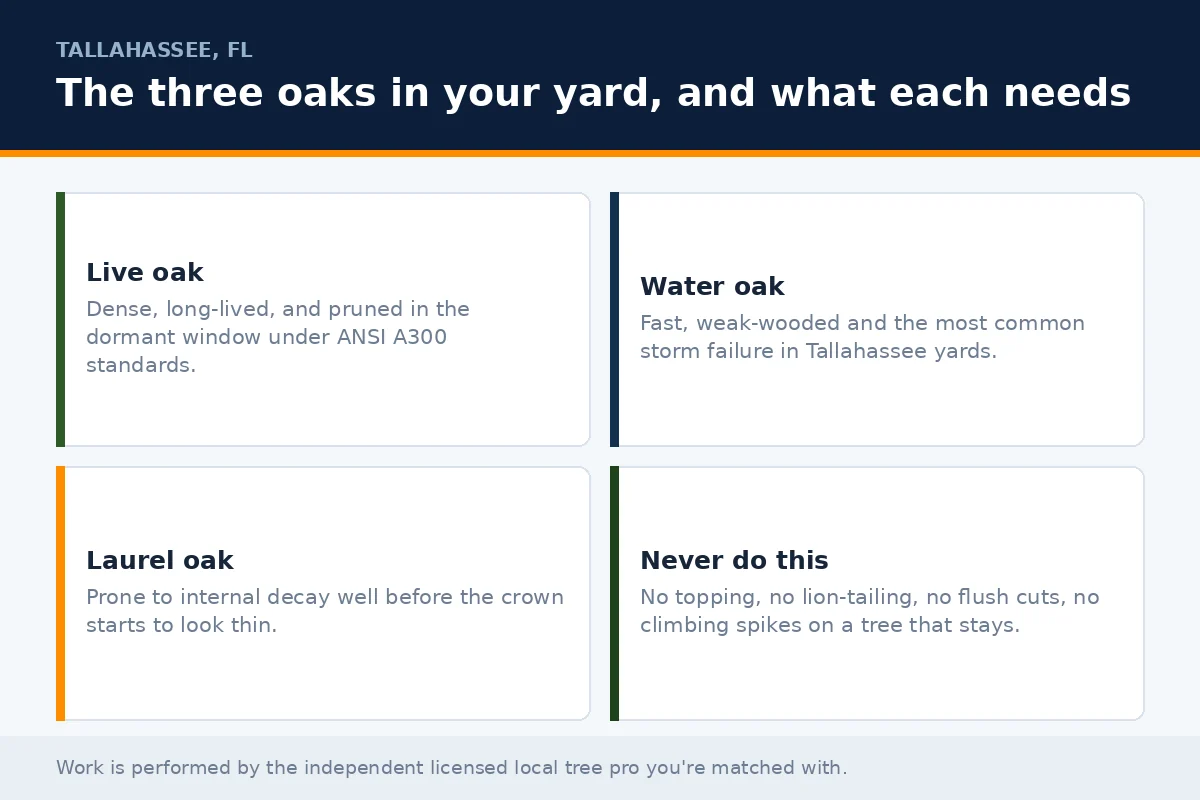
The three oaks in your yard, and what each one needs
| Species | How it behaves in Leon County | Pruning approach |
|---|---|---|
| Live oak (Quercus virginiana) | The heritage tree. Evergreen, wide-spreading, dense wood, can live centuries. Heavy horizontal limbs carry serious end-weight over roofs. | Dormant-season structural work, deadwood, sprout management. Conservative — never a big reduction without a hard reason. See live oak trimming. |
| Laurel oak (Quercus laurifolia) | Planted heavily mid-century, now hitting the end of its 50–70 year window across Midtown, Betton Hills, and the Southside. Hollows out fast. | Hazard reduction and deadwooding buy time. Many are past saving — read laurel oak problems. |
| Water oak (Quercus nigra) | Fast, upright, brittle, prone to hypoxylon and included-bark unions. Fails suddenly rather than gradually. | End-weight reduction before June, five-to-seven-year clean cycle. See water oak trimming. |
| Southern red, post, bluejack oak | Scattered on rural and woodland-edge lots out toward Miccosukee and Wakulla. | Deadwood and clearance; case-by-case structural work. |
Simple field test: if it goes completely bare in February, it is a water oak or a laurel oak, not the live oak you thought you had. That single fact changes the risk read on the tree over your bedroom.
What ANSI A300 pruning actually means
A300 is the written American standard, and it names exactly six things a pruning cut can be doing:
- Crown cleaning. Dead, dying, diseased, and broken limbs out. The highest-value, lowest-risk work on any oak.
- Crown thinning. Selective removal of small live branches to reduce density. Done sparingly — over-thinning is its own kind of damage.
- Crown raising. Lifting the low canopy for clearance over a driveway, a walkway, or the mail truck.
- Crown reduction. Shortening limbs back to a lateral at least a third the diameter of the cut. This is what people mean when they think they want “topping” — it is the correct version.
- Structural pruning. Subordinating a competing leader, opening an included-bark union while the cut is still small. Cheapest and most valuable on a young tree.
- Hazard reduction. Targeted cuts against a specific defect found on inspection.
Four things that should never happen to a Tallahassee oak
- Topping. Heading cuts back to stubs, leaving nothing to take over as a terminal. Decay enters at every cut, the tree throws weak sprouts, and in five to eight years you have a bigger hazard than you started with. Alternatives are on the topping alternatives page.
- Lion-tailing. Stripping the interior foliage so all the leaves sit at the branch tips. It looks tidy for a season, then it sunscalds the exposed bark and turns every limb into a lever arm that snaps in a tropical system.
- Over-thinning. A300 caps live-foliage removal on a mature tree at roughly a quarter in a growing season, and stressed or old trees want considerably less. A crew that hauls away half your canopy did not do you a favor.
- Spiking a live tree. Climbing spurs punch through the bark into the cambium. They belong on a removal, never on a tree you intend to keep.
Limb hanging in the canopy, or a fresh crack where two trunks meet? That is a priority-dispatch situation, not a scheduled trim.
📞 Call Now — (858) 319-0022Vetted local pros — availability depends on independent provider schedules and demand.*How getting matched works
When to trim an oak in Tallahassee
Late fall through early March is the window for structural work. The tree is dormant, sap flow is low, the bare structure is visible from the ground, and the risk of spreading oak wilt through fresh cuts is at its lowest. Growing-season pruning on oaks is best kept to what genuinely cannot wait.
Two exceptions that always override the calendar: hazard limbs and storm damage. A cracked limb over a bedroom does not care what month it is. And on brittle species — laurel and water oak — end-weight reduction ahead of hurricane season is worth doing before June, which in practice means booking it in late winter.
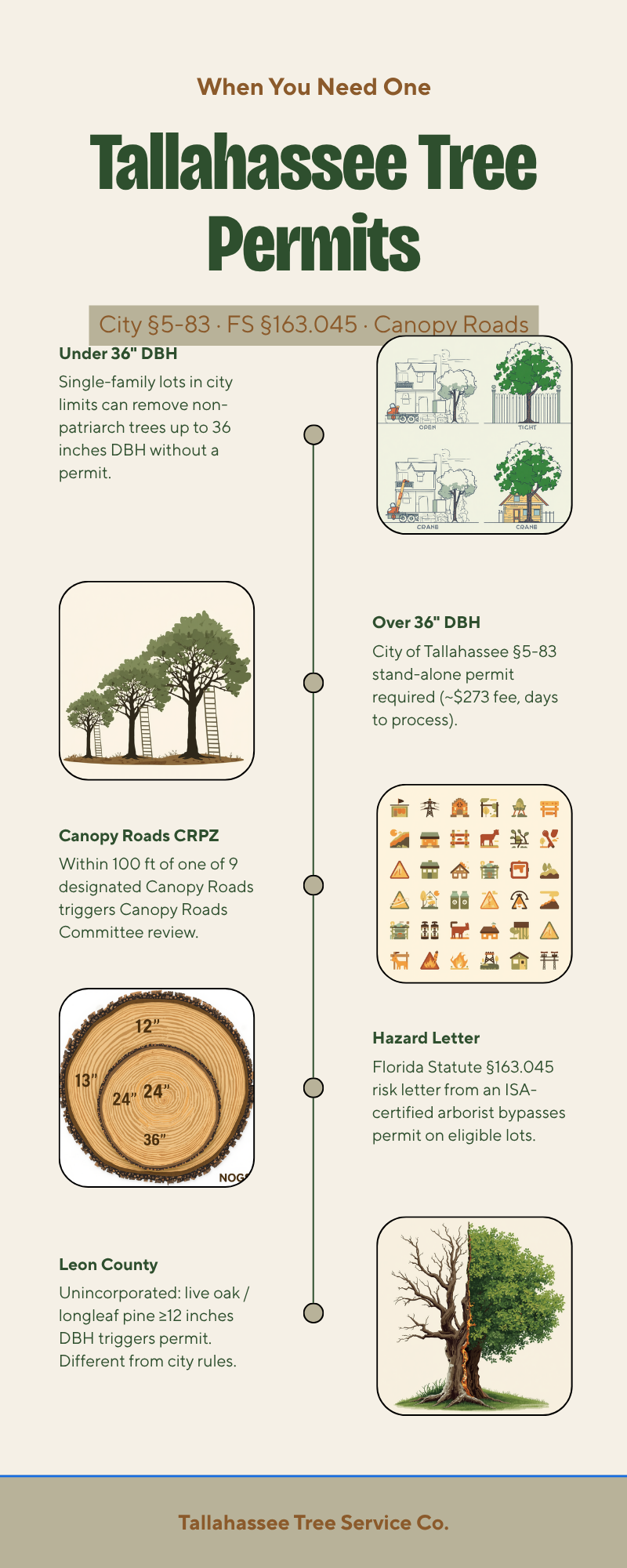
Permits: when oak work needs paperwork
Routine pruning of an unprotected yard oak generally does not require a permit. It gets more complicated when the tree is large, protected, a designated patriarch, or standing in a Canopy Road Protection Zone — and Leon County’s Chapter 10 environmental rules apply outside the city limits. Substantial canopy removal on a protected live oak can trigger City §5-83 review even though nobody is taking the tree down.
A documented hazard tree can qualify for the Florida Statute 163.045 exception, but that requires the right arborist documentation, not just an opinion. The pro you are matched with flags the permit question before any saw runs — the full framework is in the Tallahassee tree permit guide.
What drives the scope of an oak trimming job
| Factor | Why it moves the job |
|---|---|
| Objective | Deadwood-only is a fraction of a full structural prune. Name what you want. |
| Size and spread | A 60-ft live oak with a 50-ft spread is climbing and rigging, not a bucket and a pole saw. |
| Access | Truck to the trunk, or a hand-carry through a side gate. Biggest single swing factor. |
| Targets underneath | Roof, pool cage, fence, service drop — each piece gets lowered on rope. |
| Permit status | Protected tree or Canopy Road frontage adds documentation time to the job. |
| Debris | Oak makes a lot of wood. Chipping on site versus hauling changes the day. |
Typical local-market ranges live on the tree pruning cost page — those are market ranges, not our prices, and the arborist you are matched with gives the binding written quote.
Frequently asked questions
When is the right time to trim an oak in Tallahassee?
Late fall through early March. The tree is dormant, sap flow is low, the structure is visible without leaves, and oak wilt risk from fresh cuts is at its lowest. Hazard limbs and storm damage get handled whenever they happen.
How much can be pruned off an oak in one visit?
ANSI A300 puts the ceiling at roughly a quarter of the live foliage on a mature tree in a single growing season, and older or stressed trees want less than that. If a crew is proposing to strip half the canopy, that is a reason to get a second opinion.
Will an arborist top my oak if I ask?
An ISA-certified arborist will decline. Topping is outside the standard and creates a more hazardous tree within a few years. If height or spread is the real problem, the right answer is reduction back to lateral branches — or, on a tree that has genuinely aged out, an honest removal conversation.
Do I need a permit to prune my oak?
Usually not for routine pruning of an unprotected yard tree. Protected or patriarch trees, Canopy Road Protection Zones, and substantial canopy removal can trigger City §5-83 review, and Leon County Chapter 10 applies outside the city. The pro you are matched with checks it up front.
Can pruning save a declining laurel oak?
Sometimes it buys years, not decades. Hazard reduction and deadwooding on a laurel oak with sound structure is worthwhile; a laurel oak with a hollow trunk, fruiting conks, or a compromised root plate is on borrowed time no matter how it is pruned. A written risk assessment settles it.
Will heavy pruning kill my oak?
It can. Topping, lion-tailing, and over-thinning all stress the tree, invite decay, and shorten its life — the damage just shows up years later. Proper A300 work does the opposite: it makes the tree stronger and safer without visibly gutting it.
Related Tallahassee tree services
Tree Trimming
Live Oak Trimming
Water Oak Trimming
Laurel Oak Problems
Topping Alternatives
Tree Risk Assessment
Tree Permit Guide
Tree Pruning Cost
Get your oak pruned by someone who knows which oak it is
Call now and we’ll connect you with a vetted, ISA-certified Tallahassee arborist. Free to use, no obligation, no sign-up.
📞 Call Now — (858) 319-0022Tallahassee Tree Service is a free referral service. Tallahassee Tree Service is not a licensed tree service provider and does not directly provide tree care services. All work is performed by independent, licensed and insured third-party providers in your area. Calls and form submissions placed through this site may be connected with a participating provider, and you may be contacted by that provider regarding your request. Same-day, emergency, and 24/7 availability are not guaranteed and depend on provider schedules, location, and demand. Service availability, pricing, licensing, and final response times are determined solely by the providers. It is the responsibility of the homeowner to verify that the hired contractor furnishes the necessary license and insurance required for the work being performed. All persons depicted in a photo or video are actors or models and not contractors listed on Tallahassee Tree Service.