Water Oak Trimming in Tallahassee, FL
The fast-growing oak in half the yards in this town is also the one that hollows out first. Call now and we’ll connect you with a vetted, insured local arborist who prunes water oaks to ANSI A300 — reduction cuts to laterals, deadwood out, no topping, no lion-tailing.
📞 Call Now — (858) 319-0022Want a second opinion before anyone cuts? Call now and we’ll connect you any hour.Water oak (Quercus nigra) is the workhorse shade tree of Tallahassee’s post-war neighborhoods. Builders in the 1950s through the 1970s planted it everywhere from Indianhead Acres to Levy Park to the older streets off Thomasville Road, because it grows fast and shades a yard within fifteen years. That speed is the whole problem. Water oak buys its growth rate with weak wood, and the trees planted in that build-out are now 55 to 75 years old — right at the edge of their natural lifespan in Leon County.
Live oak is a 200-year tree. Water oak, on a yard lot in USDA Zone 8b with our heat, humidity, and summer storm cycle, is a 60- to 80-year tree that starts hollowing out from old wounds well before it looks sick. Pruned properly on a five- to seven-year cycle, it stays safe and gives you decades of shade. Ignored until a limb lands on the carport, it becomes an expensive removal instead of a manageable prune.
Is it a water oak or a live oak? Check in February
Half the “live oaks” people call about in Tallahassee are water oaks. The tell is simple: a water oak goes bare in late winter. A live oak swaps its leaves quickly in spring and never looks naked. Beyond that:
| Water oak (Quercus nigra) | Live oak (Quercus virginiana) | |
|---|---|---|
| Leaves | Small, spatula-shaped, dropped in late winter | Leathery, narrow, effectively evergreen |
| Form | Upright, taller than wide | Low, wide-spreading, heavy horizontal limbs |
| Wood | Weaker; decays from wounds quickly | Dense and strong; decays slowly |
| Lifespan here | 60–80 years on a yard lot | 150+ years in good conditions |
| Failure mode | Sudden limb drop at included-bark unions | Gradual; usually gives more warning |
The distinction is not academic. It changes the pruning cycle, the risk read, and whether the honest answer is a prune or a removal. If the tree is a live oak, the live oak dormant-pruning approach applies instead.
Why water oaks earn a shorter pruning cycle
Four things stack up on a Tallahassee water oak, and they compound:
- Decay travels fast. Every wound — a storm break, a bad cut from a previous crew, a lawnmower scrape at the base — opens a decay column. Water oak compartmentalizes poorly, so those columns spread up the trunk instead of walling off.
- Included bark at the unions. Water oak throws co-dominant stems with bark pinched between them instead of a proper branch collar. Those unions are the fail point, and they fail without a creak of warning.
- Overextended laterals. Fast growth means long, heavy limbs with all the weight at the tip — exactly the geometry that snaps in a 60-mph gust.
- Age. The build-out cohort is aging out together. The wave of laurel oak and water oak decline showing up across Midtown, Betton Hills, and the Southside right now is not bad luck; it is a planting cohort hitting its lifespan at the same time.
Idalia in 2023 and Helene in 2024 both proved the point. The trees that shed limbs onto roofs were disproportionately water and laurel oaks with long, tip-heavy laterals and hollow unions. Pre-season end-weight reduction is the single highest-value cut you can buy on this species — see the hurricane tree prep checklist for the full pre-season sequence.
What ANSI A300 actually requires
ANSI A300 Part 1 is the written American standard for pruning. It is not marketing language — it defines what a cut is allowed to be:
- Cut placement: just outside the branch collar. No flush cuts into the trunk, no stubs left behind.
- Cut size: generally not more than about one-third of the parent stem diameter on a mature tree without a specific reason.
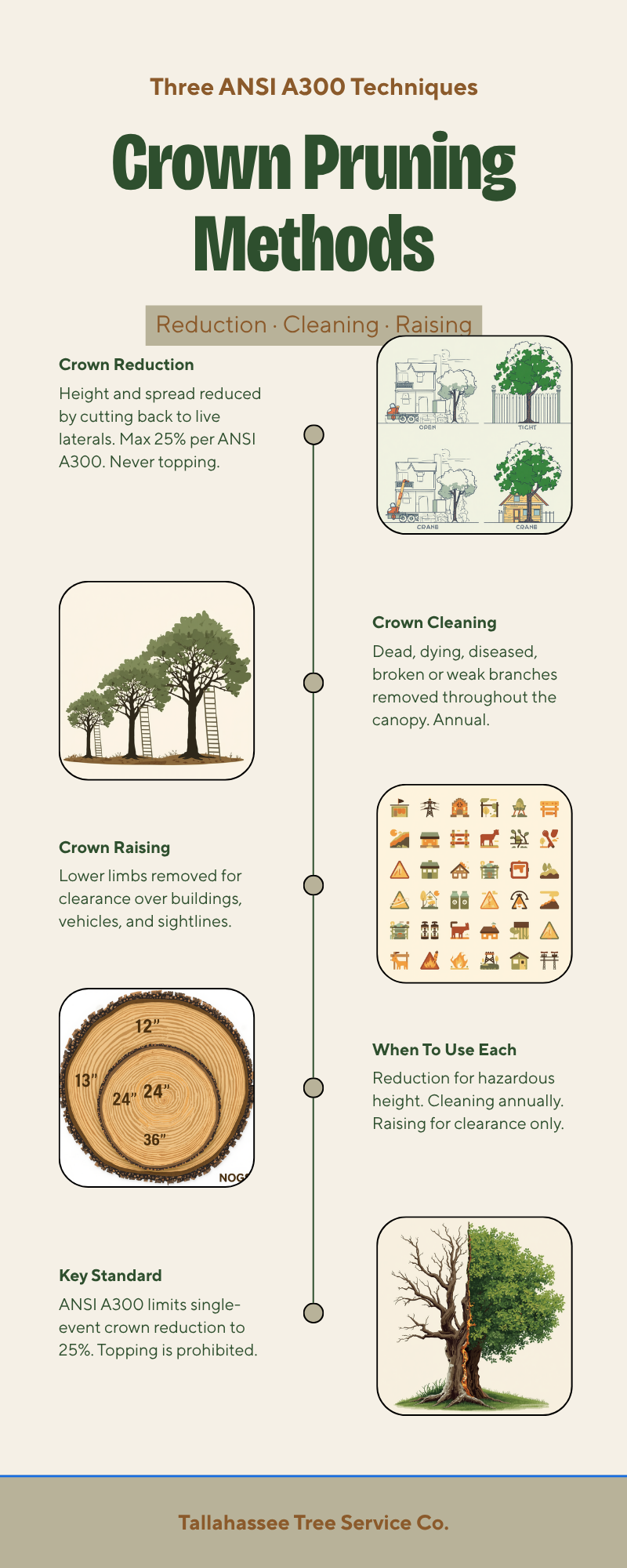
- Legitimate objectives: clean (deadwood and broken limbs), raise (lift the low canopy), reduce (shorten limbs back to laterals), thin (reduce density), structure (fix form on a younger tree).
- Not objectives: topping and lion-tailing. Both sit outside the standard entirely.
On a water oak, reduction is done by drop-crotch cuts — shortening a limb back to a lateral branch at least a third the diameter of the wood being removed, so the tree still has a leader to push growth through. Topping instead of reducing turns a heavy limb into a cluster of weakly attached sprouts, and on a species that already decays fast, that is a countdown. Read the case against it on the topping alternatives page.
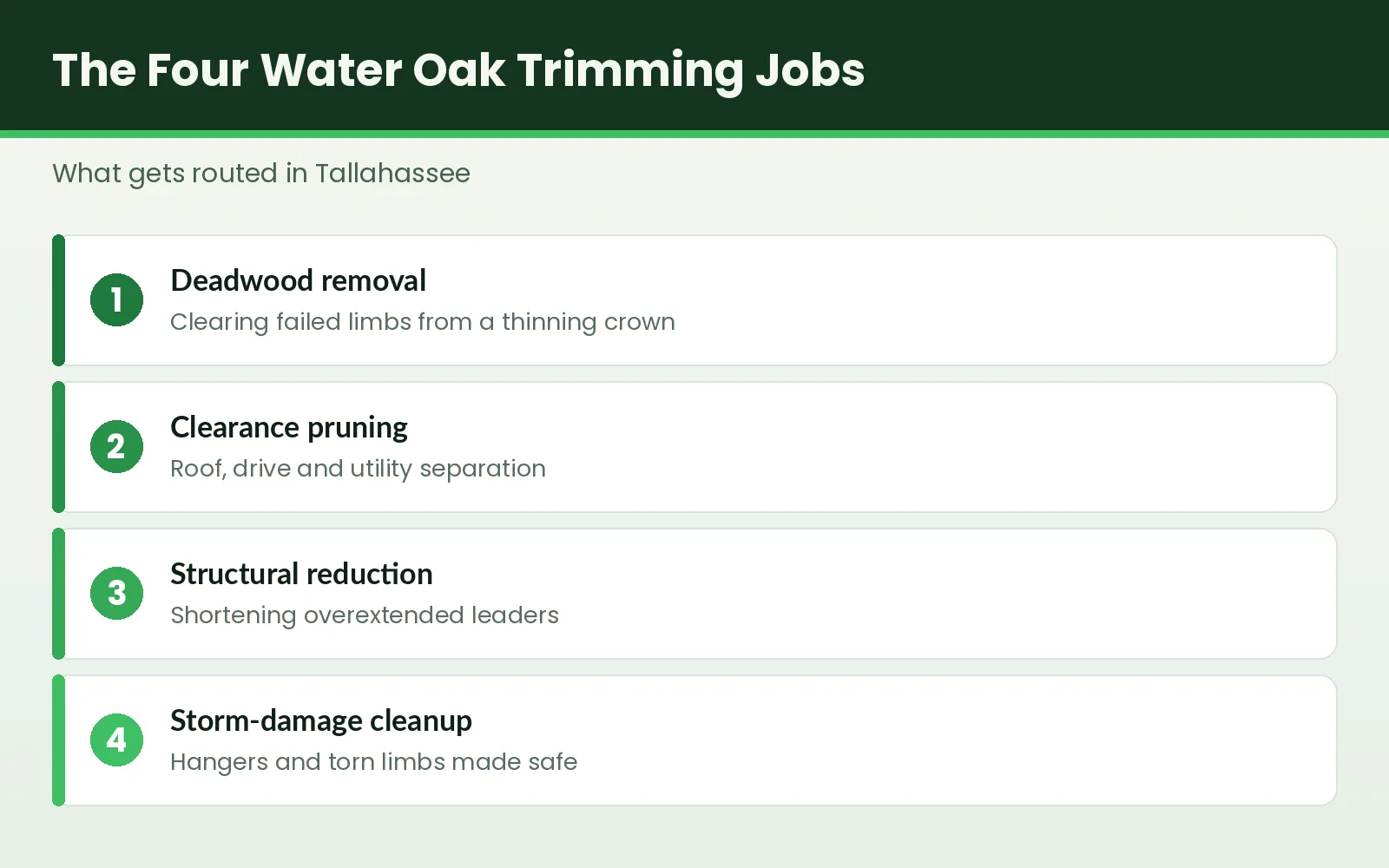
The four water oak jobs we route in Tallahassee
Deadwood and hangers
The most common request. Dead leaders in the top, a broken hanger caught in the canopy after a summer squall, a limb over the driveway shedding twigs. The right approach reads the whole tree, not just the limb you pointed at — a water oak dropping deadwood in one quadrant is often telling you something about the root plate on that side.
Structural pruning on a young or maturing tree
Between roughly 15 and 30 years old, a water oak can still be corrected. Pick the dominant leader, remove the competing co-dominant stem, take out the included-bark unions while the cuts are small enough to seal. This is the cheapest tree work you will ever buy and it is the reason a tree makes 70 years instead of 40.
End-weight reduction before storm season
Aim for it before June. Shortening the tip-heavy laterals and pulling deadwood cuts the sail area and the lever arm at the same time. It does not make the tree hurricane-proof; it removes the parts most likely to end up in your living room.
Hazard limbs over the house
A big lateral over a bedroom roof on a 65-year-old water oak with a suspicious union is a case-by-case call. Sometimes the answer is reducing the limb. Sometimes it is cabling — see cabling and bracing. Sometimes the honest answer is that the tree has aged out and a water oak removal is the safer money. A pro who tells you which is which without upselling is the one you want, and a formal risk assessment puts it in writing.
Limb already touching the roof, or a fresh crack at a branch union? That is a priority-dispatch situation, not a scheduled trim.
📞 Call Now — (858) 319-0022Vetted local pros — availability depends on independent provider schedules and demand.*How getting matched works
What drives the scope of a water oak prune
There is no flat rate for a tree. These are the factors that move the number — the pro you are matched with walks the canopy and gives the binding written quote:
| Factor | Why it matters on a Tallahassee water oak |
|---|---|
| Objective | Deadwood-only is a fraction of a full structural reduction. Say which one you want. |
| Size and spread | A 70-ft water oak with a 50-ft spread is a climb-and-rig day, not an afternoon. |
| Decay present | Hollow unions change the rigging plan — nothing gets tied off to wood that cannot hold. |
| Proximity to roof or lines | Every piece over a structure gets lowered on rope instead of dropped. |
| Access | No chipper path to the back yard means everything walks out by hand. |
| Debris volume | Water oak throws a lot of wood. Chipping on site versus hauling changes the day. |
Typical local-market ranges — not our prices — are laid out on the Tallahassee tree trimming cost page.
Before you call — how to describe your oak
- Deciduous or not. “It drops all its leaves in February” tells the arborist it is a water oak before anyone sets foot on the property.
- What you have noticed. Dead limbs in the top, mushrooms at the base, a crack where two trunks meet, sawdust, a limb that dropped last month.
- The target. Roof, driveway, fence, the neighbor’s car, a power drop through the canopy.
- The goal. Clearance off the roof, less weight before storm season, or just deadwood out.
If there is a service drop running through the branches, say so up front. Line-clearance work follows different rules and the utility may need to be involved first.
Frequently asked questions
Is my tree a water oak or a live oak?
If it goes completely bare in late winter, it is a water oak. Live oaks stay in leaf year-round, swapping foliage quickly in spring. Water oak leaves are small and spatula-shaped; live oak leaves are leathery and narrow. Water oak grows upright and fast; live oak spreads wide and slow.
How often should a water oak be pruned in Tallahassee?
A mature water oak generally does well on a five- to seven-year clean-and-structure cycle, with deadwood pulled as needed in between. Younger trees benefit from structural pruning every three to five years while the corrective cuts are still small.
When is the best time of year to trim a water oak?
Late fall through winter is the ideal window for structural work here. The tree is dormant, the canopy is bare so the structure is visible, and oak wilt risk from growing-season cuts is lower. Storm-driven deadwood and hazard limbs get handled whenever they appear.
Will an arborist top my water oak to make it shorter?
An ISA-certified arborist will refuse. Topping heads limbs back to stubs, which triggers weak sprout regrowth and decay at every cut — on a species that already decays fast, that is a hazard tree within a few years. Height reduction is done with drop-crotch cuts back to laterals instead.
Why do water oaks fail more than live oaks?
Weaker wood, faster decay from old wounds, and branch unions with included bark that pull apart under load. A 65-year-old water oak has usually accumulated far more interior weakness than a live oak of the same age, and it tends to fail suddenly rather than gradually.
When is a water oak past pruning?
When the trunk sounds hollow, when conks or mushrooms are fruiting at the base or on the trunk, when large limbs have already failed in past storms, or when the crown is thin and not fully re-leafing in spring. At that point a reduction only buys time, and an honest arborist will say so.
Related Tallahassee tree services
Oak Tree Trimming
Tree Pruning
Topping Alternatives
Water Oak Removal
Cabling & Bracing
Tree Risk Assessment
Hurricane Tree Prep
Tree Trimming Cost
Get the oak read before the next storm does
Call now and we’ll connect you with a vetted, ISA-certified Tallahassee arborist. Free to use, no obligation, no sign-up.
📞 Call Now — (858) 319-0022Tallahassee Tree Service is a free referral service. Tallahassee Tree Service is not a licensed tree service provider and does not directly provide tree care services. All work is performed by independent, licensed and insured third-party providers in your area. Calls and form submissions placed through this site may be connected with a participating provider, and you may be contacted by that provider regarding your request. Same-day, emergency, and 24/7 availability are not guaranteed and depend on provider schedules, location, and demand. Service availability, pricing, licensing, and final response times are determined solely by the providers. It is the responsibility of the homeowner to verify that the hired contractor furnishes the necessary license and insurance required for the work being performed. All persons depicted in a photo or video are actors or models and not contractors listed on Tallahassee Tree Service.