When to Remove a Tree in Tallahassee
Seven signs it needs to come down. Four signs it probably doesn’t. Call now and we’ll connect you with a vetted, ISA-certified local arborist who’ll give you a documented answer — from Killearn to Lake Jackson to Crawfordville.
📞 Call Now — (858) 319-0022Free to use, no obligation — the arborist gives the quote after the assessment.Tree removal is the highest-stakes decision a Tallahassee homeowner makes about their property’s canopy. Done right, it removes a genuine hazard before it becomes a crisis. Done wrong, it permanently eliminates a tree that could have been saved — and in a city where a 100-year-old live oak cannot be replaced on any reasonable timeline, that loss is irreversible. This guide gives you the signs ISA-certified arborists actually use to separate “this needs to come down” from “this can be managed” — written for the trees that grow here: the live oaks of Killearn Estates and Myers Park, the laurel oaks reaching the end of their lifespan, the slash pines east of the Cody Scarp, and the water oaks that took the worst of Hurricane Idalia in 2023.
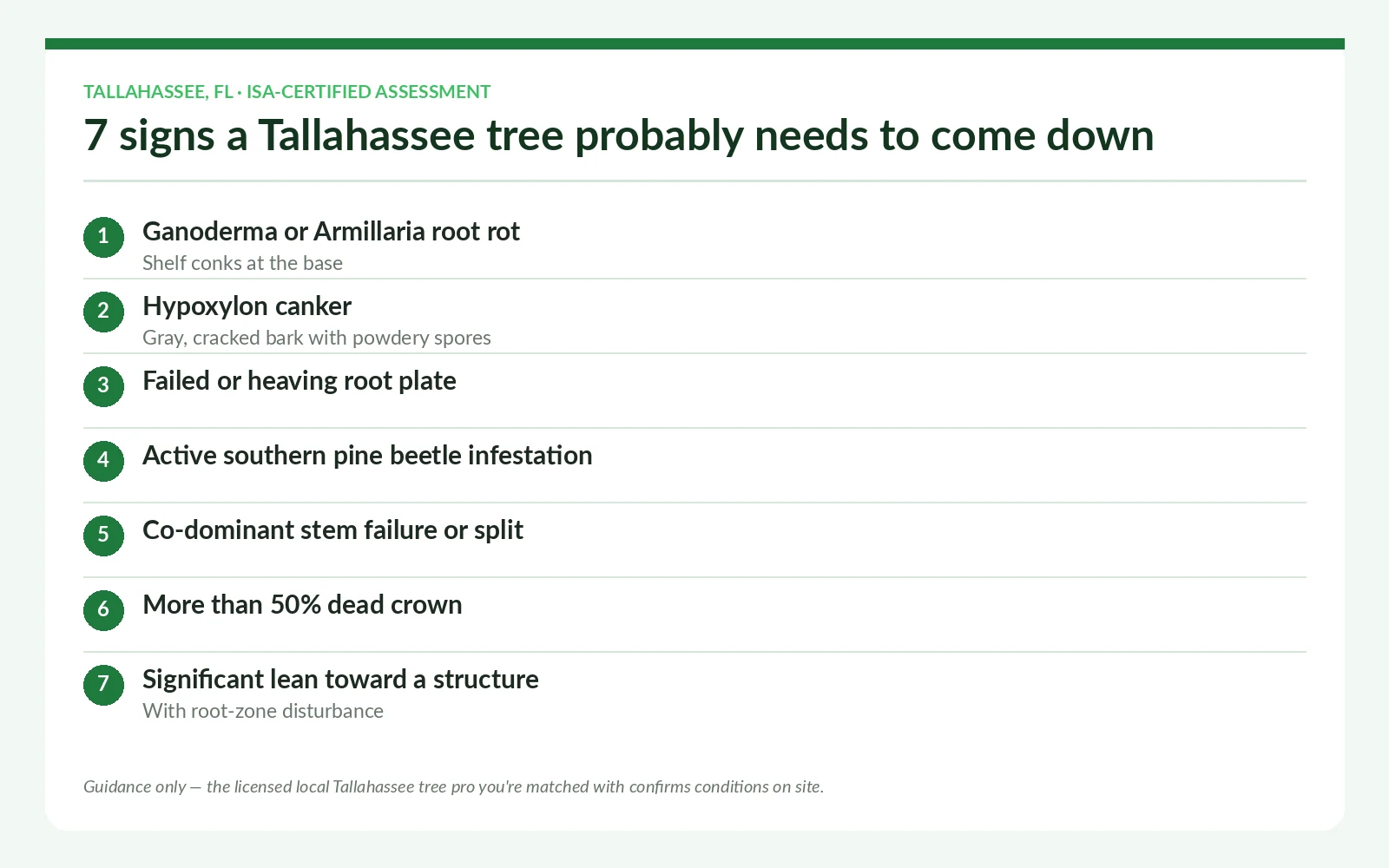
7 signs a Tallahassee tree probably needs to come down
1. Ganoderma or Armillaria root rot — shelf conks at the base
A large shelf-like conk at the base — reddish-brown on top, white underneath — is almost always Ganoderma causing white rot of the structural roots. It destroys the lignin that gives wood tensile strength, turning structural roots to pulp while the tree above looks healthy. By the time a conk is visible externally, serious internal damage has already happened. Common on aging water oaks and sweetgums in Betton Hills, Myers Park, and older Lake Jackson sections. Within falling distance of a structure, this calls for an urgent TRAQ-qualified assessment, not watch-and-wait.
2. Hypoxylon canker — gray, cracked bark with powdery spores
Hypoxylon (Biscogniauxia atropunctata) moves in on trees already stressed by drought, root damage, or compaction: grayish crusty patches slough off to reveal bronze or silver spore masses. There is no fungicide treatment — it’s terminal. It’s the most common reason water oaks and laurel oaks fail in Killearn Estates, Betton Hills, and Myers Park, where the 1965–early-80s plantings are now deep in the 40–60-year failure window arborists call the “Killearn wave.”
3. Failed or heaving root plate
Soil cracking, lifting, or heaving near the base — especially on the side away from a lean — means the root plate is actively failing. This is an emergency-level indicator: a heaving root plate can complete its windthrow in minimal wind. Common after prolonged wet spells on Lake Jackson waterfront lots and low-lying Killearn Lakes parcels, and on big water oaks anywhere lateral roots were cut by driveway, pool, or utility work inside the drip line. Call now now — this one doesn’t wait in the normal queue.
4. Active southern pine beetle infestation
A slash or longleaf pine with pitch tubes (popcorn-like resin masses), running pitch streaks, and crown fade from green to yellow-orange-red is a removal priority, not a treatment candidate. FDACS monitoring showed elevated SPB pressure across North Florida in 2023–2024. Removing an infested pine before beetles spread to neighboring pines is the single most effective management step — and material should be chipped on-site. Full ID guide: southern pine beetle in North Florida.
5. Co-dominant stem failure or split
Where two co-dominant stems meet with included bark, the union is structurally weak — and once it has partially split or cracked open, the remaining wood is in ongoing failure. Many Killearn Estates and Myers Park live oaks carry 40-inch co-dominant stems over bedrooms that were never structurally pruned in their first 20 years. Idalia took down dozens of these unions across the Big Bend.
6. More than 50% dead crown
A tree with over half its crown dead is signaling root or vascular failure. Deadwood itself is normal and manageable — an advancing dead-crown front is not. Laurel oaks (40–60-year lifespan per UF/IFAS ST549, vs 200+ for live oak per ST564) across Killearn Estates, Betton Hills, and older SouthWood are showing exactly this pattern now.
7. Significant lean toward a structure — with root-zone disturbance
A lean alone is not a removal ticket; many Tallahassee live oaks have leaned safely for fifty years from sun-tracking growth. The alarming combination is a recent lean plus root-zone construction history or any root-plate heaving. Lean without disturbance is worth an assessment, not automatic removal.
See one of the seven signs on your tree? Get a documented answer — and the paperwork a City or County removal permit requires if it warrants removal.
📞 Call Now — (858) 319-0022Emergencies route to the on-call network 24/7 — availability depends on conditions and provider schedules.4 situations where removal is probably the wrong answer
1. “It drops a lot of leaves, acorns, or debris”
Live oak leaf drop (heaviest in spring, not fall), acorns, and general canopy litter are the tree functioning normally. Removing a healthy 80-year-old live oak because it drops leaves on your car is the most common misuse of removal in Tallahassee — and one an ISA arborist will flag as an unnecessary permit application. Gutter guards cost less than an irreplaceable tree.
2. “It’s blocking my view or shading my garden”
Canopy elevation and selective crown thinning handle most shade and view-line concerns without removal — see ANSI A300-standard pruning. Removing a healthy protected tree for aesthetics also requires a City permit, involves a waiting period, and is likely to be denied for patriarch-scale specimens.
3. Surface roots are lifting the sidewalk or driveway
Frustrating and expensive, but rarely a tree-health or structural hazard. Root barriers, permeable-paving redesign, or targeted root pruning by an ISA arborist usually solve it. Removing a 60-year-old live oak to protect a concrete driveway is almost never the right economic or ecological call — City Urban Forestry, (850) 891-6500, has hardscape-compatible design resources. More: tree roots vs foundations and sidewalks.
4. There’s deadwood in the crown
Interior deadwood is normal in big live oaks. It becomes a concern only when individual dead limbs are large and positioned over targets, or when it’s extensive enough to signal systemic decline (see sign 6). Standard crown cleaning removes the risk without touching the live crown — a trimming job, not a removal.
What an ISA-certified arborist actually assesses
- Root zone: heaving, cracks, plate lift, construction-cut evidence. West of the Cody Scarp (Killearn, Bull Run, Midtown, Myers Park) compaction patterns show in red Orangeburg clay; east of it (SouthWood, Buck Lake, Bradfordville, Woodville) root-plate failure presents differently in sandy flatwoods soil.
- Trunk and bark: cankers, cavities, Ganoderma/Hypoxylon fruiting, cracks, seams, basal decay — assessed visually and by sounding. Lightning scars are routine here: Tallahassee sees roughly 80–100 strikes per square mile per year, among the highest in the continental US per NWS.
- Crown: deadwood percentage, dieback pattern, leaf density and color, chlorosis, tip dieback.
- Structure: co-dominant stems, included bark, crown asymmetry, and damage from past bad pruning (lion-tailing, topping, flush cuts).
- Targets: what would actually be struck, from which direction — TRAQ explicitly weights target occupancy. A big tree over open lawn is a different risk than the same tree over a master bedroom.
For patriarch candidates or permit-threshold trees, the written ISA report becomes the primary permit document. Arborists in this network produce that report as a standard deliverable whenever removal documentation is required.
Permits: city vs county in 60 seconds
Inside city limits, City of Tallahassee LDC §5-83 requires a permit for protected and patriarch trees (36-inch DBH threshold for live oak). In unincorporated Leon County, §10-4.362 sets a 12-inch DBH threshold for live oak and longleaf pine and 4-inch for dogwood. Hazard trees with an imminent-threat ISA report may qualify for the Fla. Stat. §163.045 exemption. Killearn Estates is city; Killearn Lakes is mostly county; Crawfordville (Wakulla) and Monticello (Jefferson) run separate frameworks. Full breakdown: the Tallahassee tree permit guide.
When to remove a tree in Tallahassee — FAQ
How do I know if my tree needs to be removed?
An ISA-certified assessment is the only reliable call. The urgent visible signs: shelf conks at the base, gray cracked bark with powdery spores, heaving soil at the root plate, 50%+ dead crown, split co-dominant unions, and a recent lean combined with root-zone disturbance. Any one of these within striking distance of a home warrants assessment now.
What does an arborist assessment cost?
It varies with scope: a basic visual inspection with a written report costs less than a TRAQ-qualified risk assessment with permit-grade documentation. Providers in this network often credit the assessment toward the removal if the work proceeds with the same crew — ask when you’re connected.
Do I need a permit to remove a tree in Tallahassee?
Depends on jurisdiction: City LDC §5-83 for protected/patriarch trees inside city limits; Leon County §10-4.362 (12-inch DBH live oak/longleaf, 4-inch dogwood) in the unincorporated county; §163.045 exemption possible for documented hazard trees.
Is Hypoxylon canker treatable in oaks?
No. There is no fungicide that reverses or halts it. Once the gray patches and spore masses are visible, xylem damage is advanced. Affected oaks near structures should be assessed and typically removed before the next storm season.
Will homeowner’s insurance pay to remove a hazard tree?
Standard Florida policies usually don’t cover preventive removal — it’s treated as maintenance. Coverage typically starts after a tree falls on a covered structure. A written ISA risk assessment can support post-loss claims; review your policy before assuming coverage.
How long can a leaning tree stand before it fails?
No reliable timeline exists. A sun-tracking lean on a healthy live oak can stand for decades; a new lean with upslope soil cracking or root cutting can complete windthrow within hours of the next storm. Root-zone integrity, not lean angle, is the qualifier.
What’s the best time of year for a removal?
For non-emergencies, January–March: firm ground, leafless deciduous crowns, and done before hurricane season. For trees showing any of the seven signs above, don’t wait for a season — get it assessed immediately.
Related Tallahassee tree resources
Tree inspection
Hazardous tree removal
Dead tree removal
Tree permit guide
Emergency tree service
Southern pine beetle
Laurel oak problems
Live oak care
Tree trimming
Primary sources: UF/IFAS EDIS ST549 (laurel oak) and ST564 (live oak); ISA TRAQ methodology and ANSI A300 standards; FDACS Florida Forest Service SPB monitoring 2023–2024; City of Tallahassee LDC §5-83, Urban Forestry (850) 891-6500; Leon County §10-4.362, Development Services (850) 606-1300; NWS Tallahassee lightning data. Regulatory data current through April 2026.
Get a documented answer on your tree.
Call now and we’ll connect you with a vetted, ISA-certified Tallahassee arborist. If removal is warranted, the written report becomes your permit application document. Free to use, no obligation, no sign-up.
📞 Call Now — (858) 319-0022Tallahassee Tree Service is a free referral service. Tallahassee Tree Service is not a licensed tree service provider and does not directly provide tree care services. All work is performed by independent, licensed and insured third-party providers in your area. Calls and form submissions placed through this site may be connected with a participating provider, and you may be contacted by that provider regarding your request. Same-day, emergency, and 24/7 availability are not guaranteed and depend on provider schedules, location, and demand. Service availability, pricing, licensing, and final response times are determined solely by the providers. It is the responsibility of the homeowner to verify that the hired contractor furnishes the necessary license and insurance required for the work being performed. All persons depicted in a photo or video are actors or models and not contractors listed on Tallahassee Tree Service. Fungal and pest identification sourced from UF/IFAS EDIS and FDACS forest health monitoring; permit thresholds reflect City LDC §5-83, Leon County §10-4.362, and Fla. Stat. §163.045 current through April 2026.