
Every spring, Tallahassee homeowners with mature live oaks see the same thing happen: the canopy thins, leaves carpet the driveway, and for about three weeks the tree looks half-dead. Then it pushes new growth and looks fine. Spring leaf drop on live oak (Quercus virginiana) is the single most-misunderstood normal event in North Florida tree biology, and it generates more “is my tree dying?” calls to ISA-certified arborists than any other concern. Here’s the biology, the timing, what’s normal across Killearn, Midtown, Myers Park, and Betton Hills, and the small set of symptoms that genuinely warrant a professional look.
Live Oaks Are Evergreen — Until They Aren’t
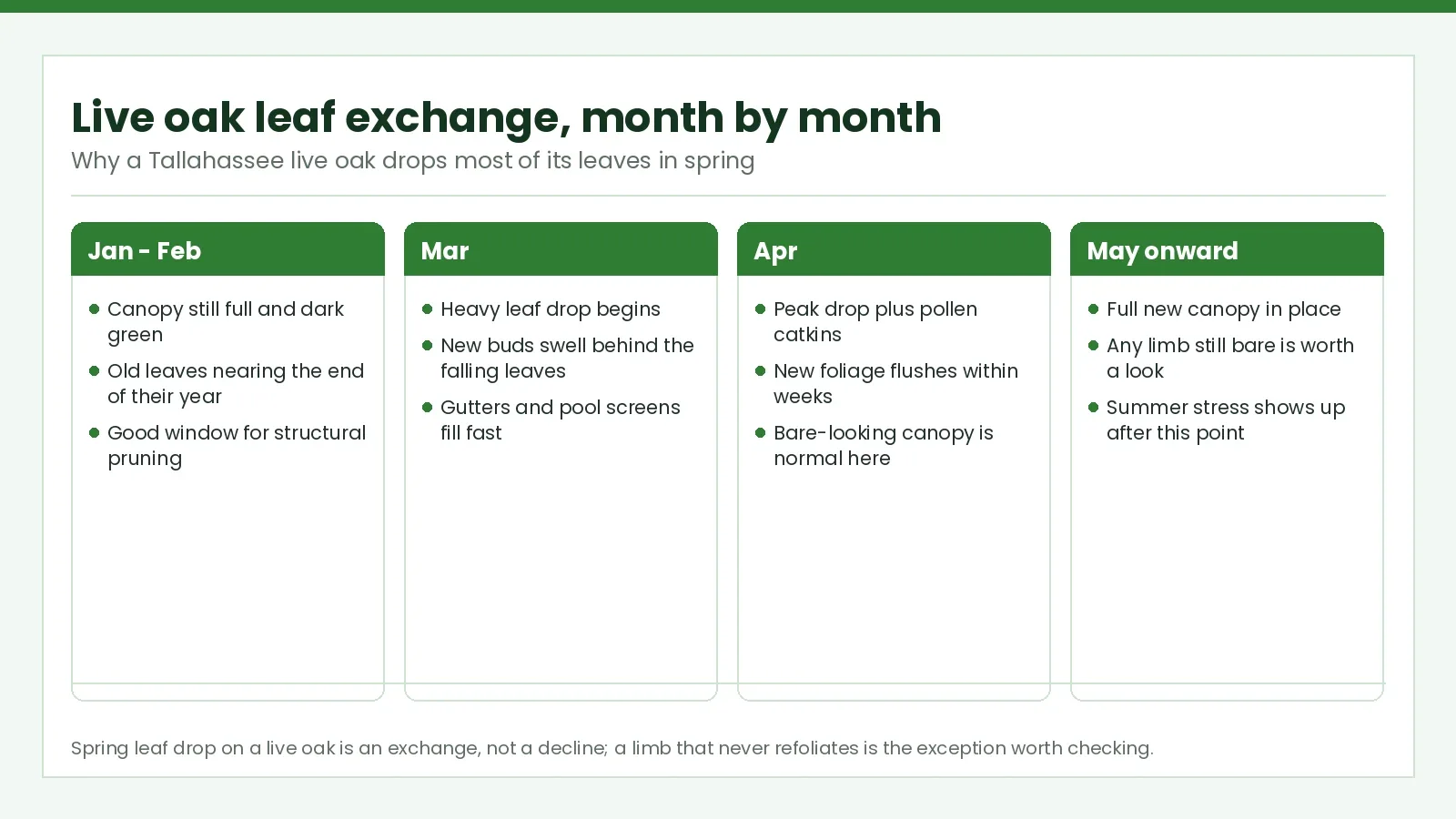
Live oak is technically classified as evergreen because it holds leaves year-round in most years. What actually happens, however, is that the tree exchanges nearly its entire previous-year leaf cohort during a 2–4 week window in late winter to early spring. In Tallahassee that window typically runs late February through early April, sometimes pushing into mid-April after a cold winter that delayed bud break. For a brief period the canopy can look almost bare. By the end of April or early May the tree is fully leafed out again with the new year’s foliage.
This is not a stress response, not a disease symptom, and not a sign of root or trunk problems. It is normal phenology — the same kind of event a deciduous tree does in autumn, just shifted by season and stretched over a short window. UF/IFAS EDIS publication ST564 (Quercus virginiana fact sheet) documents this exact pattern for North Florida live oaks. If you see it, the tree is doing what live oaks do.
Storm damage or a tree on your house? Call now.
Stay out of rooms under the tree and keep clear of downed lines — report those to the power company first. Then call and we’ll connect you with a local tree crew that handles storm work.
📞 Call (858) 319-0022Free 24/7 dispatch line · availability varies by storm volume
What Spring Leaf Drop Looks Like in Tallahassee
The pattern is recognizable once you’ve seen one cycle. In late February, leaves begin yellowing across the canopy — not localized to one branch, but distributed evenly. Over the next two to three weeks, leaves fall in volume. A mature 60-inch DBH live oak can drop several cubic yards of leaves in this window. Simultaneously, new bud break begins; if you look at branch tips during the drop, you’ll see new leaves emerging and old leaves falling at the same time.
The species is also producing pollen and small flowers (catkins) during this window. The yellow pollen dust on cars and patio furniture in March is largely live oak and laurel oak pollen. By the end of the window, the canopy is uniformly green with fresh, smaller, lighter-colored leaves that darken through summer. Across Tallahassee’s Canopy Roads — Old Bainbridge, Centerville, Miccosukee — the drop is visible at scale; entire stretches of road become leaf-carpeted before the new canopy fills in.
Spring Leaf Drop vs. Real Problems
The diagnostic line between normal spring drop and a genuine problem comes down to timing and pattern. Normal spring drop is even across the entire canopy, finishes by late April or early May, and is followed by full leaf-out. Problems show different patterns:
Crown dieback that doesn’t recover. If sections of the canopy remain bare through May and June while the rest of the tree has leafed out, that section is not participating in spring drop — it’s dead or dying. This warrants an ISA-certified arborist assessment to find the cause (root damage, structural failure, decay, Hypoxylon canker).
Localized leaf scorch in summer. Brown, dry leaves on one limb during the growing season — months after spring drop — is a different signal. It can indicate oak wilt (rare in North Florida but documented at the regional scale), root damage from construction, or lightning injury.
Premature defoliation. Heavy leaf drop in June, July, or August is not spring drop. Causes include drought stress, root rot, sudden environmental change (compaction, grade fill), or pest pressure. See our live oak care guide for the full diagnostic walk.
What to Do During the Drop Window
For most homeowners, nothing. Rake leaves to compost or use them as natural mulch. Live oak leaves are slow-decomposing and excellent mulch — they retain moisture and suppress weeds. A 4–6 inch mulch ring around the dripline (pulled back from the trunk by at least 6 inches — never volcano-mulch) is the single best thing you can do for the tree.
Do not prune during the spring drop. Live oak pruning in Tallahassee is best performed July through August or November through January per ANSI A300 timing for the species. Spring pruning during active leaf-out creates wounds at the moment beetles and fungal spores are most active. See the timing calendar in our Tallahassee tree pruning guide.
Do not fertilize routinely. Healthy live oaks rarely need supplemental nitrogen. Over-fertilization can drive flush growth that’s structurally weak. Soil testing through UF/IFAS county extension is the right first step if you suspect a nutrient deficiency.
When to Call an ISA Arborist
Spring leaf drop itself never warrants a call. The legitimate reasons to bring in an ISA-certified arborist during or around the spring window are: visible shelf fungi (Ganoderma) at the base or root flare, a new lean that wasn’t there last year, bark seams or vertical cracks in the trunk, visible cavities, recent construction within 30 feet of the trunk, or canopy thinning that doesn’t recover by Memorial Day. Each of those is a structural or pathological signal that deserves professional eyes.
Authority reference: UF/IFAS EDIS publishes Florida’s authoritative tree-care fact sheets, including ST564 on live oak biology and management for North Florida.
Mature Live Oak in Tallahassee? Get Connected With an ISA-Certified Arborist
The arborists in our network specialize in Tallahassee’s heritage live oaks across Killearn, Midtown, Myers Park, Betton Hills, and the Canopy Roads. Pruning recommendations, root-zone evaluation, structural review, and permit guidance from the arborist you’re matched with.
Call now on our homepage to be connected with an ISA-certified local arborist for a live oak assessment — dispatch coordination is available Mon–Sat 7am–7pm; actual on-site scheduling depends on the independent provider’s availability and is not guaranteed.
Frequently Asked Questions
When do live oaks drop their leaves in Tallahassee?
Late February through early April, depending on winter weather. The drop is concentrated in a 2–4 week window during which the tree simultaneously sheds old leaves and pushes new ones. By late April or early May the canopy is fully leafed out again.
Is heavy leaf drop a sign my live oak is dying?
Almost never. Live oak is technically evergreen but exchanges nearly its entire leaf cohort each spring. Heavy, even drop across the canopy in late February through April is normal. Heavy drop concentrated to one limb, or drop in summer months, is a different signal.
Should I prune my live oak during spring leaf drop?
No. The right pruning windows for Tallahassee live oaks are July–August (best) and November–January. Pruning during active spring leaf-out creates wounds when beetles and fungal spores are most active.
Can I use the fallen live oak leaves as mulch?
Yes — live oak leaves are excellent slow-decomposing mulch. A 4–6 inch ring around the dripline retains soil moisture and suppresses weeds. Pull mulch back at least 6 inches from the trunk; never volcano-mulch.
What should I do if my live oak doesn’t leaf out fully by May?
Schedule an ISA-certified arborist assessment. Crown dieback that doesn’t recover after spring drop is the diagnostic signal that warrants professional investigation — possible causes include root damage, structural decay, Hypoxylon canker, or construction impact within the critical root zone. See our tree risk assessment page for the inspection protocol.