Pecan Tree Care in Tallahassee, FL
Leaves dropping in August, sap-sticky cars every June, a 70-year-old giant with a split fork leaning over the kitchen — call now and we’ll connect you with a vetted, ISA-certified local arborist who knows pecans as both orchard heritage and the yard tree that needs watching.
📞 Call Now — (858) 319-0022Old pecan over the house? A structural look before storm season is the smart order of operations.Pecans are Big Bend heritage. The old homesteads across Leon and Jefferson counties — Monticello styles itself pecan country for a reason — planted them a century ago, and the trees are still here: 80-foot giants shading half a backyard, still throwing nuts in the good years. In the deep red-clay and alluvial soils north and east of town, a healthy pecan can outlive everyone who ever picked under it.
They’re also, of all the big trees in Tallahassee yards, the one that earns the most mixed feelings. Pecan wood is brittle. The classic old-tree architecture — two or three massive co-dominant trunks with included bark in the crotch — is exactly the structure that fails in summer thunderstorms. And the species hosts a full cast of harmless-but-annoying tenants: scab fungus, honeydew-dripping aphids, webworms, and squirrels running a full-time nut heist. Knowing which problems are cosmetic, which are cultural, and which are structural is the whole art of pecan care here.
The annual pecan complaints — and what they actually mean
August leaf drop: pecan scab
A pecan raining blackened leaves in late summer almost always has scab — the fungal disease that defines pecan growing in the humid South. On susceptible old varieties it strips foliage and blackens shucks in every wet year. Orchards fight it with spray towers; that’s not realistic over a house, so residential management is cultural: rake and dispose of infected leaves and shucks, thin the canopy for airflow, and accept that an old susceptible tree will have ugly late summers. It stresses the tree over decades rather than killing it outright — and if you ever replant, scab-resistant cultivars like Elliott, Sumner, and Caddo make the whole problem optional.
June drip: aphid honeydew
The sticky film on cars and patios under a pecan is honeydew from black-margined and yellow pecan aphids feeding overhead — followed shortly by black sooty mold growing on the sugar. It looks terrible and hurts almost nothing. Where the mess is intolerable, a properly timed systemic treatment gives season-long control; where it’s tolerable, natural predators usually catch up by midsummer.
Late-summer webs: fall webworms
The silk tents at branch tips in August and September are webworms eating the leaves inside the web. On a mature tree it’s cosmetic — the season’s photosynthesis is mostly banked. A pole-pruner can pull reachable webs; spraying a whole 80-footer is rarely justified.
The every-other-year crop
Alternate bearing is built into the species: a heavy mast year drains reserves, the next year runs light. It’s biology, not a deficiency — though genuinely poor filling across multiple years can point to zinc deficiency, the classic pecan nutrition gap, which shows as bunched, undersized leaflets (“rosette”) and is fixable.
The conversation that matters: old pecans and storm risk
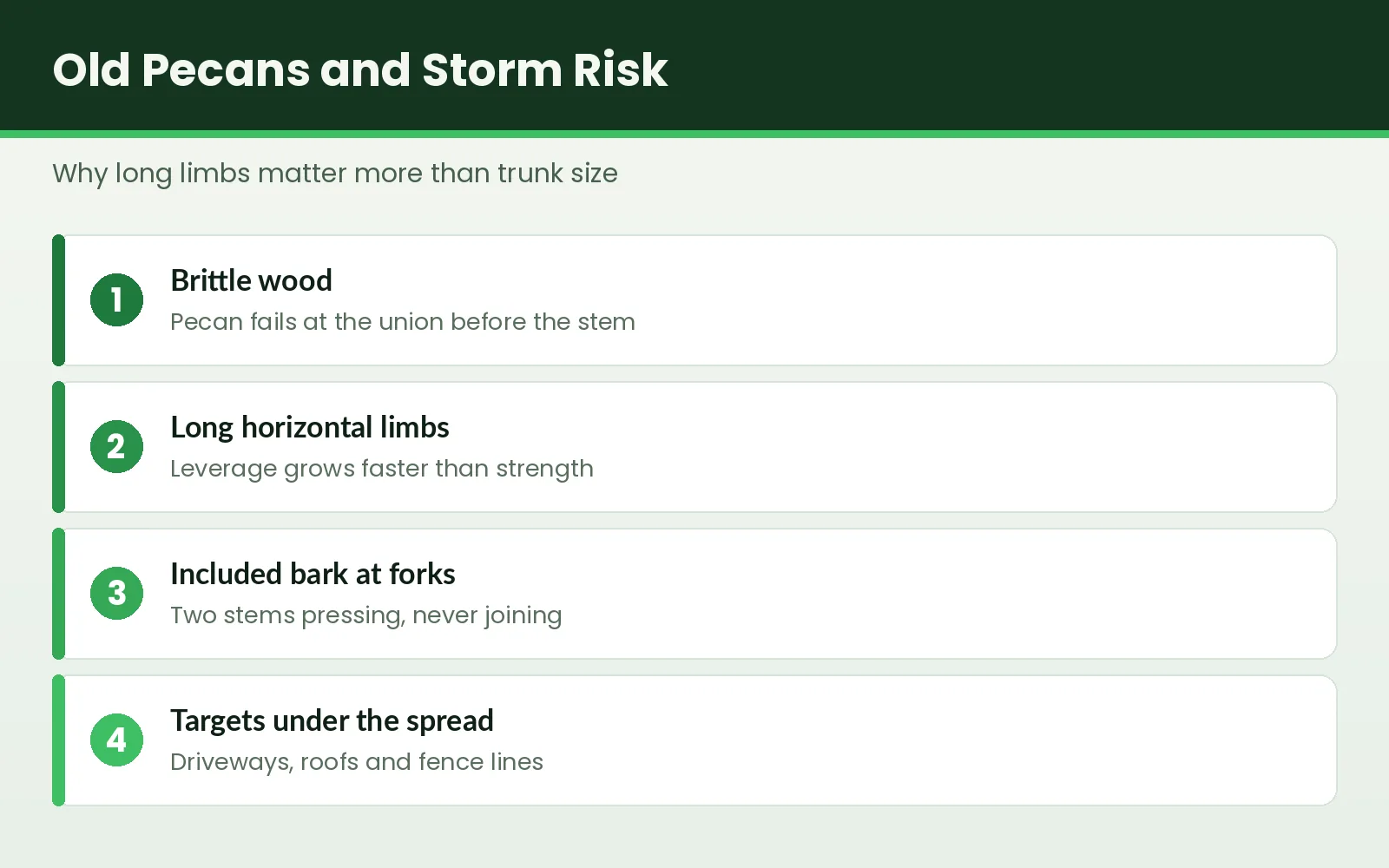
Here’s the honest part. Pecan wood is brittle, the limbs are enormous, and decades of nut-harvest pruning left many old trees with narrow, bark-included forks. In a July thunderstorm downburst — never mind a named storm — a loaded pecan limb over the roof is one of the higher-consequence failures in a Tallahassee yard. The pattern to respect:
- Co-dominant leaders with included bark — two trunks squeezing a seam of bark in the fork. The seam has no wood connection; it’s a pre-made crack.
- Long horizontal limbs over targets — pecan limbs run heavy and far; end-weight over a roof or driveway is leverage waiting on wind.
- Old topping wounds and cavities — decades-old cuts that never closed become hollow anchor points for exactly the limbs you least want failing.
None of this means every old pecan should come down — most shouldn’t. It means a mature pecan near a house deserves a real risk assessment and, where warranted, end-weight reduction, deadwooding, or cabling and bracing on the big forks — done in the dormant window, before June. That’s the highest-value money a pecan owner spends. See the hurricane tree prep guide for how it fits the pre-season calendar.
What drives the scope of a pecan job
The arborist you’re matched with scopes your specific tree and puts it in a written quote before any work starts. On pecans, these move the number:
| Factor | Why it matters for pecans |
|---|---|
| Sheer size | Mature pecans run 70–100 feet with wide, heavy limbs — big-tree rigging, not a ladder job. |
| Structural work vs. cleanup | Cabling a split-prone fork or reducing end-weight over a roof is engineering; pulling webworm tents is an hour. |
| Targets below | House, driveway, pool, neighbor’s fence — controlled lowering over targets multiplies crew time. |
| Wood volume | Pecan removals generate serious tonnage; hauling vs. on-site processing changes the math. |
| Access | Old backyard pecans often predate the fences around them — equipment path or hand-carry decides the day. |
Fork starting to split, or a big limb hanging after a storm? Keep everyone out from under it — that’s a priority-dispatch situation.
📞 Call Now — (858) 319-0022Vetted local pros — availability depends on independent provider schedules and demand.*How getting matched works
When to prune a pecan in Tallahassee
Dormant season — December through February — is the pecan window: structure is visible with the leaves down, cuts seal ahead of the growing season, and the work lands before spring storms. Young pecans repay early structural pruning more than almost any tree; building one dominant leader in the first 15 years prevents the co-dominant fork problem the tree would otherwise carry for the next century. On old trees, dormant-season deadwooding and end-weight reduction — never topping — is the standard. A topped pecan regrows fast, weakly attached, and more dangerous than before; see why topping backfires.
Removal, permits, and what an old pecan is worth keeping for
When a pecan does reach the end — hollow main fork, major limb failures, more deadwood than crown — removal is a heavy-equipment day, and inside the city it generally needs a permit first; pecans aren’t on the protected list, but the ordinance’s size threshold catches essentially every mature one. Start with the Tallahassee tree permit guide, then scope the removal and the stump grinding together — pecan stumps are wide and sucker if left. But get the assessment before the removal quote: plenty of “scary” pecans are structurally sound trees having a normal scab year, and a good arborist will say so.
Frequently asked questions
Why does my pecan drop leaves every August?
Pecan scab — the South’s defining pecan fungus — strips susceptible varieties in wet summers. On a yard tree, cultural management (rake and remove fallen leaves and shucks, thin for airflow) is the realistic play; full spray programs belong to orchards with towers.
How do I stop the sticky drip on everything under my pecan?
That’s aphid honeydew, and the black film that follows is sooty mold growing on it. It’s harmless to the tree; where the mess matters, a properly timed systemic treatment gives season-long control.
Are pecan trees dangerous near houses?
They deserve more respect than most species: brittle wood, huge limbs, and the old co-dominant, bark-included forks that split in storms. A risk assessment plus dormant-season structural pruning — or cabling on a valuable tree — manages most of it.
Why does my pecan only make nuts every other year?
Alternate bearing — a heavy crop year exhausts reserves, so the next runs light. It’s normal pecan biology. Consistently empty or poorly filled nuts across years is a different problem, often zinc nutrition, and worth a look.
What are the big webs on my pecan’s branches?
Fall webworms. They’re cosmetic on a healthy mature tree — pull the reachable tents with a pole pruner if the look bothers you, and skip whole-tree spraying.
How long do pecan trees live here?
On the deep soils of Leon and Jefferson counties, 150 years is ordinary and older is common — many of the region’s homestead pecans date to the early 1900s and still bear. Structure, not age, is usually what decides when one comes down.
Do I need a permit to remove a pecan in Tallahassee?
Almost always inside the city — mature pecans are far past the ordinance’s size threshold. Check the permit guide or let the arborist you’re matched with flag it before scheduling.
Related Tallahassee tree services
Tree Removal
Tree Pruning
Cabling & Bracing
Tree Risk Assessment
Hurricane Tree Prep
Stump Grinding
Tree Permit Guide
Dogwood Tree Care
A century-old tree deserves a real assessment, not a guess.
Call now and we’ll connect you with a vetted, ISA-certified Tallahassee arborist who reads pecan structure honestly. Free to use, no obligation, no sign-up.
📞 Call Now — (858) 319-0022Tallahassee Tree Service is a free referral service. Tallahassee Tree Service is not a licensed tree service provider and does not directly provide tree care services. All work is performed by independent, licensed and insured third-party providers in your area. Calls and form submissions placed through this site may be connected with a participating provider, and you may be contacted by that provider regarding your request. Same-day, emergency, and 24/7 availability are not guaranteed and depend on provider schedules, location, and demand. Service availability, pricing, licensing, and final response times are determined solely by the providers. It is the responsibility of the homeowner to verify that the hired contractor furnishes the necessary license and insurance required for the work being performed. All persons depicted in a photo or video are actors or models and not contractors listed on Tallahassee Tree Service.