Tallahassee is defined by its tree canopy. The live oaks arching over Old St. Augustine Road and the laurel oaks shading neighborhoods across Leon County are not just scenery; they are working habitat. For the people who pay closest attention to that habitat, the canopy is a year-round food source, nesting site, and migration stopover for dozens of native bird species. Caring for those trees well, and knowing when not to cut, is part of keeping the canopy healthy for the birds that live in it.
Why mature canopy oaks matter for birds
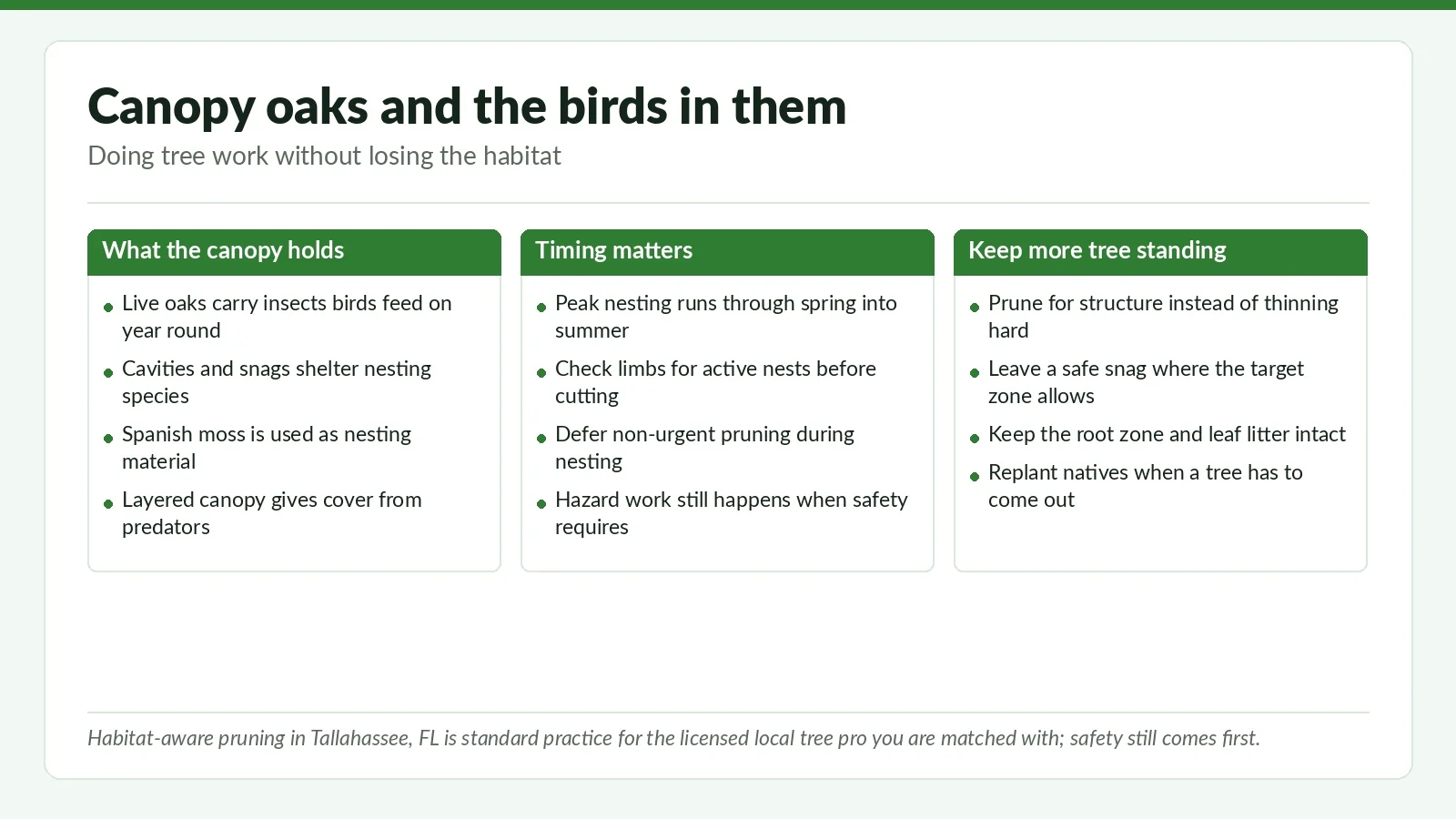
A mature live oak supports far more wildlife than a young replacement tree can. The acorns feed jays, woodpeckers, and wild turkeys; the rough bark and limbs host the insects that warblers and nuthatches forage; and the broad crown gives nesting cover and a corridor for migrating songbirds moving through North Florida in spring and fall. When a large canopy oak comes down, it is not replaced ecologically for decades, which is why decisions about removal versus careful pruning carry weight beyond a single yard.
Storm damage or a tree on your house? Call now.
Stay out of rooms under the tree and keep clear of downed lines — report those to the power company first. Then call and we’ll connect you with a local tree crew that handles storm work.
📞 Call (858) 319-0022Free 24/7 dispatch line · availability varies by storm volume
The local work of Apalachee Audubon
Much of the local knowledge about which trees and habitats matter most comes from Apalachee Audubon Society, the Tallahassee-area chapter that has spent decades on bird conservation, habitat education, and community programs across the Big Bend. Their resources page points to native plant guides, regional bird lists, and the conservation partners working to keep North Florida’s habitats intact. For any homeowner trying to weigh a tree decision against the wildlife that depends on it, their material is a useful place to start.
How careful tree care supports the canopy
Good tree care and bird habitat are not at odds. Most of what keeps a canopy oak standing and safe, structural pruning, removing genuinely dead or hazardous limbs, addressing decay early, also keeps it living longer as habitat. The goal is to preserve the mature tree wherever it can be kept safely, prune to reduce real risk rather than for convenience, and reserve removal for trees that are truly hazardous. When work is timed to avoid active nesting season where practical, the tree stays healthy and the birds that depend on it are disturbed as little as possible.
Have a canopy oak you are unsure about?
Call now code on our home page to get matched with an independent, licensed and insured tree service provider serving Tallahassee and the surrounding Leon County area.
Frequently asked questions
Why are mature oaks so important for Tallahassee birds?
Mature oaks provide acorns, insect-rich bark and limbs, nesting cover, and migration corridors. A young replacement tree does not provide that habitat for decades, so keeping healthy mature trees standing matters for local bird populations.
Does pruning or removing a tree hurt nesting birds?
It can if done during active nesting. Where practical, timing major work outside nesting season and preserving healthy mature trees reduces the impact on birds.
Where can I learn more about local birds and habitat?
The Apalachee Audubon Society offers regional bird lists, native plant guidance, and conservation resources for the Tallahassee and Big Bend area.
Disclaimer: Tallahassee Tree Service is a local dispatch and referral service, not a licensed tree service provider. We connect Tallahassee and Leon County, Florida homeowners with independent, licensed and insured tree care companies. All work is performed by those independent providers, who set their own pricing, scheduling, and service terms. Apalachee Audubon Society is an independent nonprofit mentioned here as a local resource; we are not affiliated and receive no payment for the mention.
Any reference to same-day, emergency, or 24/7 service describes the typical scheduling of matched independent providers and is not guaranteed; actual response times vary by provider, season, location, and demand.