
You had a tree taken down, and now there’s a stump sitting in the yard — tripping the mower, sprouting suckers, and quietly becoming a home for ants. The natural next question is: what will it take to be rid of it? In Tallahassee, where wide live-oak and pine stumps with sprawling root flares are common, the honest answer is “it depends” — but it depends on factors you can actually weigh once you understand how the work is scoped.
This guide breaks down what goes into a stump grinding job in the Tallahassee and Leon County area, what makes one stump a bigger job than another, and how long the work takes. There are no set numbers here — every stump is different, and your actual estimate is between you and the arborist who looks at your specific stump.
Get matched with a licensed Tallahassee arborist Call now code and our 24/7 dispatch line connects you with an ISA-certified, insured arborist in our network who serves Tallahassee and Leon County. A real person answers — describe what happened and you’ll be routed to the right pro. → Call now to get connected
How is a stump grinding job scoped in Tallahassee?
By measured diameter at the widest point, grind depth, access for the machine, and how many stumps can be batched in one visit — the full walkthrough is below. Call now to get matched for stump grinding in Tallahassee.
Storm damage or a tree on your house? Call now.
Stay out of rooms under the tree and keep clear of downed lines — report those to the power company first. Then call and we’ll connect you with a local tree crew that handles storm work.
📞 Call (858) 319-0022Free 24/7 dispatch line · availability varies by storm volume
How stump grinding is scoped: diameter plus a mobilization minimum
The biggest single driver of a stump grinding job is the diameter of the stump. You measure the stump straight across at its widest point at ground level, and that width is the best predictor of how much grinding the job takes.
On top of the diameter, almost every job carries a minimum that reflects getting a grinder, a truck, and a crew to your property. That floor matters: mobilizing the equipment takes the same effort whether the stump is small or large, so very small stumps are usually scoped at the minimum rather than strictly by width. Diameter starts to dominate the effort once stumps get big.
A few scoping structures you may encounter:
- Per-inch of diameter — the standard, as above.
- Flat per-stump quote — a single quoted scope after the arborist sees it.
- Minimum job — the floor any small job rolls up to.
- Multi-stump discounts — a reduced rate when several stumps are ground in one visit (more on this below).
How stump jobs scale by size
Putting diameter and the mobilization minimum together, here’s how stump jobs tend to scale in our area, framed by stump size. Treat these as planning categories, not quotes.
| Stump size (diameter) | What tends to drive the job |
|---|---|
| Small (up to ~12 in) | Usually rolls up to the mobilization minimum |
| Medium (12–24 in) | Diameter starts to drive the grinding time |
| Large (24–36 in) | Wide, dense root flares add real time |
| Extra-large / multi-trunk (36 in+) | Most time on site; often staged in passes |
In Tallahassee specifically, the largest jobs tend to be mature live oaks and large pines — trees whose stumps carry wide buttressed root flares that take real time to grind out.
What affects the job: root spread, hardness, access, and multiple stumps
Two stumps measured at the same diameter can land at noticeably different efforts. Here’s what moves the needle.
Root spread and flare. Diameter measured at ground level doesn’t capture the buttressing root flare that mature live oaks throw out at the base. A live oak can have a root collar far wider than its trunk, and grinding that flare flush takes extra passes. This is the single biggest reason Tallahassee oak stumps trend toward the larger end.
Wood hardness. Live oak is dense, hard wood that’s slower to grind than a softer species. Long-dead, seasoned stumps can also be harder on equipment than fresh-cut ones.
Access and location. A stump in an open backyard is straightforward. A stump behind a locked gate, wedged against a fence, on a slope, near a septic field, or boxed in by hardscape may require a smaller walk-behind grinder instead of a tow-behind unit — and smaller machines work slower, which adds time.
Grinding depth. Standard grinding takes the stump down a few inches below grade — enough to plant grass or lay sod over it. If you’re planning to replant a tree, build, or pour in that spot, you may want deeper grinding, which adds work.
Number of stumps. This one usually works in your favor. Because so much of the effort is mobilizing equipment, multi-stump discounts are common — grinding five stumps in one visit almost always works out better per stump than five separate trips. If you’ve cleared several trees, get them all done at once.
Chip and debris cleanup. Grinding produces a surprising volume of wood chips and soil. Some quotes include haul-away or backfilling the hole; others leave the chips on site. Clarify which, because cleanup can add to the scope.
How long stump grinding takes
Time tracks closely with size and hardness. As a rough guide:
- Small stumps: about 15 to 45 minutes.
- Medium stumps: roughly 45 minutes to 1.5 hours.
- Large live-oak or pine stumps: commonly 2 to 3 hours, especially with wide root flares.
Overall, most single-stump jobs fall in the 15-minute to 3-hour window. Multiple stumps add time but not proportionally — the crew is already set up, so each additional stump goes faster than the first.
Have a stump you want looked at? Call now to reach the 24/7 dispatch line. A real person connects you with a licensed, insured arborist in our network who serves Tallahassee and Leon County and can assess your specific stump. → Call now to get connected
Grinding vs. full removal (and what happens to the chips)
People use “stump removal” and “stump grinding” interchangeably, but they’re different jobs with different scopes.
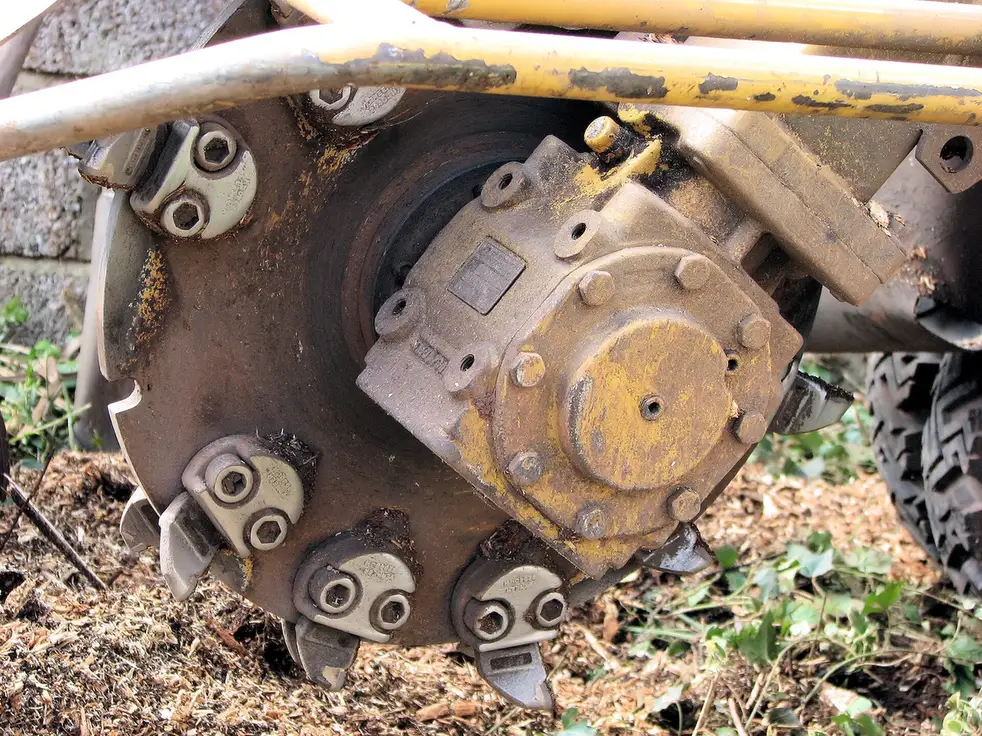
Stump grinding uses a rotating cutting wheel to chew the stump down to mulch, a few inches below grade. The visible stump disappears, but the root system stays in the ground and decays naturally over time. It’s faster and less disruptive to the surrounding yard — which is why it’s the common choice.
Full stump removal physically extracts the entire stump and major root ball, usually with an excavator. It leaves a large hole that needs backfilling and is a more involved, more invasive job. It’s mainly worth it when you need the root mass gone — for a building footprint, a pool, or major regrading.
For most Tallahassee homeowners who just want the stump out of sight so they can mow, plant grass, or reclaim the spot, grinding is the practical answer. If you’re clearing a larger area — say, an overgrown lot or a fence line thick with brush and small trees — forestry mulching in Tallahassee may be a more efficient approach than grinding stumps one by one. And if you still have a standing tree to deal with before the stump even exists, start with our overview of tree removal in Tallahassee.
As for the chips: a typical grind produces a mound of wood chips mixed with soil. Many homeowners spread them as mulch in beds or use them to backfill the hole as it settles. If you’d rather they be hauled away, ask up front so it’s in the quote.
What to ask the arborist
A few questions get you an apples-to-apples quote and head off surprises:
- Is the scope based on diameter, a flat per-stump quote, or a minimum?
- How is the stump measured — at ground level, or including the root flare?
- How deep will you grind? Standard below-grade, or deeper for replanting or building?
- Are wood chips hauled away, or left on site? Is the hole backfilled?
- Is there a discount for grinding multiple stumps in one visit?
- Are surface roots radiating from the stump included, or only the central stump?
- Is the arborist licensed and insured for work in Leon County?
Getting these answers in writing means the scope you’re quoted is the scope you get.
FAQ
How much does stump grinding cost in Tallahassee?
There’s no flat rate. The job is scoped mainly by the stump’s diameter, plus a minimum that covers bringing the grinder and crew out. A small stump usually rolls up to that minimum, while a large live oak or pine with a wide root flare is a bigger job because there’s more hard material to grind. The only real number is the one an arborist gives you after looking at your specific stump — call now to get connected.
What does “per inch” mean for stump grinding?
It means the arborist measures the stump’s diameter across its widest point at ground level and scopes the grinding from that width. Wider stumps are bigger jobs, though small stumps often still hit the minimum because the equipment trip is the same either way.
How is stump grinding scoped in Florida?
Most arborists scope grinding by the stump’s diameter at ground level — the wider the stump, the bigger the job — with a minimum for small stumps. The exact scope depends on size, species, and site access, so it’s set when an arborist sees your stump.
Is there a minimum for stump grinding?
Usually, yes. Most companies apply a minimum that covers bringing the grinder and crew to your property, so even a very small stump is scoped at that floor rather than strictly by its width.
How long does stump grinding take?
A single stump usually takes anywhere from 15 minutes to 3 hours. Small stumps run about 15–45 minutes, medium ones 45 minutes to 1.5 hours, and large live-oak or pine stumps often 2–3 hours because of their wide, dense root flares.
Why are live-oak and pine stumps a bigger job in Tallahassee?
Mature live oaks have wide buttressed root flares far broader than the trunk, and live oak is dense, hard wood that grinds slowly. Large pines add size. Both make these stumps a bigger job because there’s simply more hard material to grind.
Is it better to grind several stumps at once?
Usually, yes. Much of the effort is mobilizing the equipment, so multi-stump discounts are common. Grinding several stumps in one visit typically works out better per stump than separate trips. If you’ve cleared multiple trees, having them ground together is the economical move.
What’s the difference between stump grinding and stump removal?
Grinding chews the stump down a few inches below grade and leaves the roots to decay naturally — faster and less disruptive. Full removal extracts the entire stump and root ball with heavy equipment, leaving a large hole; it’s a more involved job and is mainly needed when the root mass must be gone for building or major landscaping.
What happens to the wood chips after grinding?
Grinding produces a mound of chips mixed with soil. Many homeowners spread them as mulch or use them to backfill the hole. If you want them hauled away, ask before the work starts so it’s included in the quote.
TallahasseeTreeService.co is a dispatch service. We connect callers with licensed Florida arborists. We are not a licensed tree service company.
The disclaimer in our site footer and our 24/7 dispatch caveat apply to this page.