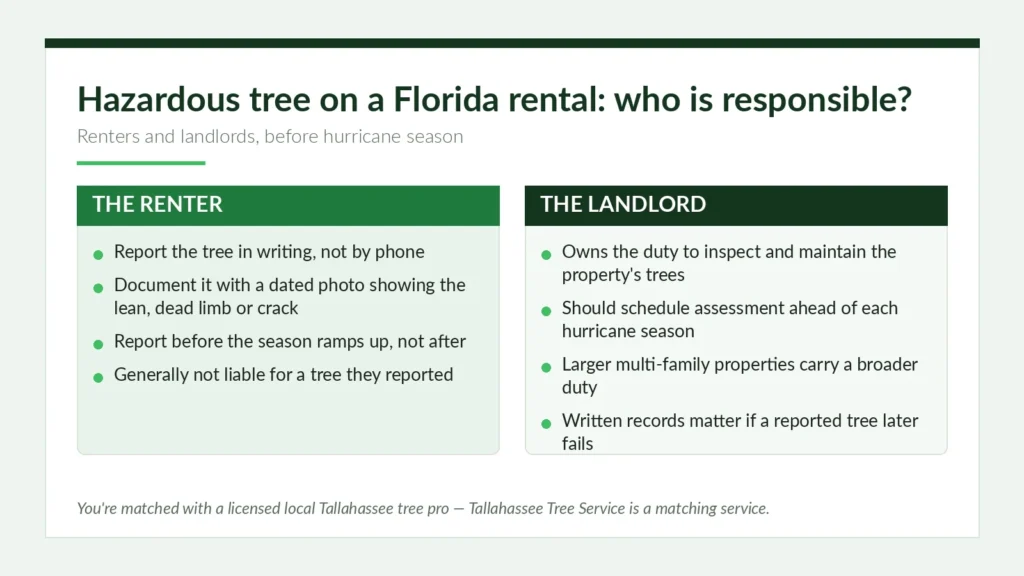
In Florida rental housing, the landlord is generally responsible for tree hazards on the property under the state’s landlord-tenant law, while a tenant is responsible for reporting a hazard promptly and not causing damage through neglect. Before hurricane season, that split matters: a renter who spots a leaning tree or dead limb should put the request in writing to the landlord or property manager, and a landlord who ignores a documented hazard can carry liability if that tree fails during a storm and causes injury or damage.
Tallahassee has one of the largest renter populations of any mid-size Florida city, driven by FSU and FAMU, and a lot of that rental housing sits on older, tree-heavy lots in neighborhoods like Midtown, College Town, and the streets closest to both campuses. That’s a good thing for shade and curb appeal. It also means a lot of hurricane-season tree risk sits on properties where the person living under the tree isn’t the person who legally controls what happens to it — which creates confusion every storm season about who’s actually supposed to act.
Who’s Legally Responsible for a Hazardous Tree on a Rental Property?
Under Florida’s Residential Landlord and Tenant Act, a landlord is generally responsible for maintaining the structural and safety condition of a rental property, which includes hazards in the yard like a dead or structurally unsound tree. A tenant’s obligations run the other direction — using the property reasonably, not damaging it, and generally reporting problems that need the landlord’s attention. Neither party’s exact obligations are identical in every lease, since a written lease can shift some yard-maintenance duties to the tenant, so the specific lease language matters alongside the baseline rules in Florida Statutes Chapter 83, the Residential Landlord and Tenant Act.
Storm damage or a tree on your house? Call now.
Stay out of rooms under the tree and keep clear of downed lines — report those to the power company first. Then call and we’ll connect you with a local tree crew that handles storm work.
📞 Call (858) 319-0022Free 24/7 dispatch line · availability varies by storm volume
What Should a Renter Actually Do About a Tree That Looks Risky?
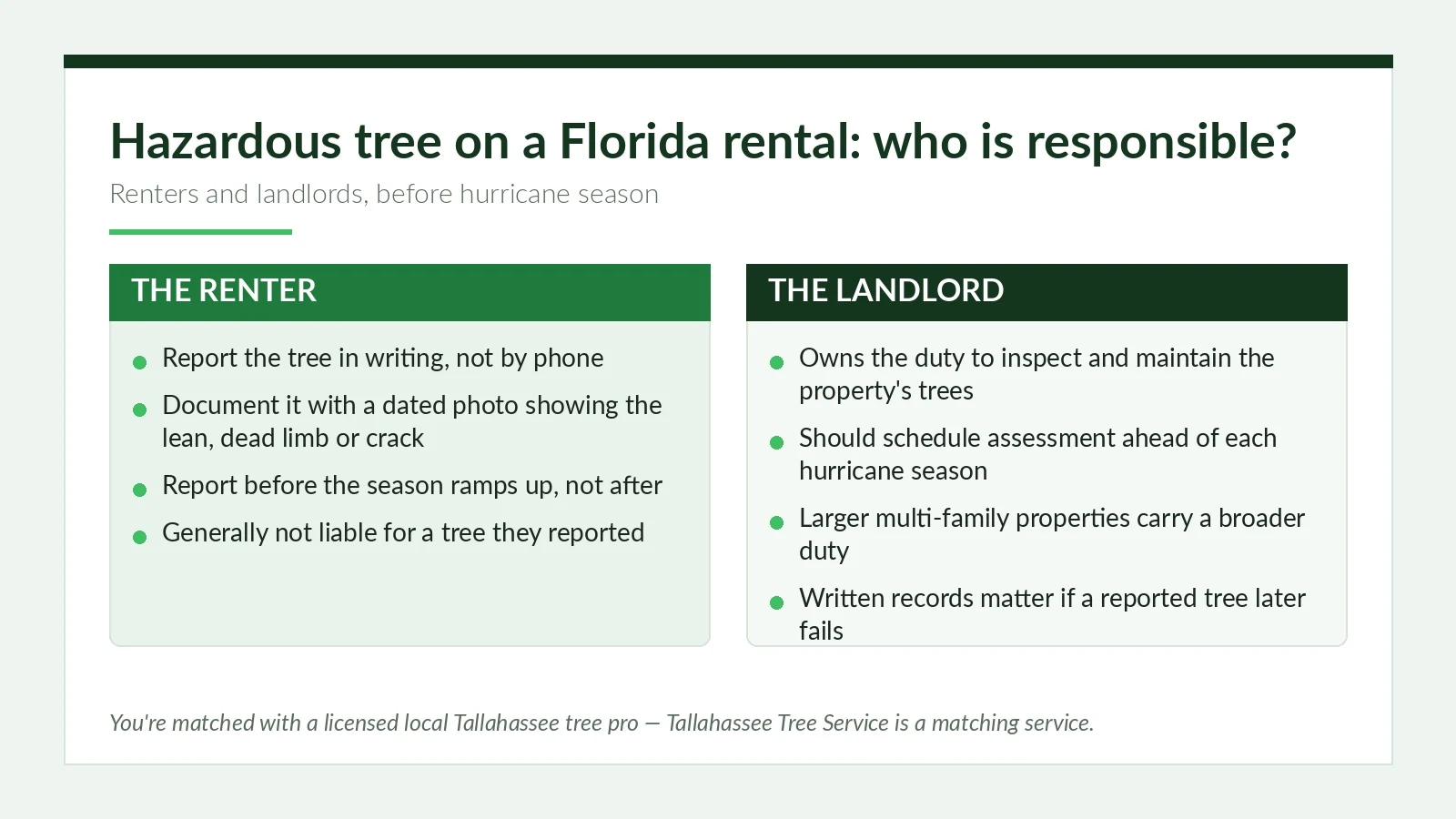
- Document it — a photo with a date, showing the lean, the dead limb, or the visible crack, before hurricane season ramps up.
- Report it in writing — an email or text to the landlord or property manager creates a timestamp and a record, which matters far more than a verbal mention if the tree later fails.
- Follow the lease’s notice process — many leases specify how maintenance requests need to be submitted; using that process protects the tenant if the issue isn’t addressed.
- Don’t attempt the work yourself — removing or trimming a tree on a rental property without authorization can create its own liability question, separate from the original hazard.
Can a Tenant Be Held Responsible If a Tree Falls During a Storm?
Generally not, if the tenant reported the hazard and the landlord failed to act on it — that scenario points toward landlord liability, not tenant liability. A tenant is more likely to face responsibility if they caused the damage directly (cutting roots, damaging the trunk, ignoring a lease term that put yard maintenance in their hands) rather than simply living under a tree the landlord failed to maintain. This is exactly why documentation matters: a dated report to the landlord is the difference between “the tenant never said anything” and “the landlord was notified and didn’t act.”
Landlord or property manager dealing with a tenant-reported hazard? Get matched with a licensed, insured local Tallahassee arborist for an assessment before the tree becomes a storm-season liability.
What Should a Landlord Do Before Hurricane Season Starts?
The practical move is proactive, not reactive: walk or have someone walk every rental property’s yard before hurricane season opens, get any tree with visible dead wood, a pronounced lean, or a cavity assessed by a licensed arborist, and keep documentation of that assessment. That record does two things at once — it protects tenants from a preventable hazard, and it protects the landlord’s liability position if a storm does bring a tree down despite reasonable pre-season maintenance. For landlords managing several units, especially in the older, tree-dense rental corridors near both universities, treating this as an annual pre-season task rather than a tenant-complaint-driven task avoids the scramble that happens every year once a storm is already in the forecast.
Does It Matter Whose Property the Tree Is On?
Yes, and this trips up a lot of rental disputes. If the hazardous tree sits on the rental property itself, the responsibility framework above applies. If the tree that concerns a tenant is actually on the neighboring property, the rental property’s landlord generally isn’t the responsible party — that’s a neighbor-to-neighbor issue, though a landlord may still want to flag it since a neighbor’s tree can still fail onto the rental structure. Confirming which parcel a tree actually sits on, rather than assuming based on which yard it looks like it’s in, is worth doing before assigning responsibility either direction.
What About Multi-Family and Larger Rental Properties?
The same landlord-responsibility framework applies to multi-family rentals and larger managed properties, but the practical stakes are higher because more tenants are exposed to the same hazard, and a homeowners association or property management company may have its own maintenance obligations layered on top of the base landlord-tenant rules. Properties near campus with multiple units under mature canopy are a common case where a single hazardous tree affects several leases at once, which is one more reason a single pre-season assessment covering the whole property is more efficient than responding unit by unit as complaints come in.
For rental properties specifically in the university-adjacent rental market, the tree service near FSU and tree service near FAMU pages cover the landlord and property-manager side of this directly, and the emergency tree service page covers what happens if a tree comes down on a rental property once a storm has already hit.
FAQ
Is a landlord or tenant responsible for tree removal on a Florida rental?
Generally the landlord, since maintaining the safety condition of the property falls under the landlord’s obligations in Florida’s Residential Landlord and Tenant Act, though specific lease terms can shift some yard-maintenance duties to the tenant.
What should a renter do if they think a tree on the property is dangerous?
Document the hazard with a dated photo and report it in writing to the landlord or property manager, following whatever notice process the lease specifies, rather than relying on a verbal mention.
Can a tenant be liable if a reported tree falls during a storm?
Generally not if the hazard was reported and the landlord failed to act – that points toward landlord liability. A tenant is more likely to face responsibility only if they directly caused the damage.
Should landlords inspect rental trees before every hurricane season?
Yes – a proactive pre-season walk-through and arborist assessment for any tree with visible dead wood, lean, or cavities protects both tenant safety and the landlord’s liability position.
Tallahassee Tree Service is a free referral and dispatch service. We are not a licensed tree service provider, a law firm, and do not perform tree work ourselves or provide legal advice. All work is performed by independent, licensed and insured third-party arborists in our network. This article is general information, not legal advice – consult a licensed Florida attorney for guidance specific to a lease or property.