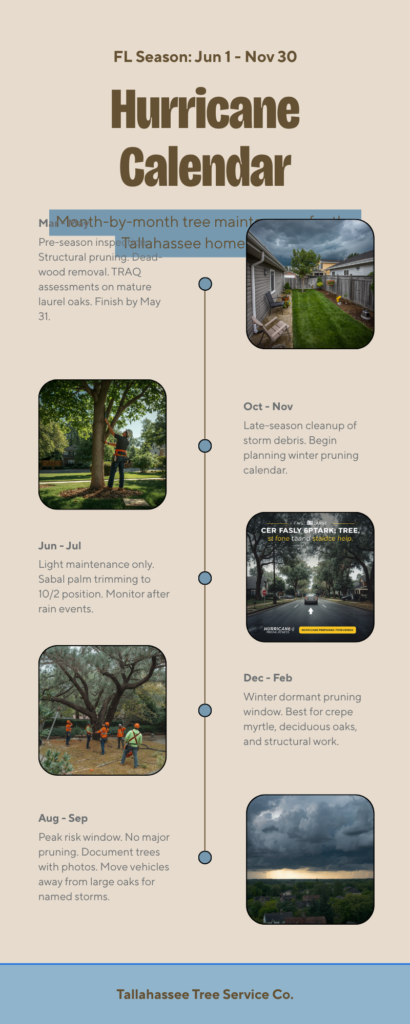
Tallahassee hurricane season tree maintenance calendar infographic — month-by-month arborist guidance for Big Bend FL homeowners

Sabal Palm Trimming Season in Tallahassee: When and How

Sabal palm (Sabal palmetto) is Florida’s state tree and one of the iconic species across Tallahassee residential and commercial properties. It’s also the species most commonly mistreated by well-meaning landscapers — over-pruned to a single tuft at the top (“hurricane cut”), trimmed at the wrong season, or treated to a “skinning” of the trunk that creates lasting damage. Done right, sabal palm trimming is one of the simpler maintenance jobs in Tallahassee tree care. Done wrong, it stresses the palm for years. Here’s the right approach.

The 10-and-2 Standard

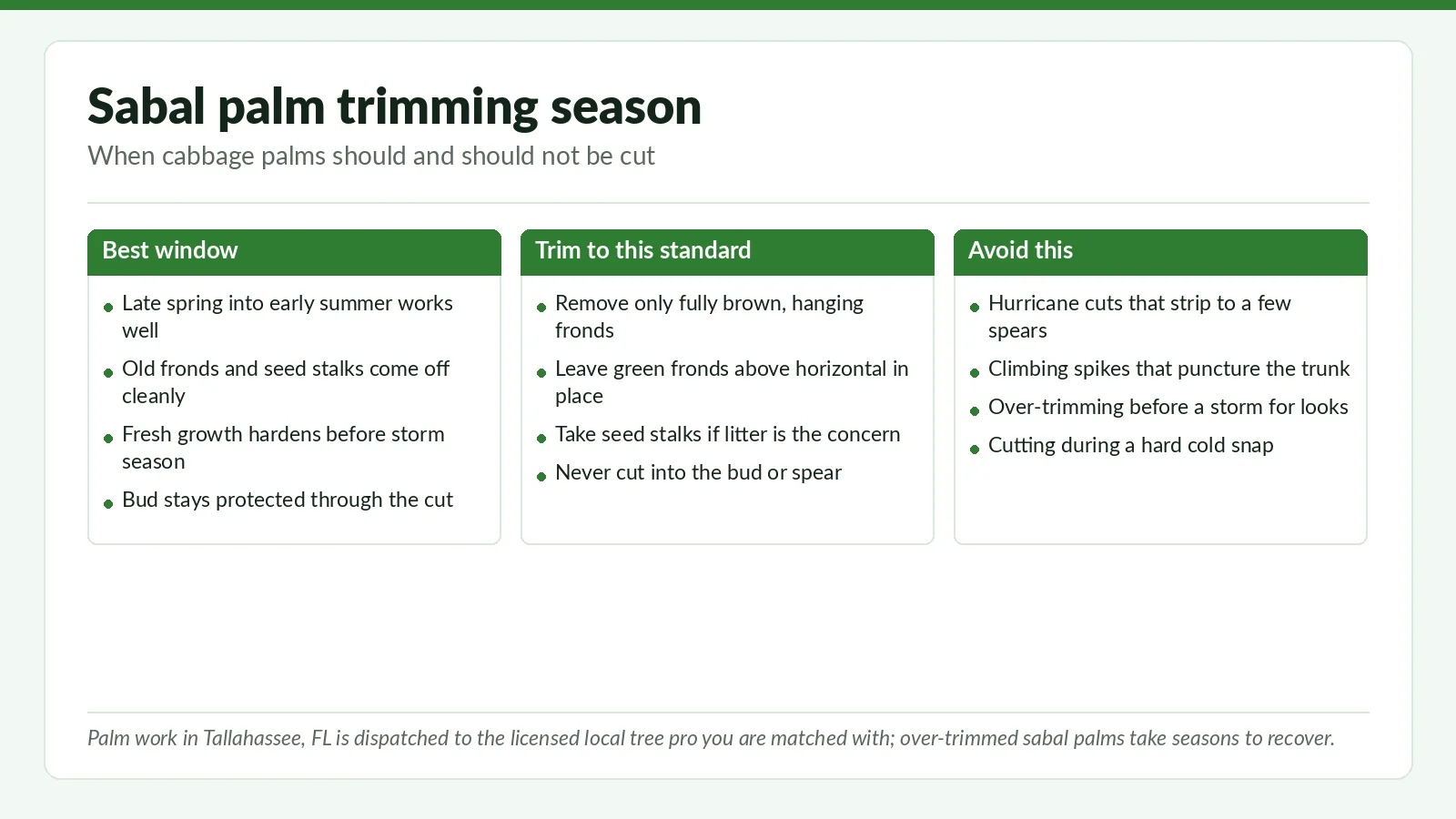
The right amount of trimming on a sabal palm follows what arborists call the “10 and 2 o’clock” standard: viewing the palm from the side, leave fronds extending up to the 10 o’clock and 2 o’clock positions, removing only fronds that have fully browned or drooped below horizontal. The horizontal line is the baseline — anything green and held above horizontal is doing photosynthetic work and should remain.

The wrong approach is “hurricane cut” or “pencil cut” — removing all but the topmost vertical fronds to leave a slim spear at the crown. This is the single most common mistake in Tallahassee palm care. It dramatically reduces photosynthetic capacity, stresses the palm, accelerates nutrient deficiency, and contrary to common belief does not improve hurricane survival. Properly maintained 10-and-2 palms perform better in storms than over-pruned ones.

The Right Trimming Season

The standard window for sabal palm trimming in Tallahassee is spring through early summer — typically April through June, finishing well before peak hurricane risk. Avoid trimming during the hottest part of summer (July–August) when the palm is already managing heat stress. Late-fall and winter trimming is acceptable for routine work but is less common.

Pre-hurricane trimming should be completed by May 31. The reduction to 10-and-2 reduces wind catch and removes brown fronds that can become projectiles in 70+ mph winds. Schedule with the same pre-hurricane window as oak and pine work — see our hurricane tree prep page.

Boot Removal — Yes or No

The persistent leaf bases on a sabal palm trunk are called “boots.” On young palms, boots create a textured appearance and provide some pest habitat (lizards, anoles, occasional invertebrates). On mature palms, boots eventually self-shed as the trunk continues to develop, leaving the smooth grayish trunk characteristic of older sabal palms.

Some homeowners request boot removal for aesthetic reasons. The procedure is acceptable when done carefully — boots can be cut flush with the trunk without damaging trunk tissue. The risk is over-cutting that nicks the trunk and creates wounds susceptible to disease. Modern best practice is to remove boots only when they have loosened naturally and can be pulled or cut without forcing — never strip green or firmly-attached boots.

Sabal Palm Nutrient Concerns

The most common chronic issue on Tallahassee sabal palms is potassium deficiency. The diagnostic sign is yellowing or browning of older (lower) fronds with translucent yellow-orange spotting. Untreated potassium deficiency progresses upward through the canopy and can eventually be fatal.

Treatment is a controlled-release palm fertilizer applied per UF/IFAS palm nutrition protocols. Standard recommendation is 8-2-12-4 Mg with micronutrients, applied at the rate specified in UF/IFAS publication EP261. Avoid generic “lawn” fertilizers near palms — high nitrogen actually exacerbates potassium deficiency. The arborists in our network can diagnose and treat — see our deep-root fertilization page.

Ganoderma Butt Rot — The Watch List

Ganoderma zonatum is the most serious sabal palm disease in Florida. The fungus colonizes the lower trunk and root tissue, eventually causing complete structural failure. The diagnostic sign is the appearance of conk fruiting bodies — shelf fungi with white margins and reddish-brown upper surfaces — on the lower 3–5 feet of the trunk. Once conks appear, the palm has typically been infected for 3+ years and structural failure is imminent.

UF/IFAS publication PP100 specifies the protocol for Ganoderma-infected palms: immediate removal, grinding of the stump below grade, off-site disposal of all infected material (do not chip on-site), and avoidance of replanting palms in the same location. The disease spreads through spores in soil and from infected stumps. See our sabal palm care page.

Permit and Protected-Species Notes

Sabal palm has unique status in Florida. As the state tree, sabal palms have some additional protections, but for City of Tallahassee residential lot purposes, palms are generally not in the protected-species categories of §5-83. Removal of a residential sabal palm typically doesn’t require a permit unless the palm is within a Canopy Road Protection Zone or unless the parcel is in unincorporated Leon County where local rules may apply.

Where the protections do apply: state-managed lands, conservation easements, and certain commercial development zones. For typical Killearn, Midtown, or Bradfordville residential lots, sabal palm trimming and removal proceeds as standard tree work without §5-83 permit requirements. See our Tallahassee tree permit guide.

Cost expectations: trimming a single sabal palm in Tallahassee typically runs $75–$200 depending on height and access. Most palms are trimmed annually or every other year. Multi-palm jobs price down per palm. See our palm tree trimming page.

Authority reference: UF/IFAS EDIS publishes the comprehensive Florida palm management literature including ST575 (sabal palm fact sheet), PP100 (Ganoderma protocol), and EP261 (palm nutrition).

Sabal Palm Trimming — Tallahassee

10-and-2 standard trimming, Ganoderma diagnosis, potassium-deficiency treatment, pre-hurricane prep. Schedule by May 31 for pre-season availability. tap to talk with an arborist across Leon, Wakulla, Gadsden, and Jefferson counties.

Call (850) 820-2166 — Mon–Sat 7am–7pm. Free palm assessments.

Frequently Asked Questions

When should I trim my sabal palm in Tallahassee?
April through June. Finish before May 31 for pre-hurricane prep. Avoid the hottest part of summer (July–August) when the palm is already managing heat stress. Late-fall trimming is acceptable for routine work.

What is the 10-and-2 trimming standard?
Viewing the palm from the side, leave fronds extending to the 10 o’clock and 2 o’clock positions. Remove only fronds that have fully browned or drooped below horizontal. Anything green and held above horizontal is doing photosynthetic work and should remain.

Are hurricane cuts good for palm survival?
No — the opposite. Over-pruning to a single vertical tuft reduces photosynthetic capacity, accelerates nutrient deficiency, stresses the palm, and does not improve hurricane survival. Properly trimmed 10-and-2 palms perform better in storms than over-pruned ones.

Why are my sabal palm’s lower fronds turning yellow?
Most commonly potassium deficiency. The diagnostic sign is yellowing or browning of older lower fronds with translucent yellow-orange spotting. Treatment is controlled-release palm fertilizer per UF/IFAS protocols. Generic lawn fertilizer makes the problem worse.

What are the shelf fungi appearing on my palm trunk?
Almost certainly Ganoderma zonatum (Ganoderma butt rot), a serious disease that causes structural failure. Once conks appear, the palm has been infected for years. Removal protocol per UF/IFAS PP100 requires off-site disposal and avoiding replanting palms in the same spot. See our sabal palm care page.

Call Tallahassee Tree Service — (850) 820-2166Call Now · Free to Call