There is a particular kind of worry that comes with a big tree close to the house. Maybe it is leaning a little more than it used to, or a few large branches have gone bare while the rest leafed out, or you noticed mushrooms growing at the base after a wet spell. In a city as shaded as Tallahassee, where mature live oaks, laurel oaks, water oaks, and tall pines tower over older homes, knowing how to read those signs is genuinely useful — both for your peace of mind and for describing the tree accurately when you reach an arborist.
This guide walks through the warning signs of a hazardous or declining tree, the species-specific risks that matter most in the Tallahassee canopy, the difference between sudden and slow decline, what you can reasonably assess from the ground versus what requires a trained eye, and why root and trunk problems are the ones that deserve the most respect. It is meant to help you understand what you are looking at — not to turn you into a tree-risk assessor, which is a job for a professional.
The Warning Signs to Watch For
A tree rarely fails without giving some warning, and most of the signals are visible if you know to look. No single sign is a verdict on its own, but several together raise the concern level.
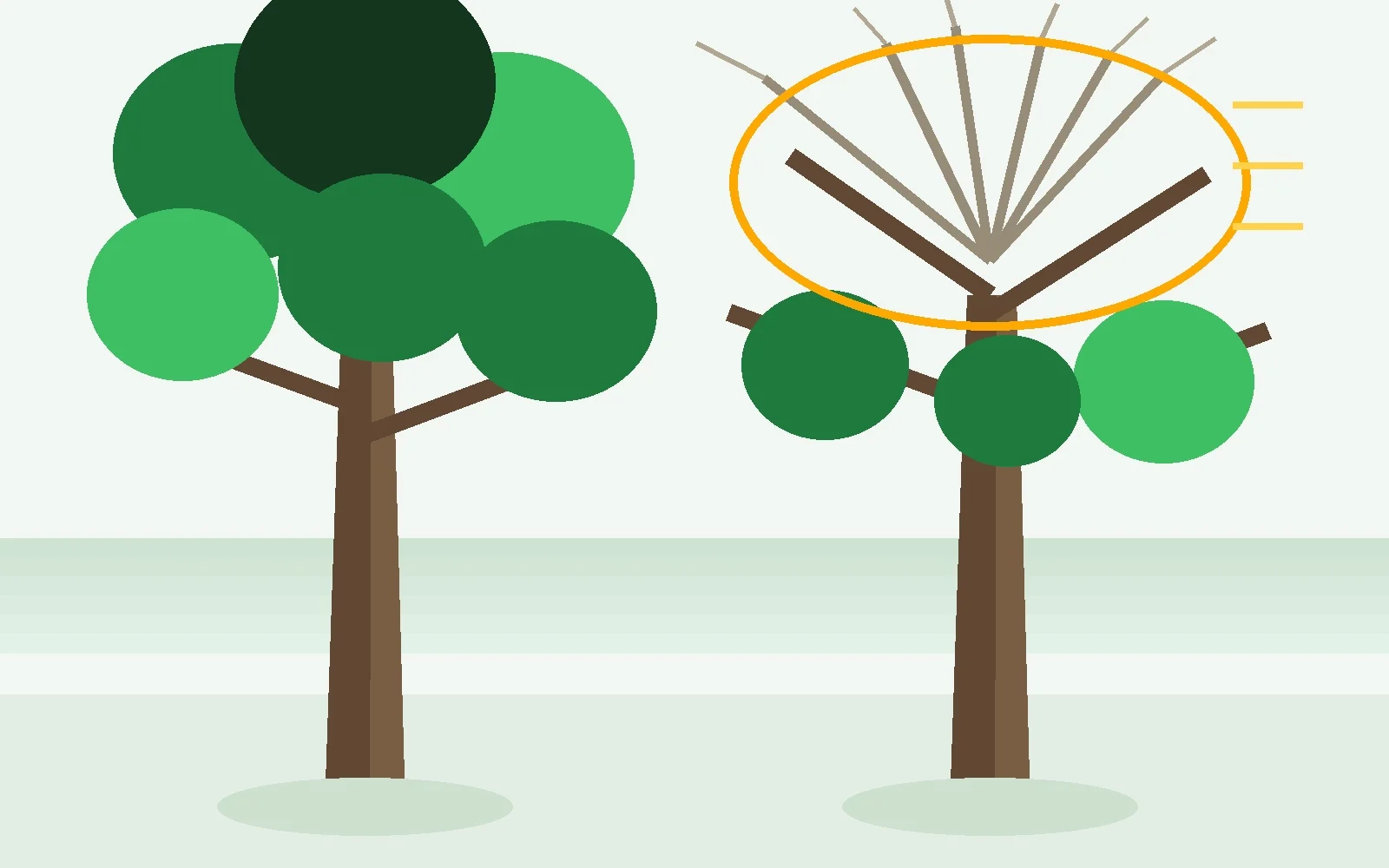
A new or worsening lean is one of the more serious signs, especially if it appeared suddenly or if the soil on one side of the trunk is lifting or cracking. A tree that has grown at a slight angle its whole life is different from one that has recently started to tip. Large deadwood — sizable bare branches with no leaves while the rest of the canopy is full, brittle limbs, or whole dead sections — signals decline and creates the immediate hazard of falling branches. Cracks and cavities in the trunk or major limbs, deep splits, seams, or open hollows, point to compromised structure. Fungal growth, particularly mushrooms or shelf-like conks at the base of the trunk or over the root zone, is a red flag because it often indicates internal decay you cannot see from outside. Root problems show up as heaving or cracking soil around the base, exposed or damaged roots, or fungus over the root area. Other clues include bark falling away in large patches, a trunk that sounds hollow when tapped, sparse or undersized leaves, early fall color, and a canopy that is thinning year over year. The more of these a tree shows, and the closer it is to your house, driveway, or a place people gather, the more it warrants a professional look.
Storm damage or a tree on your house? Call now.
Stay out of rooms under the tree and keep clear of downed lines — report those to the power company first. Then call and we’ll connect you with a local tree crew that handles storm work.
📞 Call (858) 319-0022Free 24/7 dispatch line · availability varies by storm volume
Species-Specific Risks in Tallahassee
Part of reading a tree well is knowing how the species behaves, because Tallahassee’s signature trees fail in different ways.
Live oaks are the sturdiest of the bunch — dense, strong-wooded, and long-lived — which is part of why they are the city’s beloved shade tree. But their very size is the risk: a mature live oak is enormous, with heavy, wide-spreading limbs, so even a sturdy one can do tremendous damage if a major limb fails, and a compromised live oak is a serious matter simply because of its scale. Laurel oaks and water oaks are a different story. Both are comparatively shorter-lived and prone to internal decay, often hollowing and weakening from the inside as they mature, sometimes while still looking reasonably full on the outside. In a region full of these oaks, that tendency toward hidden internal decay is one of the most important local risks to understand — a laurel or water oak in apparent decline deserves real attention. Pines — the tall loblolly and slash pines so common around Tallahassee homes — bring their own hazard: they grow very tall and shallow-rooted relative to their height, and in saturated soil and high wind they can uproot or snap, which is why pines are such frequent failures in storms. Matching what you are seeing to the species helps you gauge how concerned to be and gives the arborist a head start.
Sudden vs. Slow Decline
How quickly a tree changes tells you something about what is happening and how urgently to act.
Slow decline unfolds over seasons or years: a canopy that thins a little more each spring, branches that die back gradually, growth that slows, leaves that come in smaller or color early. This pattern usually reflects chronic stress — age, root damage, long-term disease, drought, or construction impact — and while it is not an emergency, it is a signal to have the tree evaluated before the decline reaches a dangerous stage. Sudden decline is more alarming and more urgent: a tree that wilts or browns rapidly, a fresh lean that appears over days, a large limb that drops without warning, or soil heaving after a storm. Rapid change can indicate acute root failure, a major structural crack, or a tree that has effectively already begun to fail. Sudden changes — especially a new lean, heaving roots, or a major limb failure near the house — are the situations to treat seriously and not wait on. For circumstances that have crossed from “concerning” into “active hazard,” the arborists in our network also handle emergency tree service in Tallahassee.
Worried a tree could be a hazard? Get matched with a licensed Tallahassee arborist Call now code and our 24/7 dispatch line connects you with an ISA-certified, insured arborist in our network who serves Tallahassee and Leon County. A real person answers — describe the tree, the lean, and how close it is to your house, and you’ll be routed to the right pro. → Call now to get connected
What You Can Check From the Ground vs. What Needs an Arborist
There is a clear line between what a homeowner can reasonably observe and what requires training and equipment, and respecting that line keeps you safe.
From the ground, you can do a useful visual walk-around. Look at the whole tree from a distance for lean and overall canopy health, then move in to check the trunk for cracks, cavities, peeling bark, and conks, and the root zone for heaving soil, exposed or damaged roots, and fungus. Note deadwood in the canopy and compare this year’s leaf-out to last year’s. Photograph anything concerning. That is genuinely valuable information, and it is exactly what helps you describe the tree accurately when you reach a pro.
What you should not try to do is climb the tree, probe cavities, evaluate the inside of the trunk, or judge whether a large tree near a structure is safe to leave standing. Internal decay, the true extent of root loss, and the structural integrity of a big tree are assessed by an ISA-certified arborist using training, experience, and sometimes specialized tools — and getting up into a potentially compromised tree is dangerous. The ground-level check is for gathering information; the risk verdict and any removal or pruning decision belong to a professional. For trees that need work short of removal, the arborists in our network also handle tree pruning in Tallahassee, and for trees that have to come down, tree removal in Tallahassee.
Why Root and Trunk Problems Are the Dangerous Ones
Not all tree defects are equal. A dead branch high in the canopy is a real hazard, but it is a localized one — usually a single limb. Root and trunk problems are the ones that can take down the whole tree, which is why they deserve the most respect.
The roots and the lower trunk are the tree’s foundation and its main support column. When roots are damaged, decayed, or losing their grip — from disease, construction, rot, or saturated soil — the tree can lose anchorage and fail at the base, toppling entirely rather than dropping a piece. Soil heaving around the trunk is so concerning precisely because it can signal that the root plate is lifting. Likewise, decay or a major crack in the main trunk undermines the structure that holds everything above it; a hollow or split trunk can fail catastrophically, bringing the entire canopy down. This is also why those internal-decay-prone laurel and water oaks, and shallow-rooted pines in wet soil, are such notable local risks — both involve the foundational parts of the tree. The takeaway is simple: deadwood in the canopy is worth addressing, but fungal conks at the base, heaving roots, and trunk cracks or cavities are signals to get a professional assessment without delay, because they bear on whether the whole tree is sound.
What to Tell the Arborist When You Reach One
A clear description helps a pro understand the situation before they arrive. Note what you are seeing and where — a lean, deadwood, a trunk crack, conks at the base, heaving soil — and which part of the tree it involves. Mention the species if you know it (live oak, laurel or water oak, pine) and the tree’s size and distance from your house, driveway, or where people spend time, since proximity drives how urgent a hazard is. Note whether the change was sudden or gradual and whether it followed a storm or heavy rain. Photos help. The more accurately you can describe it, the better an arborist can gauge urgency and plan the right kind of visit.
Want a professional eye on a worrying tree? Get matched with a licensed Tallahassee arborist Call now code and our 24/7 dispatch line connects you with an ISA-certified, insured arborist in our network who serves Tallahassee and Leon County. A real person answers — describe the signs you’re seeing and how close the tree sits to the house, and you’ll be routed to the right pro. → Call now to get connected
Frequently Asked Questions
What are the signs that a tree is dying or dangerous? Watch for a new or worsening lean, large dead branches while the rest of the canopy is full, cracks or cavities in the trunk, mushrooms or shelf-like conks at the base, heaving or cracking soil over the roots, bark falling away in patches, a hollow sound when the trunk is tapped, and a canopy that thins year over year. Several signs together, especially near the house, warrant a professional assessment.
Is a leaning tree dangerous? It can be, particularly if the lean is new, worsening, or accompanied by soil lifting or cracking on one side of the base — those suggest the roots may be failing. A tree that has leaned gently its whole life is generally less concerning than one that has recently started to tip. Because a new lean can signal root failure, it is one of the signs to have evaluated promptly.
Which trees are most likely to fail in Tallahassee? Laurel oaks and water oaks are comparatively short-lived and prone to internal decay, so they can weaken from the inside while still looking full. Tall pines are shallow-rooted for their height and can uproot or snap in saturated soil and high wind. Live oaks are sturdy, but their large size means a failure can cause significant damage. Each fails differently, which is why species matters.
Can I tell if a tree is rotting inside? Not reliably from the outside. External clues like fungal conks at the base, a hollow sound when tapped, cavities, and seams can suggest internal decay, but the actual extent is assessed by an ISA-certified arborist, sometimes with specialized tools. Laurel and water oaks are especially known for hidden internal decay, so apparent health on the surface does not rule it out.
What should I do if I think a tree might fall on my house? Keep people and vehicles away from the area, avoid climbing or probing the tree yourself, and get a professional assessment. If the tree is actively failing — a fresh lean, heaving roots, a major limb down, or a split trunk after a storm — treat it as an active hazard. Documenting what you see with photos helps the arborist gauge the urgency.
Does a dead branch mean the whole tree is dying? Not on its own. A single dead branch is a localized hazard that can often be pruned out, and some deadwood is normal as a tree sheds older limbs. Widespread deadwood, a thinning canopy across the whole tree, or deadwood combined with root or trunk problems is more concerning and points to broader decline worth having evaluated.
How quickly should I act on a declining tree? It depends on the pace and the proximity. Slow, gradual decline is a reason to schedule an assessment before it worsens, not an emergency. Sudden changes — a new lean, rapidly browning foliage, heaving soil, or a major limb failure, especially near the house — should be treated seriously and addressed without waiting, since they can indicate a tree that has already begun to fail.
TallahasseeTreeService.co is a dispatch service. We connect callers with licensed Florida arborists. We are not a licensed tree service company. The disclaimer in our site footer and our 24/7 dispatch caveat apply to this page.