Hurricane season in Tallahassee runs June through November, and the years that stick in people’s minds — Hermine in 2016, Michael’s outer bands in 2018, Idalia in 2023 — all share one theme: it wasn’t the wind alone that caused the damage, it was the trees. Tallahassee’s canopy is one of the thickest of any city in Florida, and that canopy is gorgeous right up until a storm turns it into the biggest safety hazard on your property. Hermine alone knocked out power to most of Leon County for over a week in 2016, largely because so many oaks and pines came down on lines across the city.
What you do in the first 48 hours after a storm passes matters more than most homeowners realize. A tree that looks fine on Tuesday can fail on Thursday because the root plate got loosened even if the trunk never fell. Here’s how to work through that window safely, and what to leave for a licensed tree pro.
Hour zero: don’t go outside until you’ve checked for wires
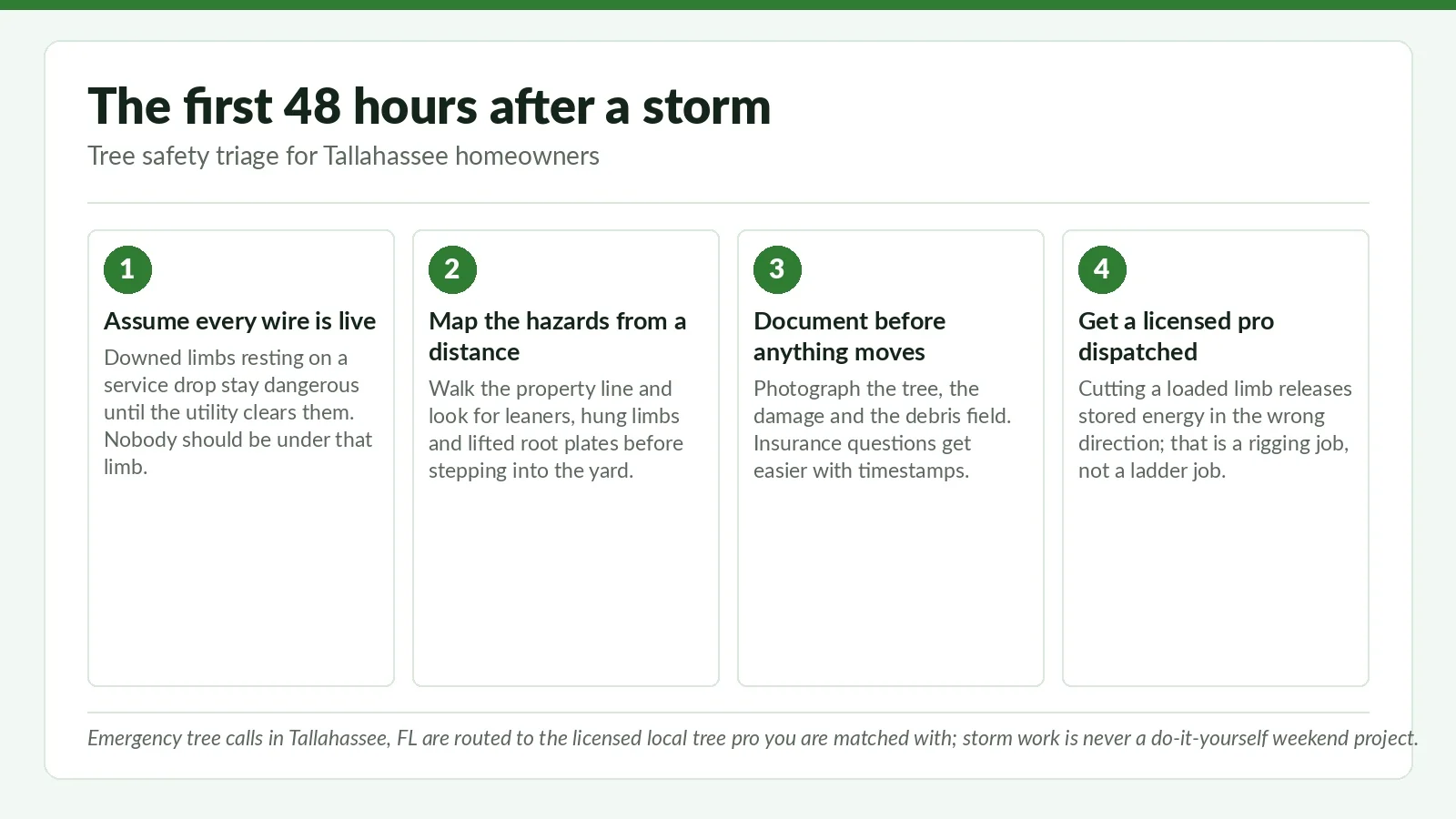
Before you walk the yard, look for downed power lines from a window or the porch. A wire doesn’t have to be sparking to be live, and a tree resting across a line should be treated as energized until the utility company confirms otherwise. If any part of a downed tree is touching a line, or a line is down anywhere on the property, stay back and call the utility company or 911 first. This is not a job for a homeowner or even most tree crews — it’s a job for the power company to de-energize the line before anyone touches the tree.
Storm damage or a tree on your house? Call now.
Stay out of rooms under the tree and keep clear of downed lines — report those to the power company first. Then call and we’ll connect you with a local tree crew that handles storm work.
📞 Call (858) 319-0022Free 24/7 dispatch line · availability varies by storm volume
What to look for once it’s safe to walk the yard
Once wires are confirmed clear, walk the property and look for these specific signs. Each one tells you something different about how urgent the situation is.
- Lifted or cracked soil at the base of a tree. This is the root plate starting to heave. Even a small crack in a rough circle around the trunk means the tree partially uprooted and could go all the way over with the next gust, even on a calm day.
- A new lean that wasn’t there before the storm. Compare to old photos if you have them. A lean of more than a few degrees that appeared overnight is different from a tree that has always grown at an angle — the new lean is the one to worry about.
- Hanging limbs caught in the canopy. Arborists call these widowmakers for a reason. A broken limb that’s still tangled up in the branches overhead can drop with no warning — no wind required.
- Split trunks or major limbs still attached by a strip of bark. This kind of partial failure often looks salvageable from a distance. It isn’t. The connective tissue holding it together is compromised and it’s a matter of time before it lets go.
- A tree resting on a structure, fence, or vehicle. Even light contact can mean the tree is under tension it’s transferring into whatever it’s leaning on. Stay out of that space entirely.
Document before you clean up
If your homeowner’s insurance is going to be part of this, photos matter more than memory. Walk the yard and photograph every leaning tree, every split limb, and any damage to structures before anything gets moved or cut. Wide shots that show the tree in relation to your house, plus close-ups of the root plate and any cracks, give an adjuster and a tree pro the same starting picture. Do this even for damage you think is minor — a hairline root plate crack today can be the difference-maker in a claim next month if that tree comes down later.
What not to do yourself
It’s tempting to grab a chainsaw and start clearing, especially if a limb is blocking your driveway. A few situations are genuinely dangerous for anyone without training and rigging equipment:
- Cutting into a leaning or partially uprooted tree. These trees are under stored tension. A cut in the wrong spot can cause the whole tree to shift or drop suddenly.
- Working near a tree that’s touching a line, even a low-voltage one, until the utility confirms it’s dead.
- Removing a hung-up limb from below. If it’s tangled overhead, it needs to come down with proper rigging, not a ladder and a pole saw.
- Climbing a tree with storm-loosened roots to “check it out.” The whole point is that you can’t tell from the ground or from the trunk how compromised the root system is.
None of this means you’re stuck waiting helplessly. It just means the triage list above is your job, and the cutting is a licensed tree pro’s job.
Sorting urgent from can-wait
Not everything needs a same-hour call. A few downed small limbs in the yard can wait until you’ve dealt with anything actually dangerous. Treat these as priority: any tree resting on a structure or vehicle, any tree with a fresh lean or a heaved root plate, any hung-up limb over a walkway, driveway, or anywhere people or pets pass through, and anything near a power line once the utility has cleared it. Licensed arborists in Tallahassee deal with this exact triage after every named storm and can tell you over the phone which of your findings needs same-day attention.
Get matched with a local tree pro
Call now to get matched with a licensed tree pro in Tallahassee who can walk you through what you’re seeing and get the urgent stuff handled first. Free to call, free to get matched — the tree pro handles the assessment and the work from there.