Need tree fertilization in Tallahassee? Call now and we’ll connect you with an ISA-certified local arborist who applies deep-root liquid injections, slow-release granular blends, and soil amendments calibrated to Leon County’s red-clay and sandy soils. A soil test comes first so you only pay for the nutrients your trees actually need.
What Is Professional Tree Fertilization?
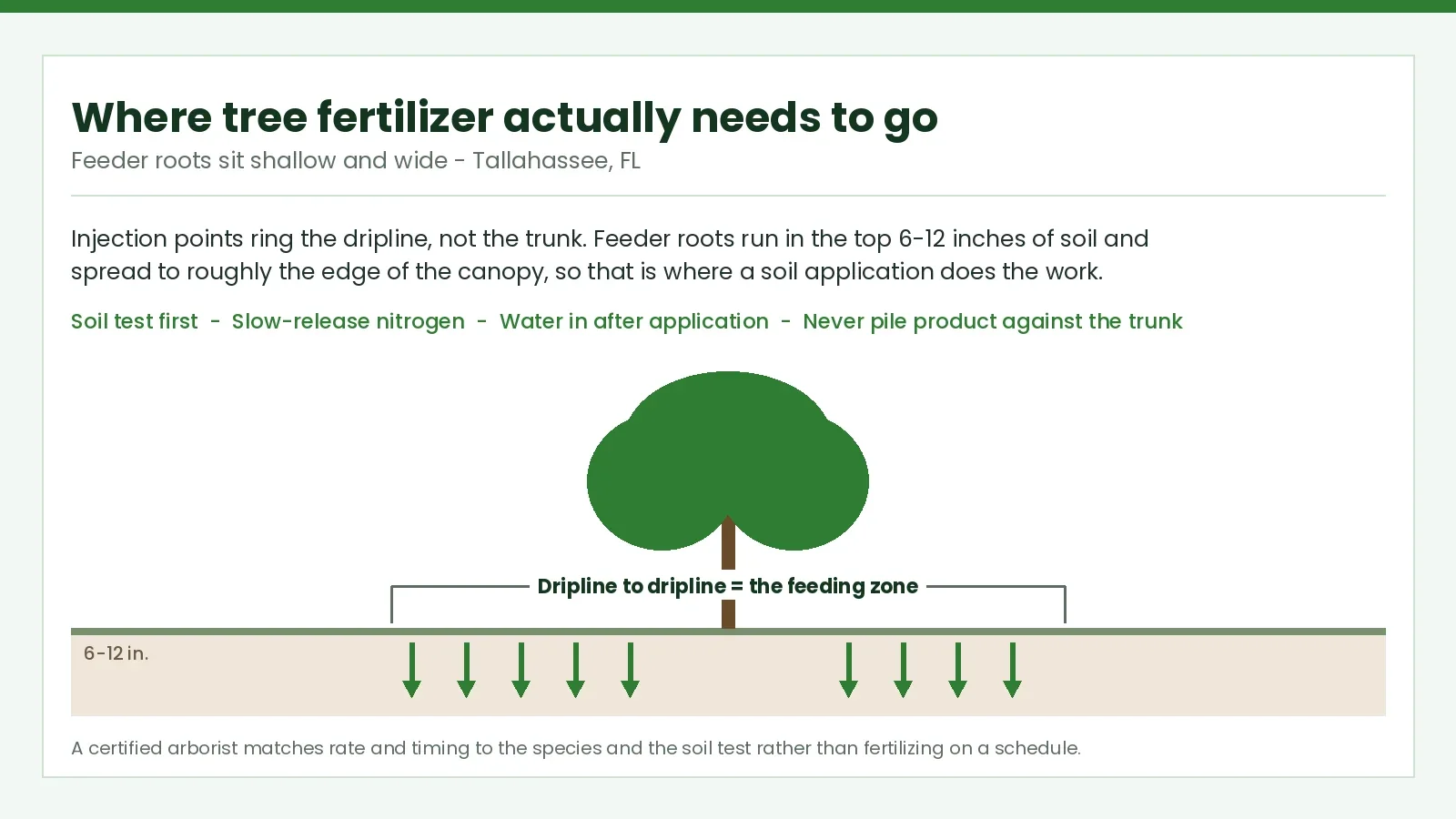
Tree fertilization is not lawn fertilization. Turf-grade granular products applied at the dripline rarely reach a mature tree’s feeder roots, which can extend two to three times the canopy radius and sit 6-12 inches below the surface. Professional tree fertilization uses deep-root injection — a high-pressure probe that delivers liquid nutrients directly into the root zone at 6-10 inch depth.
The right blend depends on what your tree is missing. A soil sample is pulled first, pH and nutrient analysis run, then a product formulated that addresses the specific deficiency. In Tallahassee’s acidic red-clay soils, iron and manganese chlorosis are common in oaks. In sandy north-side lots, nitrogen leaches fast and trees need slow-release sources. One-size-fits-all “tree food” is rarely the right answer.
Storm damage or a tree on your house? Call now.
Stay out of rooms under the tree and keep clear of downed lines — report those to the power company first. Then call and we’ll connect you with a local tree crew that handles storm work.
📞 Call (858) 319-0022Free 24/7 dispatch line · availability varies by storm volume
When Trees Need Fertilization
Healthy mature trees in undisturbed forest soils rarely need supplemental nutrients — the leaf-litter cycle does the work. Urban and suburban trees are a different story. Fertilization is worth considering when you see yellowing leaves with green veins (chlorosis); slow growth or short annual shoot extension; small, sparse, or off-color foliage; a tree recovering from construction damage or root disturbance; a tree recently transplanted (years 1-3); or a tree under disease or insect stress that needs vigor support.
Local arborists commonly fertilize trees after storm damage assessments, after emergency removals of nearby trees that disrupted the root zone, and as part of a long-term plan for legacy live oaks and southern magnolias.
What the Tallahassee Tree Fertilization Process Typically Covers
- Soil sample — 4-6 cores pulled from the dripline, sent for lab analysis, and read by the arborist rather than relying on bag-label guesswork.
- Visual assessment — leaf color, canopy density, twig dieback, bark condition, and trunk flare.
- Custom formulation — the right NPK ratio plus chelated micronutrients (iron, manganese, zinc) and bio-stimulants as needed.
- Deep-root injection — high-pressure probe applications on a grid pattern under the canopy at 30-36 inch spacing.
- Mulch refresh — if needed, a top-dress with composted hardwood mulch to feed soil biology.
- Follow-up — most trees get a second application 90-120 days later in the same season; annual soil re-testing for chronic deficiency cases.
Tallahassee-Specific Fertilization Factors
Leon County soils run acidic — typical pH ranges 4.8 to 5.8 — which locks up phosphorus and several micronutrients even when they’re present. Adding more fertilizer to a pH-limited soil is wasted money. A lime application 60 days before fertilization is often recommended to unlock what’s already in the soil profile.
Local climate also matters. Tallahassee’s hot, humid summers push pathogens hard, and an over-fertilized tree puts on lush, soft growth that’s catastrophically vulnerable to fungal disease and boring insects. Heavy nitrogen pushes are generally avoided in May-August, with most applications timed to early spring (Feb-March) and fall (Oct-Nov).
Species matter too. Live oaks and laurel oaks tolerate moderate fertilization well, but longleaf pine actively resents nitrogen and should never be fertilized as if it were a hardwood. Sabal palms have their own micronutrient demands — particularly potassium and magnesium — that require a palm-specific blend, not a general tree formula.
What Drives Tree Fertilization Cost in Tallahassee
- Soil sample with lab analysis — number of sample points across the property, plus the lab’s fee for the panel run
- Deep-root injection (small tree, under 15″ DBH) — priced by the number of injection points around the drip line, which scales with trunk diameter
- Deep-root injection (medium tree, 15-30″ DBH) — a wider drip line means more injection points and more product volume
- Deep-root injection (large tree, 30″+ DBH) — a mature live oak’s root zone can extend well past the canopy edge, and hose runs from the truck add time
- Annual fertilization program (3-5 trees) — bundled visits cost less per tree than one-off calls because mobilization is shared
- Palm-specific feeding (sabal/queen) — a slow-release palm blend with the right potassium and magnesium ratio costs more per unit than a general tree formula
Many homeowners save money over multiple seasons by enrolling in an annual program — two visits a year, one soil test a year, and applications skipped when the soil report says they aren’t needed.
Frequently Asked Questions
When is the best time to fertilize trees in Tallahassee?
Late February through March is the prime window — trees are breaking dormancy and root systems are most active. A secondary window opens in October-November for cool-season feeding before winter dormancy.
Will fertilization save a sick tree?
Sometimes yes, sometimes no. Fertilizer addresses nutrient deficiency, not disease. If your tree has root rot, vascular wilt, or borer infestation, fertilizer alone won’t fix it — you need a tree health inspection first.
How often should mature trees be fertilized?
Most established Tallahassee shade trees benefit from fertilization every 2-3 years, not annually. Over-fertilization causes more problems than it solves.
Is granular fertilizer dropped on the lawn enough?
No. Lawn fertilizer is formulated for grass and applied at depths that benefit grass roots, not the deep feeder roots of trees. It also often contains weed killers that can damage tree roots.
Do palms need different fertilizer than hardwoods?
Yes. Sabal palms, queen palms, and other palms need a palm-specific blend with extra potassium, magnesium, and manganese. Generic tree fertilizer can actually trigger deficiency symptoms in palms.
Can fertilization help a tree recover from hurricane damage?
Yes, as part of a broader recovery plan that includes proper pruning, soil decompaction, and irrigation. Most arborists wait 60-90 days post-storm before fertilizing so the tree’s wound response can stabilize first.
Is organic fertilization available?
Yes — many arborists in our network use OMRI-listed compost extracts, mycorrhizal inoculants, and organic nitrogen sources for clients who prefer organic-only programs.
Will fertilizer make my tree grow faster?
Mildly, in trees that are nutrient-deficient. In trees that are not deficient, extra fertilizer mostly produces soft, disease-prone growth without speeding mature size.
Want a soil-tested fertilization plan for your trees? Call now on our homepage for an arborist visit.