Tree Risk Assessment Tallahassee: Visual vs Advanced

Tree risk assessment for Tallahassee yards is one of the most important — and most misunderstood — services in residential tree care. Tallahassee’s mature canopy is dense with 60-to-200-year-old live oaks, southern magnolias, water oaks, sweetgums, and longleaf pines, most of them growing over homes, driveways, and play areas. The question every homeowner eventually asks the arborists in our network is: “is this tree safe?” The honest answer requires more than a glance at the trunk. This guide walks through the ISA tree risk assessment levels, when the visual-only assessment is enough, and when advanced diagnostic tools are warranted.

The ISA Tree Risk Assessment Framework

The International Society of Arboriculture (ISA) publishes a three-level structure for tree risk assessment that has become the industry standard. Each level produces a different depth of analysis:

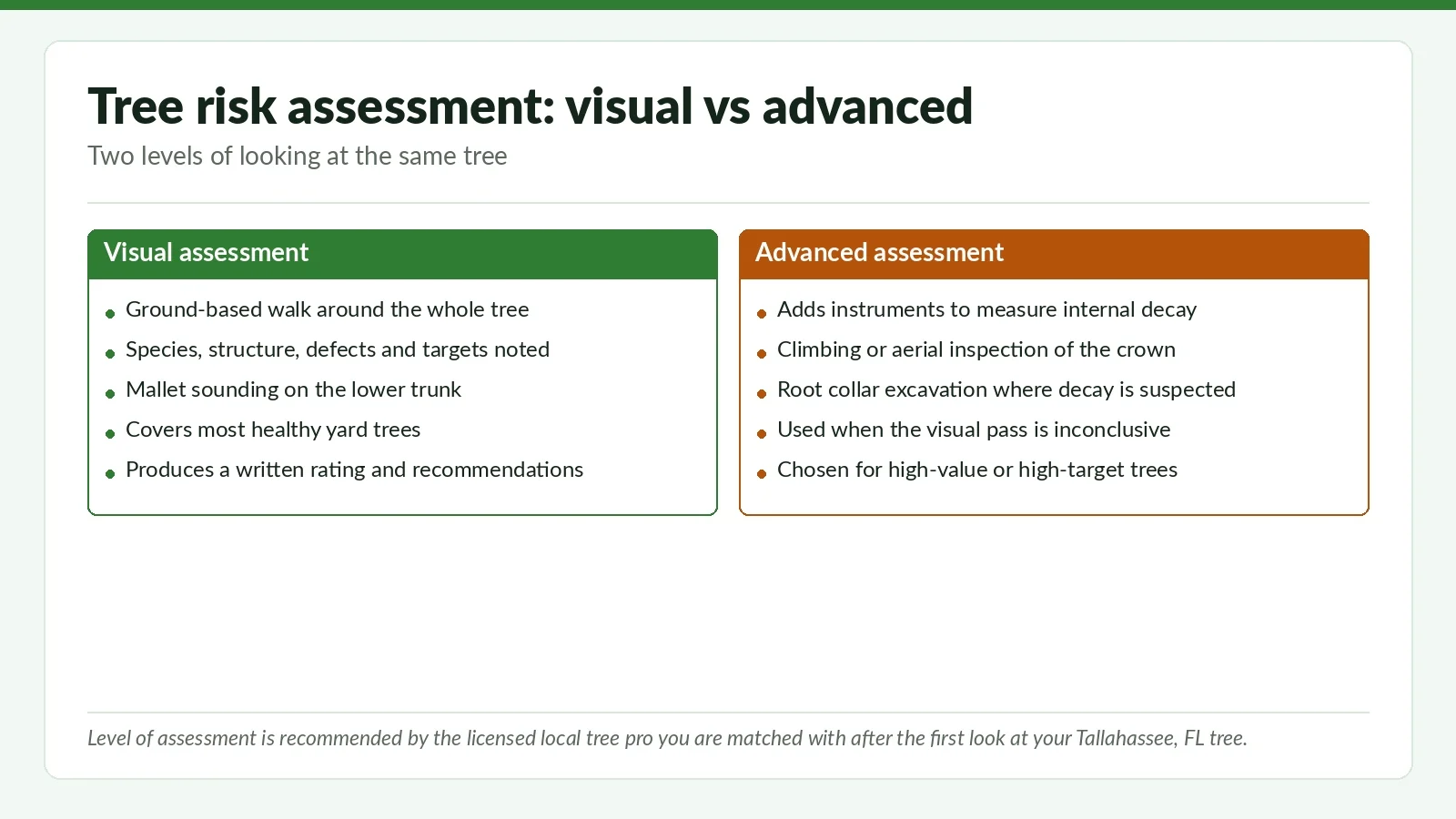
  • Level 1 — Limited Visual: a walk-by or drive-by assessment, typically conducted on multiple trees quickly. Useful for inventory-level work like utility right-of-way clearance or HOA-wide assessments. Documents only obvious defects.
  • Level 2 — Basic: a 360-degree visual inspection from the ground, with notes on canopy, trunk, root flare, and structural unions. The standard residential assessment. Documents defects, conditions of concern, and recommendations for management.
  • Level 3 — Advanced: a Level 2 assessment plus one or more advanced diagnostic techniques: aerial inspection, resistance drilling, sonic tomography, root collar excavation, or other quantitative tests. Used for trees where Level 2 findings warrant additional investigation, or for high-target situations (trees over primary residences, schools, or pedestrian areas).

For background on the certified professionals who perform these assessments, see our guide on ISA-certified arborist vs general tree service.

What a Level 2 Assessment Covers in Tallahassee

The standard residential assessment in Tallahassee covers a structured checklist:

  • Site context: targets (structures, vehicles, play areas), occupancy patterns, prevailing wind exposure, soil and drainage conditions
  • Root flare and root collar: evidence of buried trunk (planting depth), girdling roots, mechanical damage from mowers or construction, exposed roots, soil heaving
  • Trunk: wounds, cavities, decay indicators (fruiting bodies, weeping, hollow sound when tapped), bark inclusion, lean, sweep
  • Major branches and unions: included bark in V-shaped unions, dieback, cracks, prior wound closure, lateral limb loads over targets
  • Canopy: overall density, dead branches, leaf color, recent dieback patterns, prior pruning quality, species-specific issues
  • Site-specific concerns: recent construction, drainage changes, lightning history, storm damage, pest pressure such as bark beetles in stressed longleaf and other pines, and disease pressure

The output is typically a written report with photos, identified defects, target ratings, and recommended actions. Often, Level 2 is sufficient to recommend mitigation, pruning, or removal.

When Level 3 Advanced Diagnostics Are Warranted

Level 3 testing adds quantitative data when Level 2 findings raise questions that visual inspection can’t fully resolve. Common Tallahassee scenarios:

  • Suspected internal decay in a live oak over a primary residence: resistance drilling or sonic tomography can quantify remaining sound wood and inform a defensible keep-or-remove decision
  • Visible cavity with unknown extent: advanced testing maps the cavity’s true dimensions and shell thickness
  • Recent partial root failure or significant lean: root collar excavation can identify damaged structural roots that visual inspection misses
  • Heritage tree on a permit-sensitive site: when removal of a §5-83-protected tree is being requested, Level 3 documentation supports the regulatory case — see our Tallahassee tree permit guide
  • Litigation, insurance, or post-failure investigation: Level 3 reporting is the standard documentation in those contexts

Level 3 testing is more expensive but produces data that visual assessment alone cannot — that data often pays for itself by avoiding either premature removal or an unsafe-keep decision.

What an Assessment Recommends

A risk assessment in Tallahassee typically results in one of the following recommendations:

  • Monitor: minor concerns with low-risk targets; periodic visual reassessment
  • Mitigate through pruning: reducing canopy weight, removing dead branches, addressing structural defects — see our tree pruning cost guide
  • Mitigate through support systems: cabling and bracing for documented structural concerns — see our cabling and bracing guide
  • Mitigate through site changes: removing targets (relocating playground equipment, parking, etc.) when the tree is otherwise sound
  • Remove: when defects, decay, or targets create unacceptable risk that can’t be reasonably mitigated
  • Recommend Level 3 follow-up: when visual findings warrant quantitative data before a keep/remove decision

What Tallahassee Homeowners Often Get Wrong

Three common misconceptions show up regularly:

  • “My tree looks fine, so it must be fine”: visible canopy health can persist for years after significant structural damage. A live oak with 40 percent trunk decay can still produce a full canopy
  • “This tree has been here for 100 years, it’ll last another 100”: aging trees develop defects at predictable rates; longevity is not a guarantee of continued structural integrity
  • “My insurance covers it if it falls”: insurance typically covers damage from named storms; failures from pre-existing defects identified or identifiable in routine assessment may be excluded

Cost Norms for Risk Assessment in Tallahassee

  • Level 2 assessment, single tree: typically varies by size & access depending on tree size and report depth
  • Level 2 assessment, multi-tree property: varies by size & access for a 5-to-15-tree assessment
  • Level 3 with resistance drilling (per tree): varies by size & access including report
  • Level 3 with sonic tomography (per tree): varies by size & access including report
  • Root collar excavation: varies by size & access

Schedule a Tree Risk Assessment in Tallahassee

To schedule a tree risk assessment in Tallahassee — Level 2 visual, Level 3 advanced, or a multi-tree property survey — call Tallahassee Tree Service Co. at . The ISA-certified arborists in our network will conduct the appropriate assessment level, document findings with photos and recommendations, and walk through the keep/mitigate/remove decision for each tree.

Frequently Asked Questions

How often should I have my trees risk-assessed?
For most residential properties, every 3 to 5 years is reasonable for healthy mature trees. Annual or post-storm assessments are appropriate for high-value, high-target trees or after a significant wind event.

Does my insurance require an arborist report?
Some homeowners insurance carriers require periodic tree inspection on properties with mature canopies; many do not. Post-failure claims sometimes hinge on whether the defect would have been visible to a qualified inspector.

Can I get a free risk assessment?
Many companies offer free initial walk-throughs that identify obvious hazards and quote removal or pruning work. A formal, documented Level 2 assessment with written report is typically a paid service.

What does “target” mean in a risk assessment?
A target is anything of value that could be damaged if the tree (or part of it) failed — a house, vehicle, neighboring structure, road, walkway, playground equipment. Risk is the combination of failure likelihood × target presence × consequences of failure.

Will a risk assessment recommend removing my tree?
Sometimes. The arborist’s job is to scope risk honestly — if defects and targets create unacceptable risk that can’t be reasonably mitigated, removal is the responsible recommendation. Many assessments recommend mitigation rather than removal.