Walk through some of Tallahassee’s older neighborhoods and you’ll spot camphor trees everywhere — big, broad-canopied evergreens that were planted decades ago for shade and have since grown into some of the largest ornamental trees on the block. They’re also one of the more misunderstood trees homeowners deal with, because a camphor causes a different set of problems than a native live oak or water oak, and removing one is often a bigger job than it looks from the driveway.
If you’re weighing whether a camphor tree in your yard needs to come out, here’s what actually matters — and if you want the fuller picture on how tree jobs get scoped and priced locally, our complete Tallahassee tree service homeowner guide covers that in more depth.
Why Camphor Trees Cause Different Problems Than Native Shade Trees
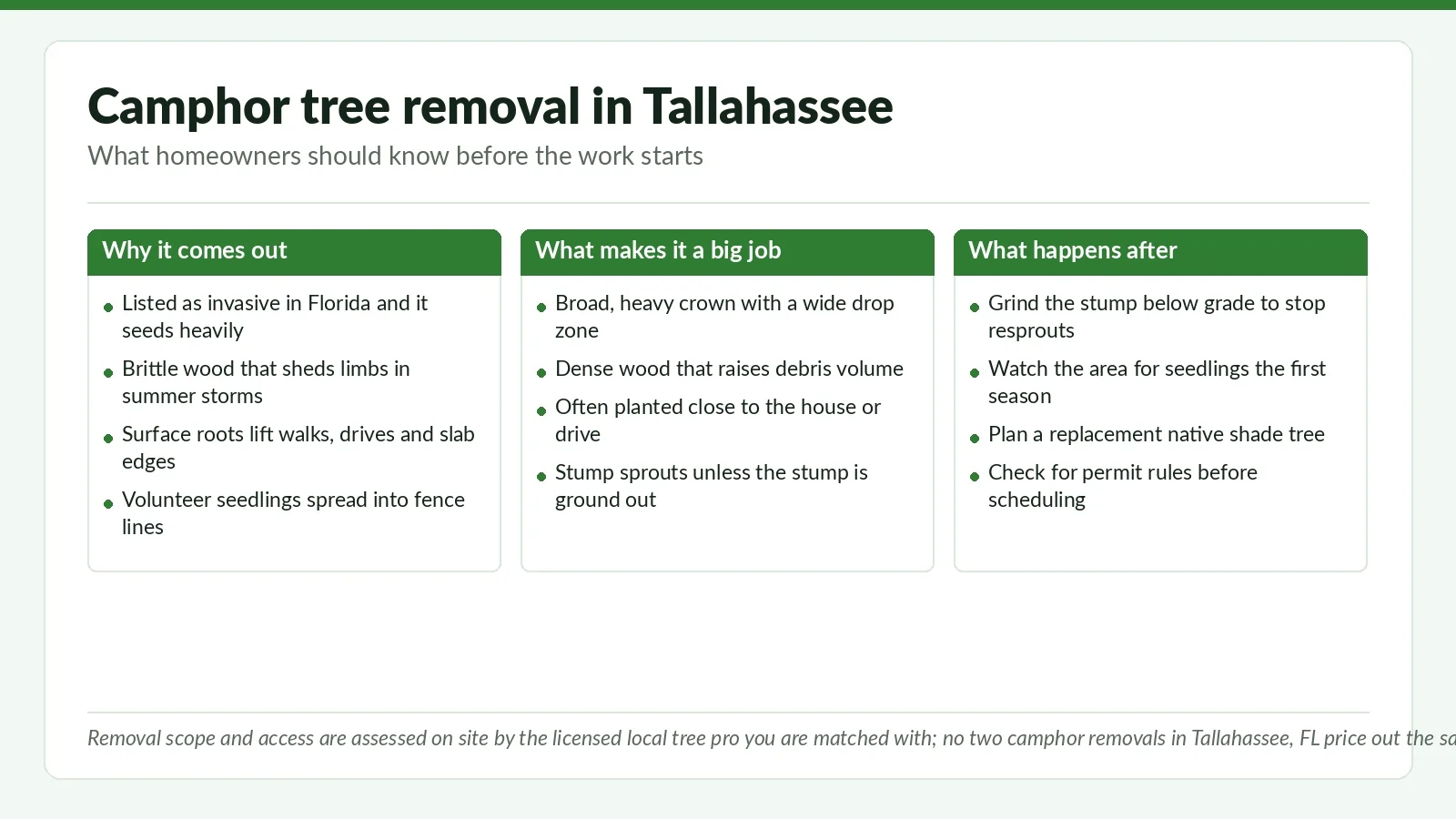
Camphor (Cinnamomum camphora) isn’t native to North Florida — it was widely planted as an ornamental shade tree in the early-to-mid 1900s and has since spread on its own, which is why it’s widely categorized as an invasive species in Florida. A few things homeowners run into with a mature camphor:
- Aggressive surface roots. Camphor roots tend to run shallow and wide, which is why you’ll often see them lifting sidewalks, driveways, or pool decks near an older specimen.
- Heavy fruit and seed drop. Camphors produce large amounts of small dark berries that birds spread widely, which is part of why the species keeps showing up in wooded areas around Leon County on its own.
- Dense canopy. A mature camphor can shade out grass and smaller plantings underneath it more thoroughly than most native shade trees.
- Strong odor when cut. The wood and leaves carry the camphor scent the tree is named for — not a safety issue, but it surprises people the first time a crew starts cutting.
Tap to call (858) 319-0022 — get connected to a licensed Tallahassee tree pro
Storm damage or a tree on your house? Call now.
Stay out of rooms under the tree and keep clear of downed lines — report those to the power company first. Then call and we’ll connect you with a local tree crew that handles storm work.
📞 Call (858) 319-0022Free 24/7 dispatch line · availability varies by storm volume
What Makes Camphor Removal a Bigger Job Than It Looks
Older camphor trees around Tallahassee often have trunk diameters that rival mature oaks, and many have multiple co-dominant leaders splitting low on the trunk rather than one clean central stem. That structure changes how a crew approaches the job — it usually means more careful, sectioned rigging rather than a straight drop, especially when the tree is close to a house, fence, or driveway, which is common since these were often planted right next to the home decades ago.
The dense canopy also means more debris volume than homeowners typically expect. And because the root system is shallow and wide-spreading, a camphor removal is one of the cases where stump grinding is worth discussing up front — leftover roots from an unground camphor stump have a track record of sending up new sprouts for a season or two afterward.
What to Expect When You Call
The licensed tree pro you get connected with will typically want to know the trunk diameter (a hug-around estimate is fine), how tall the tree is relative to the roofline, and what’s within falling distance — a fence, a shed, a neighbor’s yard, power lines. If the camphor has already lifted a nearby walkway or driveway, mention that too, since it can affect how equipment gets positioned for the job.
Because camphor wood is dense, cleanup and hauling tends to take longer than a similarly sized pine. Ask about stump grinding at the same time if you don’t want to deal with regrowth later — it’s usually easier to schedule both pieces together.
Quick Answers
Are camphor trees actually invasive in Florida?
Camphor is widely listed as a Category II invasive species by Florida invasive-plant councils, meaning it has shown a tendency to spread into natural areas without necessarily displacing native plant communities the way a Category I species does. It’s still a legitimate reason many homeowners choose to remove one rather than replant with the same species.
Do I need a permit to remove a camphor tree in Tallahassee?
Permit requirements depend on the tree’s size, species, and location within city or county limits. The licensed tree pro you’re connected with can tell you what applies to your specific address before work starts.
Will removing a camphor tree keep it from coming back?
A cut trunk alone often isn’t enough — camphor stumps can resprout. Stump grinding or a follow-up treatment on the stump is usually what actually stops regrowth, so it’s worth asking about when you schedule the removal.
Tallahassee Tree Service is a 24/7 dispatch line that connects Leon County homeowners with licensed local tree pros. We don’t send our own crew — we get you on the phone with one fast so someone experienced can size up the job correctly.