New Tallahassee subdivisions built over the last couple of decades sit on some of the same Red Hills clay soil that gives the region its famous canopy roads – but the construction process itself often leaves that soil in far worse condition for a newly planted tree than the same clay would be in an established, undisturbed yard. Heavy equipment traffic during grading and home construction compacts clay soil in a way that can take years to reverse on its own, and a young tree’s root system is the first thing to suffer for it.
Why Construction-Compacted Clay Is Different From Ordinary Clay
Tallahassee’s native clay soil already drains more slowly and resists root penetration more than sandy soil found elsewhere in north Florida. Construction equipment – graders, compactors, and repeated heavy truck traffic across a lot before and during a home build – compresses that clay further, collapsing the small pore spaces roots and water both depend on. The result is subdivision soil that can be measurably denser immediately around a new home’s foundation and along disturbed areas than the same clay would be in a wooded lot that was never graded.
Storm damage or a tree on your house? Call now.
Stay out of rooms under the tree and keep clear of downed lines — report those to the power company first. Then call and we’ll connect you with a local tree crew that handles storm work.
📞 Call (858) 319-0022Free 24/7 dispatch line · availability varies by storm volume
How Compaction Actually Hurts a Newly Planted Tree
Roots can’t penetrate compacted soil the way they need to
A young tree’s root system expands most effectively through soil with adequate pore space. Compacted clay forces roots to follow the path of least resistance, often growing shallow and lateral instead of establishing the deeper anchoring root structure a tree needs long-term.
Water either pools or barely penetrates
Compacted clay reduces infiltration, so rainfall and irrigation either run off the surface without reaching the root zone or pool in poorly graded low spots long enough to create the opposite problem – waterlogged, oxygen-starved soil right around a young tree’s roots.
Oxygen availability drops
Healthy root growth depends on oxygen reaching the root zone through soil pore spaces. Heavily compacted soil restricts that oxygen exchange, which can slow establishment even when a tree is otherwise being watered and cared for correctly.
Signs a New Tree Is Struggling With Compacted Soil
- Slow or stalled growth in the first one to two years after planting, well below what the species should typically show
- Leaves that wilt or scorch during dry periods despite regular watering
- Standing water near the root zone after rain that takes unusually long to drain
- Shallow, girdling, or surface-visible roots developing earlier than expected for the tree’s age
What Actually Helps at Planting Time
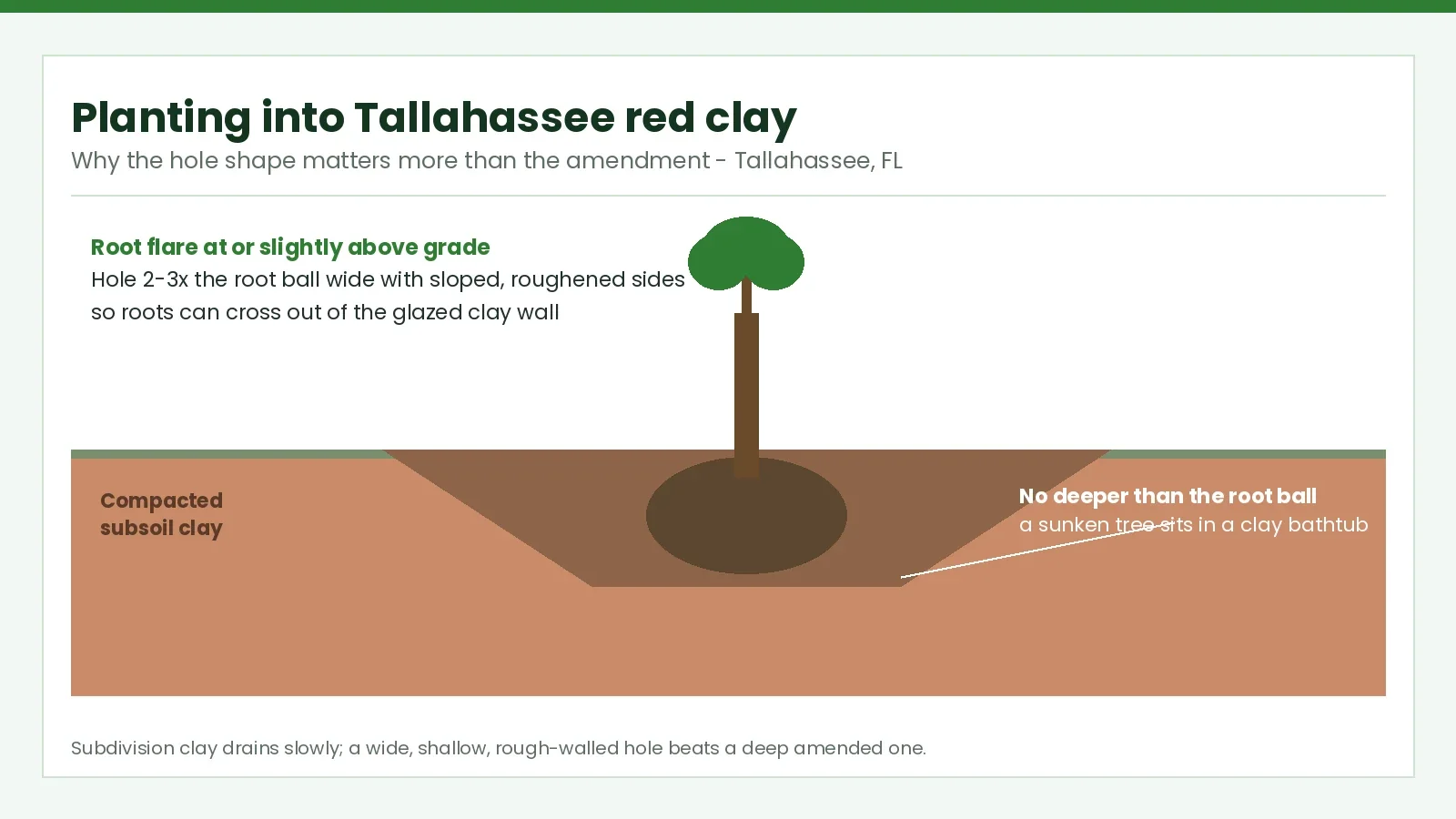
Digging a properly sized planting hole and breaking up compacted soil well beyond the immediate root ball – not just within it – gives new roots a meaningfully larger volume of workable soil to establish into. Amending backfill with organic matter, avoiding further equipment or foot traffic over the root zone once planted, and applying a proper mulch ring all help counteract what construction traffic did to the site before the tree ever went into the ground. For an established planting struggling to establish, addressing soil compaction and considering supplemental care such as deep-root fertilization can help a stressed root system catch up.
Why Species Choice Matters More in New Subdivisions
Some species tolerate compacted, disturbed subdivision soil noticeably better than others during establishment. A conversation about species selection for a specific lot’s soil condition, sun exposure, and drainage – before planting, not after a tree has already struggled for a year or two – is worth having with a professional familiar with local conditions. See our live oak care guide for background on one of the more resilient options for this region.
When to Call a Professional
A newly planted tree that is stalled, discolored, or showing signs described above deserves a professional look rather than continued guessing, particularly if you are unsure whether the issue is watering, soil compaction, or something else entirely. A tree health assessment can evaluate root zone conditions directly rather than relying on above-ground symptoms alone.
Frequently Asked Questions
How long does construction-compacted clay soil take to recover on its own?
Left completely undisturbed, natural processes like root growth, freeze-thaw cycling, and soil organism activity can slowly decompact clay over years, but a newly planted tree usually cannot wait that long for the soil around it to improve without help at planting time.
Can I test whether my subdivision soil is significantly compacted?
A simple way to get a sense of it is how easily a soil probe or shovel penetrates the ground when barely damp – compacted clay resists penetration noticeably more than loose, undisturbed soil. A professional assessment gives a more definitive picture.
Does adding topsoil on top of compacted clay fix the problem?
Not on its own. Topsoil added over compacted subsoil without breaking up the layer underneath can create a boundary that still restricts root and water penetration into the original ground.
Are all new Tallahassee subdivisions built on compacted clay?
Not universally, but grading and heavy equipment traffic during construction commonly compact native clay to some degree across most new-build lots in the region, making it worth checking rather than assuming either way.
Should I wait to plant trees until construction traffic on my lot is completely finished?
Yes, when possible – planting after all heavy equipment and construction traffic has concluded avoids new compaction on top of a tree that is still trying to establish.
Schedule a Tree Health Assessment in Tallahassee
To have a struggling new planting or subdivision soil condition assessed, call Tallahassee Tree Service Co. at (858) 319-0022. The ISA-certified arborists in our network can evaluate root zone conditions and recommend the right path to help a young tree establish.
Tallahassee Tree Service Co. is a dispatch and matching service. We connect homeowners with independent, licensed and insured tree professionals – we do not perform tree work ourselves.