Mulch Volcanos — The Most Common Slow-Kill on Tallahassee Trees
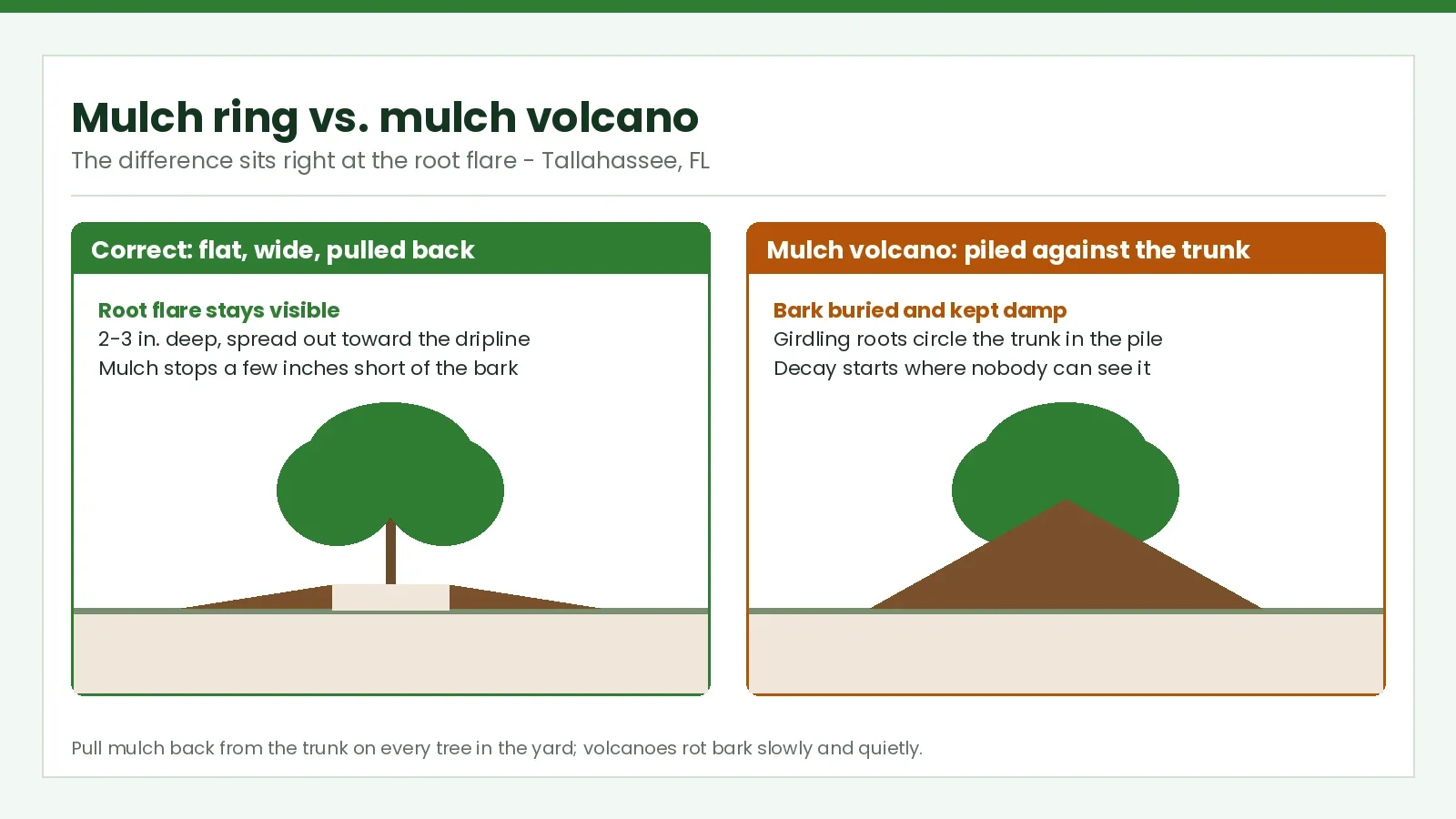
Drive any Tallahassee street and you’ll see them everywhere: trees with mulch piled in cone shapes against the trunk, often 6-12 inches deep right at the bark. They’re called “mulch volcanos” and they’re one of the single most common slow-killers of mature trees in this town.
Mulch volcanos look tidy. They look professional. They’re sold to homeowners by lawn-service crews as “tree care.” And they’re killing trees over 5-10 year timelines while the homeowners think everything’s fine.
Call now to get connected with a licensed local arborist for an ISA-certified tree-health assessment if you’ve been mulch-volcanoed.
Storm damage or a tree on your house? Call now.
Stay out of rooms under the tree and keep clear of downed lines — report those to the power company first. Then call and we’ll connect you with a local tree crew that handles storm work.
📞 Call (858) 319-0022Free 24/7 dispatch line · availability varies by storm volume
Why Mulch Volcanos Hurt Trees
Root collar suffocation. The root collar — where the trunk transitions to the root system — needs to breathe. It’s evolved to be exposed to air. Burying it under mulch reduces oxygen exchange and creates the conditions for collar rot.
Trunk bark decay. Bark exposed to constant moisture against piled mulch eventually decays. Decay opens the door for pathogens. The tree starts losing structural integrity at the base.
Girdling roots. When mulch is piled against the trunk, the tree responds by sending adventitious roots up into the mulch (because there’s moisture and nutrients there). Those roots grow around the trunk and eventually strangle it — literally — at the base. Girdling roots are a documented major cause of premature decline in landscape trees.
Rodent damage. Mulch volcanos create habitat for voles and field mice, which then chew on the trunk bark under the cover of the mulch. The damage is hidden from view.
Pathogen entry. The constant moisture and air-exclusion environment is ideal for fungi like Armillaria and Phytophthora to enter the tree.
What the Right Mulch Job Looks Like
The right approach is sometimes called the “donut method” — flat ring of mulch, not a cone:
- Depth: 2-4 inches of organic mulch
- Spread: From a few inches OFF the trunk out to the dripline (or as far as practical)
- Trunk flare exposed: The root collar should be visible, not buried
- Material: Pine straw, hardwood chips, or shredded bark are all fine in Tallahassee
- Refresh: Annually; don’t keep piling new mulch on top of old without removing old material first
Done right, mulching is genuinely beneficial — moisture retention, weed suppression, soil temperature regulation, gradual organic matter return to the soil.
How to Fix a Mulch Volcano
If your tree has been mulch-volcanoed for months or years:
Step 1. Carefully excavate the mulch away from the trunk down to the original soil level. Use a small trowel or your hands — don’t tear through bark or roots.
Step 2. Inspect what you find. Is the bark intact? Are there girdling roots starting to form? Is there visible decay? Photos are worth taking.
Step 3. Remove any girdling roots that are visible and not yet structural. (Large girdling roots that have integrated into the trunk usually can’t be removed safely — that’s an arborist conversation.)
Step 4. Re-mulch correctly using the donut method.
Step 5. Monitor for the next year. Significant girdling root removal or bark damage may stress the tree visibly, and a soil-tested tree fertilization visit can help a stressed tree rebuild vigor once the root collar is exposed and healing.
For trees that have been buried for years and show signs of decline (canopy dieback, root collar decay, structural problems), get an ISA-certified assessment from the arborists in our network. Sometimes the damage is reversible; sometimes the tree needs removal before it becomes a hazard.
Species That Are Particularly Vulnerable
Live oak. Live oaks have prominent root flares that depend on exposure. Volcanos do disproportionate damage. See oak tree care framework.
Maple, dogwood, redbud. Thin-barked species are more vulnerable to bark decay from constant moisture.
Newly-planted trees. Volcanos applied at planting can cause girdling root development from year one.
Magnolia. Generally tolerant of mulch but still better with the donut method. See southern magnolia care.
Why Lawn Services Apply Volcanos
Most volcanos aren’t malicious — they’re a habit that propagated through the lawn-care industry over decades because cones LOOK like “more care” than flat rings. The aesthetic-first approach overrode the actual horticultural science.
If your lawn service is volcano-ing your trees, ask them to switch to the donut method. Or get matched with an ISA-certified arborist who treats the tree’s biology as the standard, not the visual.
Why Get Matched Through Us
Every assessment in our network is handled by an ISA-certified, insured arborist. We connect you with pros who don’t volcano — and who can fix volcanos already in place. Call now for an on-site visit.
Call now to get connected with a licensed local arborist.
FAQ
What is a mulch volcano?
Mulch piled in a cone shape against the trunk of a tree, often 6-12 inches deep at the base. Common landscape practice that damages trees over years.
How deep should mulch be around a tree?
2-4 inches, applied in a flat ring or “donut” extending from a few inches off the trunk out to the dripline.
Can a tree recover from a mulch volcano?
Sometimes yes if caught early and the damage hasn’t progressed to girdling roots or structural decay. Often the damage is partially reversible.
Should the root flare be visible?
Yes. The root flare (trunk-to-root transition) should be exposed, not buried under mulch.
What kind of mulch is best in Tallahassee?
Pine straw, hardwood chips, and shredded bark all work. Organic, breaks down naturally, supports soil biology.
How often should mulch be refreshed?
Annually. Remove old material before adding new where possible.