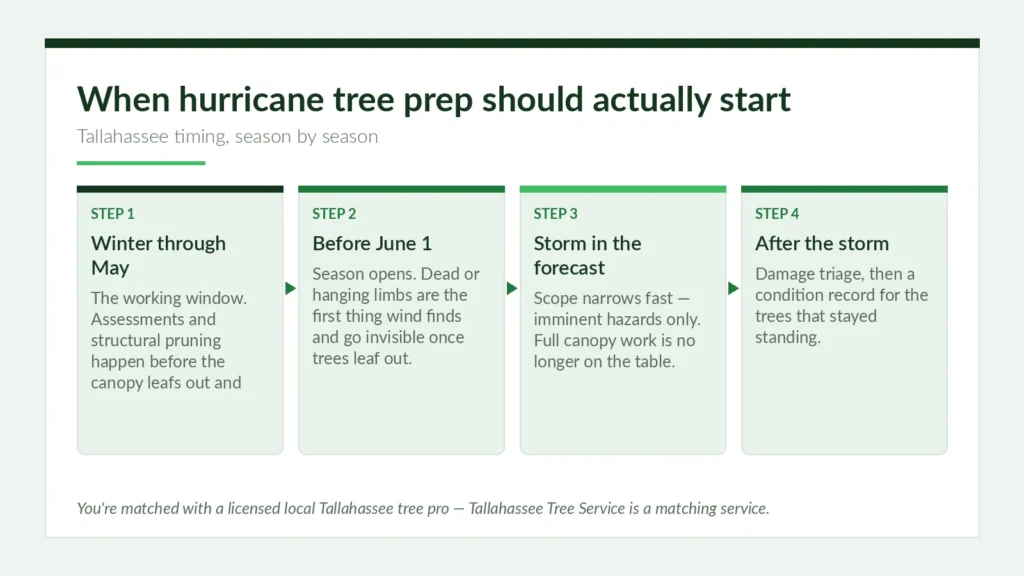
Hurricane tree prep in Tallahassee means acting before a storm forms, not after: remove dead or hollow limbs, thin dense canopy so wind passes through instead of pushing against it, and get any leaning or root-heaved tree assessed well before June. NOAA’s Atlantic hurricane season runs June 1–November 30, with the Big Bend’s highest-risk window typically mid-August through October — the same stretch Leon County has taken the worst direct hits historically.
Tallahassee’s canopy is one of the things that makes the city feel the way it does — mature live oaks, laurel oaks, and pines shading nearly every older neighborhood. It’s also the reason storm prep here looks different than it does in a city with young, thin street trees. A big, healthy oak is an asset. A big oak with a hidden cavity, a girdling root, or a canopy nobody’s thinned in a decade is a liability waiting on the right wind speed.
When Should Hurricane Tree Prep Actually Start?
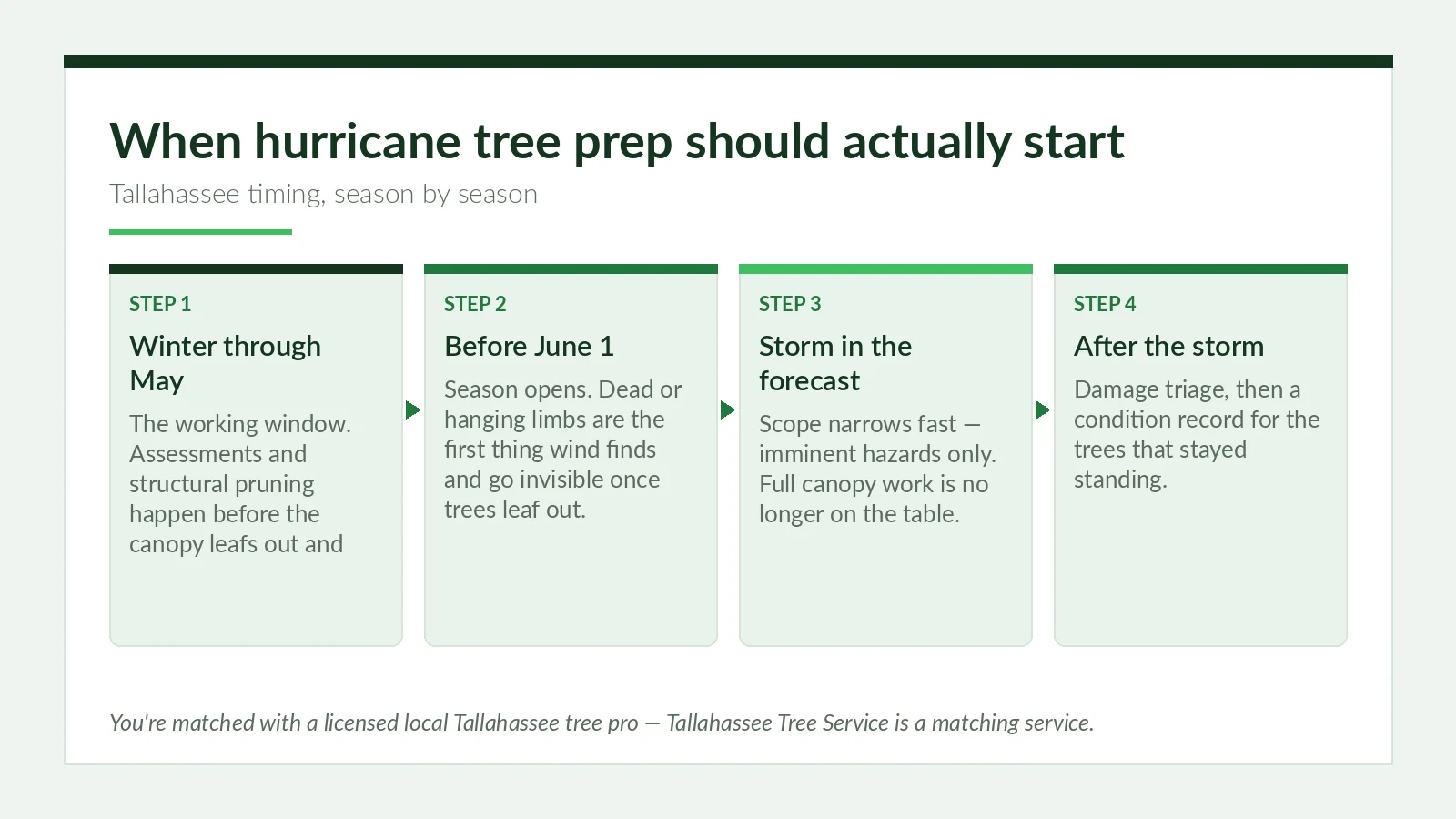
The honest answer is before the season opens, not once a storm is named. NOAA’s Atlantic hurricane season runs June 1 through November 30, and while any part of that window can produce a direct hit on the Big Bend, the National Hurricane Center’s own climatology shows activity clustering hardest from mid-August into October. That leaves a real prep window in late spring — enough time to get a leaning or hazard tree assessed and addressed before storm season peaks, instead of trying to book emergency work with a hurricane already in the forecast.
Storm damage or a tree on your house? Call now.
Stay out of rooms under the tree and keep clear of downed lines — report those to the power company first. Then call and we’ll connect you with a local tree crew that handles storm work.
📞 Call (858) 319-0022Free 24/7 dispatch line · availability varies by storm volume
Which Trees Actually Need Trimming Before a Storm?
- Dead or hanging limbs — these are the first thing wind finds, and they’re often invisible from the ground once leafed out.
- Dense, overloaded canopies — a canopy that’s never been thinned catches wind like a sail instead of letting gusts pass through.
- Limbs overhanging the roofline, driveway, or power service drop — the closer a limb is to the house, the smaller the failure needs to be to cause damage.
- Laurel oaks and water oaks with visible cavities or fungal conks — these species are more prone to interior decay than live oaks and fail with less warning.
Which Trees Should Come Down Instead of Just Being Trimmed?
Trimming buys time on a tree with a fixable problem — overloaded limbs, deadwood, a canopy that needs thinning. It doesn’t fix a structural problem. A tree with root heaving on one side, a trunk lean that’s gotten worse over a season, or a cavity that takes up a large share of the trunk cross-section is a removal conversation, not a trim conversation, and that’s a call worth getting an arborist’s eyes on rather than guessing from the yard.
Have a tree that looks like a storm risk? Get matched with a licensed, insured local Tallahassee arborist for a pre-season assessment — free to use, no obligation.
What Does a Pre-Storm Tree Assessment Actually Check?
A licensed local arborist walks the property looking for the failure points wind exploits first: co-dominant trunks with included bark (a classic weak union), root plate heaving or soil cracking on the windward side, cavities and conks signaling interior decay, and any limb with more weight than its attachment point can carry in a sustained gust. That assessment is also where a homeowner finds out whether a tree is a trim-and-monitor situation or a remove-before-June situation — and getting that answer in April is a very different experience than getting it two days before landfall.
How Does Storm Prep Change Once a Hurricane Is in the Forecast?
Once there’s an actual storm in the five-day cone, the priorities shift from long-term canopy health to immediate hazard reduction: securing or removing anything already loose, clearing debris piles that could become projectiles, and making sure nothing is actively leaning toward the house. This is also when arborist availability tightens fastest across the region, which is the practical case for doing structural work in spring rather than during storm week.
For homeowners dealing with damage after a storm has already passed through, the storm damage tree removal page covers documentation, insurance sequencing, and full-property cleanup once the emergency itself is over.
What Leon County Emergency Management Recommends
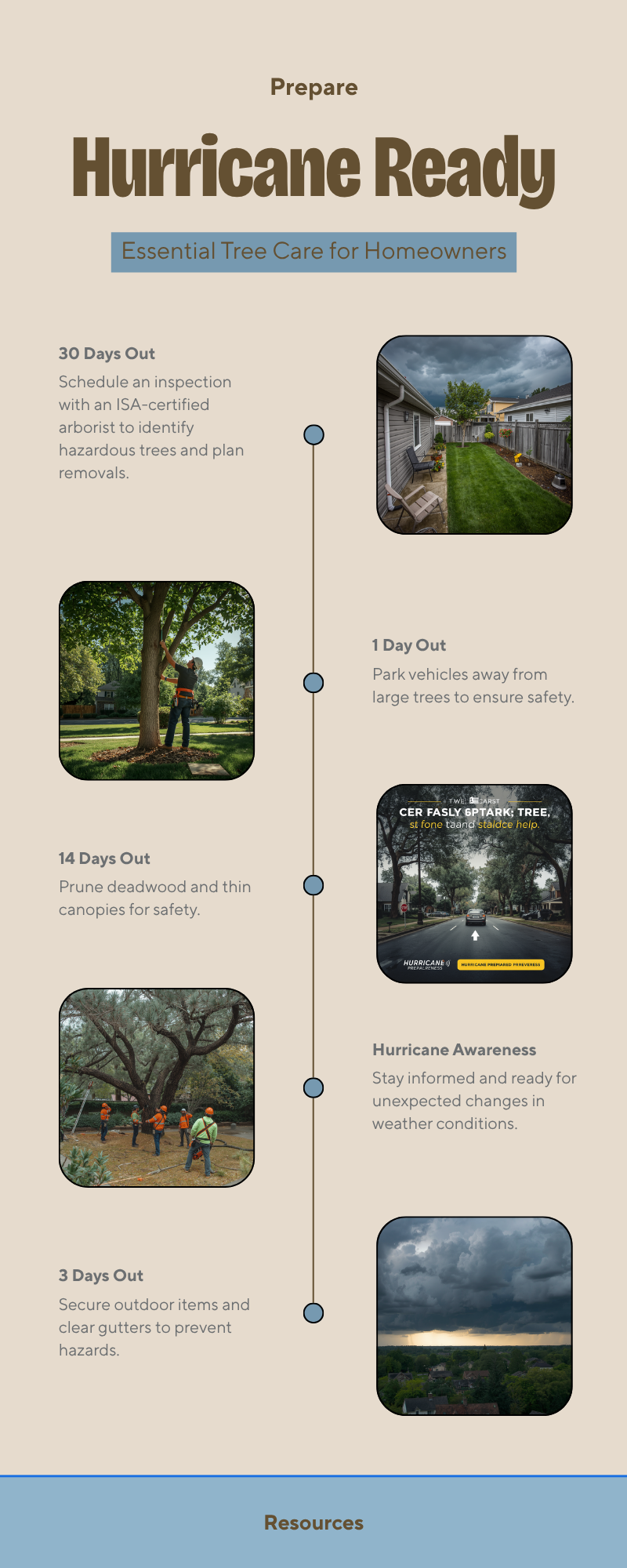
Leon County’s own emergency management guidance echoes the same core points every season: clear loose yard debris before a storm arrives (it becomes wind-driven debris otherwise), don’t wait until a watch is issued to deal with a tree you already know is a risk, and have a plan for who to call if a tree comes down on the structure during the storm itself. The county’s emergency management office publishes seasonal guidance homeowners can check ahead of each hurricane season.
What Happens If a Storm-Weakened Tree Fails Anyway?
Even a well-prepped canopy can lose a tree in a severe enough event — hurricane-force wind can bring down a healthy tree, not just a compromised one. If that happens, the licensed local arborist you’re matched with through Tallahassee Tree Service handles the assessment, the rigging plan, and the removal, and can also document the damage the way a homeowner’s insurance carrier expects to see it.
FAQ
When does hurricane season start in Tallahassee?
NOAA’s official Atlantic hurricane season runs June 1 through November 30, with the highest-risk stretch for the Big Bend typically falling between mid-August and October.
How far in advance should I get trees checked before hurricane season?
Late spring, ideally April or May, gives enough time to schedule an assessment and complete any trimming or removal work before storm activity picks up and arborist availability tightens.
Can trimming a tree actually help it survive a hurricane?
Yes, for the right kind of problem. Removing deadwood and thinning an overloaded canopy reduces wind resistance and the weight a limb attachment has to carry. It doesn’t fix a structural issue like root heaving or a major cavity.
Should I trim trees myself before a storm?
Ladder and chainsaw work on large limbs is exactly the kind of job that sends people to the ER every storm season. A licensed local arborist has the rigging and climbing equipment to do it safely, especially on anything near the roofline or power lines.
Tallahassee Tree Service is a free referral and dispatch service. We are not a licensed tree service provider and do not perform tree work ourselves. All work is performed by independent, licensed and insured third-party arborists in our network. Availability, pricing, and response times are determined solely by the dispatched provider and are not guaranteed.