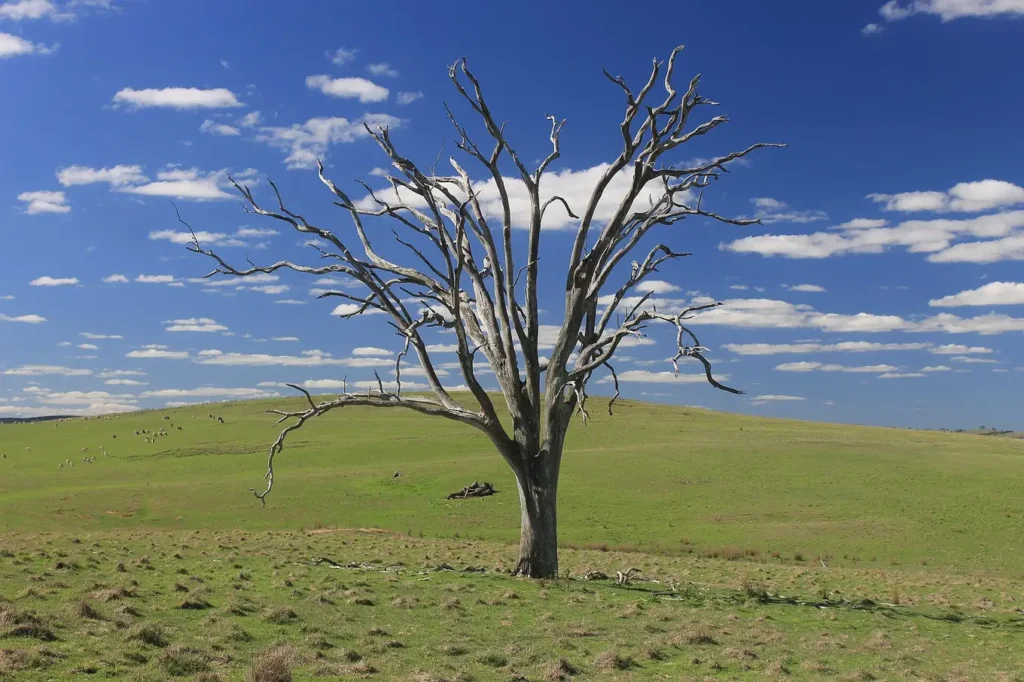
Quick answer: A dormant tree has bendable twigs, plump buds and green tissue under the bark. A dead tree has brittle twigs that snap, dry or missing buds, brown tissue under the bark, and often loose bark or mushrooms at the base. Pines are the exception: they don’t go bare in winter, so a pine with all-brown needles in Tallahassee is almost always dead or dying.
Every November and December, Tallahassee yards start to look rough. Sweetgums and red maples drop their leaves, crape myrtles go bare, bald cypresses turn rusty and lose their needles, and by late winter the laurel oaks shed a carpet of leaves too. Some of those trees are simply dormant. Others really did die over the summer, and fall is when that becomes obvious. Here’s how to tell the difference before you pay to remove a healthy tree, or leave a dead one standing over the house through storm season.
Trees that look dead but usually aren’t
- Deciduous hardwoods. Sweetgum, red maple, hickory, pecan, dogwood, redbud, crape myrtle, tulip poplar and many oaks drop all their leaves for winter.
- Bald cypress. It’s a conifer, but it’s deciduous. The needles turn orange-brown in fall and drop completely. Plenty of people assume a bald cypress by a pond is dead the first winter they own the house.
- Laurel oaks. These semi-evergreen oaks often drop a huge share of their leaves in late winter right before the new ones push out. A thin laurel oak in February isn’t automatically a problem.
- Live oaks in spring. Live oaks swap their old leaves for new ones in a few weeks in early spring and can look thin for a short stretch.
Storm damage or a tree on your house? Call now.
Stay out of rooms under the tree and keep clear of downed lines — report those to the power company first. Then call and we’ll connect you with a local tree crew that handles storm work.
📞 Call (858) 319-0022Free 24/7 dispatch line · availability varies by storm volume
Five checks you can do yourself
1. The scratch test
Use a fingernail or pocketknife to scrape a small spot of bark on a young twig. Bright green or moist pale green underneath means that part of the tree is alive. Brown, dry tissue means it’s dead. Test several twigs in different parts of the crown, because a tree can be partly dead.
2. The bend test
Living twigs bend before they break, even in winter. Dead twigs snap cleanly and sound dry.
3. Check the buds
Dormant deciduous trees carry next spring’s buds through the winter. Healthy buds look firm and full. On a dead branch, buds are shriveled, dry and crumble when you rub them, or are missing entirely.
4. Look at the trunk and bark
Bark that’s falling off in sheets, long vertical cracks, oozing, or bark that sounds hollow when tapped are warning signs. Small round holes and sawdust can mean wood-boring beetles.
5. Look at the base and roots
Mushrooms, shelf fungi or conks at the base or on the trunk, soft or crumbling wood at the root flare, and soil heaving or cracking on one side of the tree all point to decay or root problems. Those matter even on a tree that still has leaves.
Pretty sure that tree is dead?
Tap to reach the 24/7 dispatch line and get connected with a licensed local tree pro who can confirm it and quote the removal.
Tap to call (858) 319-0022Pines: a different rule
Loblolly, slash, longleaf and other pines around Tallahassee keep green needles year-round, shedding older needles mostly in the fall. A normal fall pine drops its older, inner needles while the needles at the branch tips stay green. A pine whose whole crown has turned yellow, red or brown is a different story, and usually means the tree is dead or dying.
After a dry summer or storm damage, stressed pines attract pine bark beetles. Look for small pitch tubes, which are little blobs of resin on the bark, fine reddish dust in bark crevices, and needles fading from the top down. Beetle-killed pines become brittle and can fail within months, so they’re worth dealing with quickly. The pine bark beetle guide covers what to watch for.
Why late fall is a good time to check
Dead limbs are easiest to see on evergreen trees in fall, before deciduous neighbors fill in again. On deciduous trees, a quick look once leaves drop, followed by another look in early spring when buds should open, tells you most of what you need to know. A tree that doesn’t leaf out by about mid-April, when the rest of the neighborhood has, deserves a closer look.
Fall and winter are also when tree crews tend to have more scheduling flexibility, and removing a dead tree before next year’s hurricane season is far easier than dealing with it after it lands on something.
Partly dead trees
Many trees aren’t fully alive or dead. A large oak may have a dead leader or a few dead scaffold limbs while the rest is healthy. Dead limbs over a roof, driveway or play area can often be removed with deadwood pruning rather than taking the whole tree. On the other hand, a tree that’s lost a large share of its crown, or has decay in the trunk or roots, may be a removal candidate even if it still has green leaves. The guide to signs of a hazardous or dying tree goes through the bigger red flags.
Do you need a permit to remove a dead tree?
Inside the City of Tallahassee, protected trees normally need a permit to remove, but dead and hazardous trees are handled differently. Rules change over time and Canopy Road zones and HOAs add their own layers, so check before you cut. The Tallahassee and Leon County tree permit guide explains how it works. Taking photos of the dead tree before removal is a good habit either way.
When to call an arborist
If the tree is large, near the house or power lines, or you can’t tell after these checks, have a certified arborist look at it. They can confirm whether it’s dormant, declining or dead, and whether deadwood pruning or removal is the right call.
Frequently asked questions
How can I tell if my tree is dead or dormant in winter?
Scratch a young twig: green tissue underneath means it is alive. Living twigs bend instead of snapping, and dormant trees carry firm, full buds. Dead branches snap cleanly, have brown tissue under the bark and dry or missing buds.
Is a pine tree with brown needles dead?
Usually, if the whole crown has turned brown, red or yellow. Pines shed older inner needles in the fall, but needles at the branch tips should stay green. A fully brown pine in Tallahassee is almost always dead or dying, often from bark beetles after drought or storm stress.
Why does my bald cypress look dead in the fall?
Bald cypress is a deciduous conifer. Its needles turn orange-brown in the fall and drop completely, then grow back in spring. That is normal.
When should I worry if my tree hasn’t leafed out?
If a deciduous tree has not started leafing out by about mid-April, when similar trees nearby have, check the twigs and buds and consider having an arborist look at it.
Do I need a permit to remove a dead tree in Tallahassee?
Dead and hazardous trees are handled differently from healthy protected trees, but Canopy Road zones, HOAs and changing rules can still apply. Check with the City or Leon County before removal and take photos of the tree first.
Want an arborist to check before you cut?
Call to get connected with a licensed local arborist. The pro you’re matched with looks at the tree and sets the quote.
Get connected (858) 319-0022Tallahassee Tree Service is a 24/7 tree-care dispatch & referral service. We connect Tallahassee-area callers with independent local tree-care professionals who carry their own license and insurance. We do not perform tree work ourselves and are not the licensed contractor. Your matched professional provides the quote.