After a Tallahassee thunderstorm or tropical system passes through, the same question shows up in yards across Midtown, Betton Hills, and every neighborhood shaded by mature oaks: does this tree need to come down, or can it be saved with the right pruning? The honest answer depends on where the damage is, how much of the canopy is affected, and what the trunk and root structure look like underneath the obvious broken limbs.
Start With What Broke, Not How Much
A tree that lost several large limbs can still be a reasonable pruning candidate if the trunk and major structural branches are sound. A tree that looks mostly intact from the street but has a split trunk or exposed root plate can be a more serious removal candidate. Volume of visible damage is a misleading first impression – the location and type of damage matters more than how dramatic it looks.
Storm damage or a tree on your house? Call now.
Stay out of rooms under the tree and keep clear of downed lines — report those to the power company first. Then call and we’ll connect you with a local tree crew that handles storm work.
📞 Call (858) 319-0022Free 24/7 dispatch line · availability varies by storm volume
Signs That Point Toward Pruning Rather Than Removal
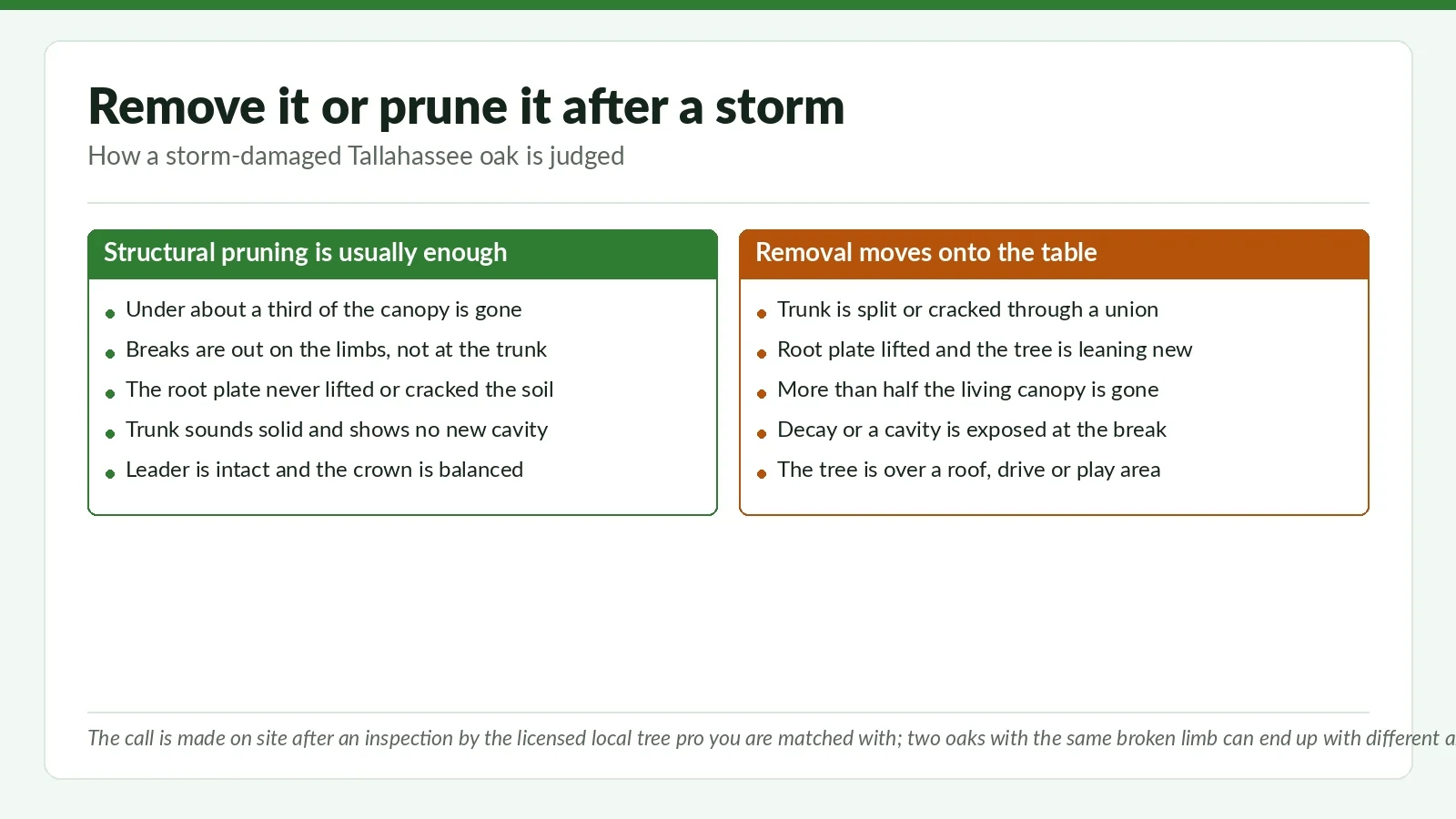
- Broken limbs are confined to the outer canopy rather than involving major scaffold branches or the central leader
- The trunk shows no vertical splits or cracks extending down toward the root flare
- The root plate has not lifted or shifted – no soil heaving or exposed roots on one side of the base
- Remaining canopy is still reasonably balanced rather than heavily lopsided after damaged limbs are accounted for
- The species is a strong compartmentalizer, such as a healthy live oak, which handles pruning wounds and recovers canopy structure better than some faster-growing species
Signs That Point Toward Removal
- A vertical trunk split or crack, even a partial one, which compromises the tree’s structural integrity in a way pruning cannot repair
- A visibly lifted or shifted root plate, indicating the tree has partially uprooted even if it is still standing
- Damage concentrated at a major structural union – where a large limb meets the trunk – rather than out at the branch tips
- Extensive canopy loss leaving the tree too imbalanced to safely retain, especially on a species already prone to decay, like a mature laurel or water oak
- Existing decay or cavities at the damage site, visible once broken wood is cleared away, suggesting the tree was already structurally compromised before the storm
Why This Isn’t Always a Clean Call
Plenty of storm-damaged trees fall into a genuine gray area – sound enough to consider saving, damaged enough that the decision carries real risk if it goes the wrong way, particularly for a large tree positioned near a house, driveway, or power line. This is exactly the situation a tree risk assessment is built for: an ISA-certified arborist can evaluate the trunk, root plate, and remaining structural integrity in a way that is difficult to judge accurately from the ground by eye alone.
What Happens If You Choose Pruning
Storm-damaged trees that are candidates for pruning still need the work done correctly – clean cuts at proper locations, removal of any remaining hazardous hangers, and an honest look at whether the tree’s new shape will need follow-up attention as it recovers. Our tree pruning page covers what that process typically involves.
What Happens If Removal Is the Right Call
A tree with a split trunk, a compromised root plate, or damage at a major structural union is generally not a tree that pruning can make sound again, regardless of how much of the canopy is still green. In that situation, a professional removal assessment – see our storm-damaged tree page – accounts for the tree’s size, position relative to structures, and the safest way to bring it down.
Frequently Asked Questions
Can a tree with a split trunk ever be saved?
Rarely, and only in specific, limited circumstances an arborist would need to evaluate directly. In most cases a split trunk represents a structural failure that pruning cannot repair.
How much canopy loss is too much to recover from?
There is no single fixed number – it depends on the species, the tree’s prior health, and where the loss is concentrated. A live oak in otherwise good health can recover from more canopy loss than a species already prone to decay.
Is a leaning tree after a storm always a removal candidate?
Not automatically, but any new lean should be checked for a shifted or lifted root plate, since that specific sign is a stronger removal indicator than the lean itself.
Should I wait to see if a damaged tree recovers on its own before calling anyone?
Waiting on a tree with a split trunk, lifted root plate, or damage near a structure or driveway adds risk the longer it sits unaddressed. An assessment sooner rather than later gives you an accurate picture either way.
Do you make the removal-versus-pruning decision over the phone?
No. An accurate call requires an in-person look at the trunk, root plate, and remaining canopy structure – phone or photo descriptions alone are not a reliable basis for that decision.
Schedule a Storm Damage Assessment in Tallahassee
To have a storm-damaged oak or other tree assessed for removal versus pruning, call Tallahassee Tree Service Co. at (858) 319-0022. The ISA-certified arborists in our network will evaluate the trunk, root plate, and canopy structure before recommending next steps.
Tallahassee Tree Service Co. is a dispatch and matching service. We connect homeowners with independent, licensed and insured tree professionals – we do not perform tree work ourselves.