Leaning Tree Assessment in Tallahassee
Some leans are decades old and structurally sound. Some are a root plate letting go in rain-soaked clay. Call now and we’ll connect you with a vetted, ISA-certified Tallahassee-area arborist who can tell you which one is standing in your yard.
📞 Call Now — (858) 319-0022Not sure how urgent it is? Call now any hour and we’ll connect you with a local pro who assesses leans for a living.A leaning tree is one of the most common reasons Tallahassee homeowners reach out for help — and one of the hardest things to judge from the ground. Some leans are decades old and structurally stable: a live oak that grew at an angle its whole life, with a root system fully compensated for it. Others are brand new, the first visible sign that a root plate is losing its grip in saturated soil after heavy rain — and those can fail within hours or days. This page walks through how a professional assessment separates one from the other, what you can check safely from the yard right now, and how to get a trained set of eyes on your tree.
One thing to know upfront: Tallahassee Tree Service is a dispatch and referral line. We connect homeowners with independent, licensed and insured tree care professionals — we don’t perform assessments or removals ourselves. Getting matched is free and carries no obligation; the pro who comes out gives the actual risk assessment and the binding written quote.
Old lean vs. new lean — what the ground tells you
The single most useful thing you can check without climbing anything is whether the ground around the base of the tree looks disturbed. A tree that has always grown at an angle typically shows no cracking or lifting in the soil near the trunk, and the trunk itself often has a slight curve near the base where the tree corrected its growth back toward vertical over the years — arborists call this reaction wood. A tree that has recently started to fail usually shows the opposite: cracked or heaved soil on the side opposite the lean, sometimes visible root movement, and a trunk that leans in a straight line without that corrective curve.
Which side of the Cody Scarp you’re on changes the answer
Tallahassee’s own geology makes lean-reading trickier than in most places. North of the Cody Scarp — Killearn, Betton Hills, Midtown, Ox Bottom — the soil is red Orangeburg clay that tends to give a slower, more readable warning: a tree leans further over days or weeks as the clay saturates and loses shear strength. South of the scarp — Woodville, Crawfordville, and in-town neighborhoods like Apalachee Ridge — thin sandy soil over limestone karst behaves differently: a tree there can hold steady and then fail suddenly, with far less warning. The same ten-degree lean means something different depending on which side of town you’re on, and it’s one of the first things a local assessor factors in.
Signs that mean act today, not wait and see
- The lean has visibly increased in the last few days — especially after heavy rain, wind, or a named storm.
- Soil cracking or lifting on the far side of the trunk from the direction of the lean — often the clearest sign a root plate is actively shifting.
- The tree is leaning toward a house, driveway, power line, or anywhere people regularly walk or park.
- You can see roots that have pulled up out of the ground, even partially.
- The tree is a species prone to internal decay — water oak and laurel oak in particular, both common in Tallahassee yards and both known for hollowing out well before they look unhealthy from the outside.
None of these signs alone is a guaranteed emergency, and the absence of all of them is not a guarantee of safety — that’s exactly why this is a judgment call for someone trained to make it, not a homeowner guessing from the porch.
What a professional leaning-tree assessment covers
An ISA-certified arborist evaluating a lean isn’t just eyeballing the angle. Here’s what a thorough assessment actually weighs:
| What gets checked | What the assessor is looking for |
|---|---|
| Degree & direction of lean | Whether the lean has progressed, and what sits in the fall path if the tree fails. |
| Soil & root plate | Cracking, heaving, or lifted roots on the tension side — active movement is the red flag. |
| Species decay profile | Water oak and laurel oak hollow out years before they look sick; live oak fails differently. |
| Trunk & canopy defects | Cavities, fungal conks, Hypoxylon patches, dieback, old topping wounds. |
| Target zone | House, driveway, service drop, sidewalk — occupied targets raise the risk rating. |
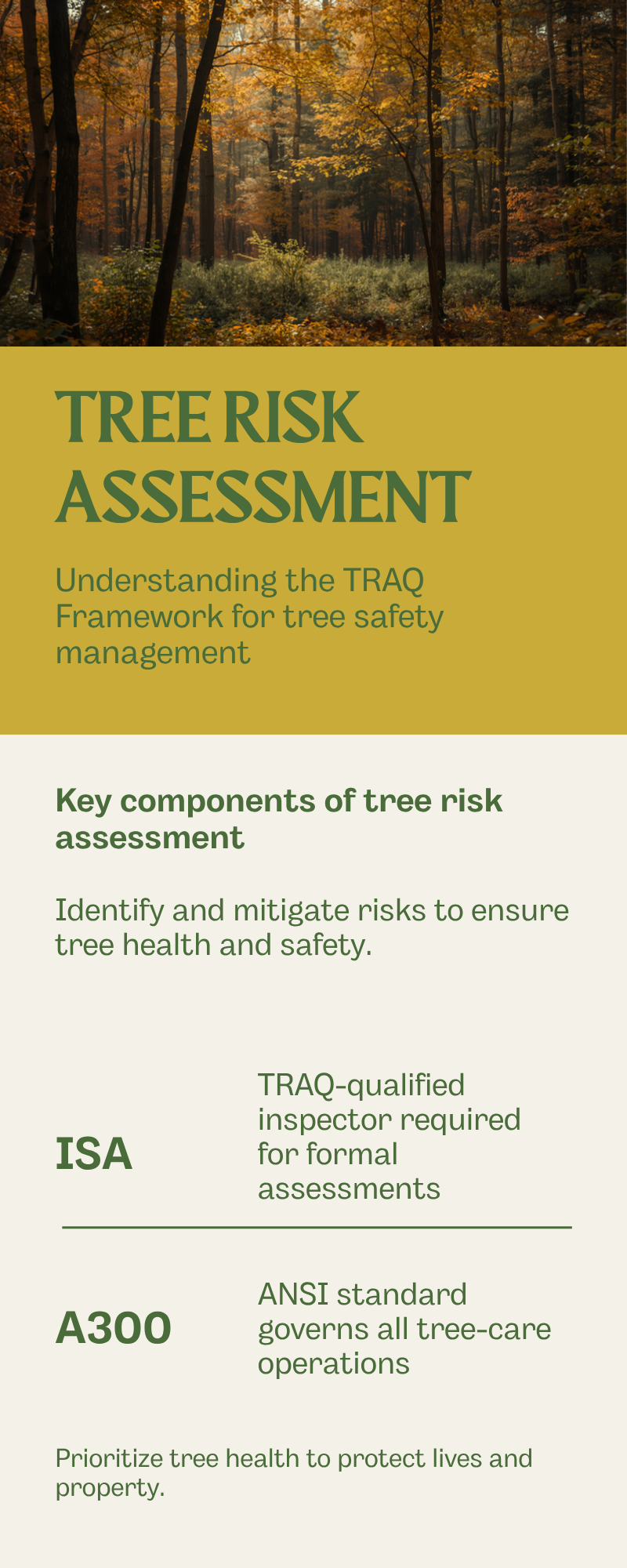
If the tree is genuinely hazardous, the assessor can document that risk under the ANSI/ISA Tree Risk Assessment Qualification (TRAQ) framework. That documentation matters twice in Tallahassee: it supports the Florida Statute §163.045 exemption that lets a homeowner remove a documented danger tree on a single-family lot without a city permit, and it creates a paper trail your insurer may want if the tree ever does cause damage.
Monitor, cable, or remove — the three honest outcomes
A straight assessment ends in one of three recommendations. A long-standing lean with a sound root system may need nothing more than periodic monitoring and end-weight reduction on the lean side. A tree with a specific structural weakness — a codominant stem, one overextended limb over the roof — can often be supported with cabling and bracing hardware instead of coming down. And a tree with an actively shifting root plate is a removal conversation, full stop — the when-to-remove decision guide covers how that call gets made honestly. For the failure signs themselves, in more depth, see the leaning tree decision guide.
Soil lifting behind the lean, or the angle changed after a storm? That’s an active-failure warning — keep everyone out of the fall zone and get matched now.
📞 Call Now — (858) 319-0022Vetted local pros — availability depends on independent provider schedules and demand.*How getting matched works
Frequently asked questions
Can a leaning tree be saved, or does it always need to come down?
It depends on the cause. A tree with a long-standing lean and a sound root system can sometimes be cabled or braced rather than removed. A tree with an actively shifting root plate is a different story — removal is often the safer, more honest recommendation.
How fast can a leaning tree actually fall?
It varies enormously. Some leans are stable for years. Others — especially after saturating rain loosens a root plate — can progress from “noticeable lean” to “on the ground” within a single storm event. That unpredictability is why a lean that changed recently deserves attention the day you notice it, not a wait-and-see approach.
What does a leaning-tree assessment cost?
Getting matched through this site is free, with no obligation. The on-site assessment and any written quote come directly from the independent local pro you’re connected with — scope and pricing are set by that pro, so ask when you’re matched.
My tree has always leaned a little — should I still get it checked?
If nothing has visibly changed — no new soil cracking, no increase in the angle, no storm since you last looked closely — a long-standing lean is often lower priority. But “always leaned a little” and “leaning more than it used to” are different situations, and it’s worth a second look if you’re not sure which one you’re in.
What should I do right now if a tree looks like it’s about to fall?
Keep people, pets, and vehicles out of the likely fall path immediately. If it’s touching a power line, don’t approach it — contact the utility first. Then call now, any hour, for priority routing to a local pro.
Does homeowners insurance cover a leaning tree that hasn’t fallen yet?
Generally no — most Florida policies only pay after a fallen tree damages a covered structure. Proactive removal of a still-standing tree is typically out-of-pocket, though an assessor’s documentation can matter later if the tree does cause damage. The insurance coverage guide breaks down what policies typically pay for.
Related Tallahassee tree services
Leaning Tree Decision Guide
Tree Risk Assessment
Tree Cabling & Bracing
When to Remove a Tree
Emergency Tree Service
Storm Damage Tree Removal
Tree Inspection
Insurance Coverage Guide
Get a real answer on that lean
Don’t guess from the porch. Call now and we’ll connect you with a vetted, ISA-certified Tallahassee-area arborist. Free to use, no obligation, no sign-up.
📞 Call Now — (858) 319-0022Tallahassee Tree Service is a free referral service. Tallahassee Tree Service is not a licensed tree service provider and does not directly provide tree care services. All work is performed by independent, licensed and insured third-party providers in your area. Calls and form submissions placed through this site may be connected with a participating provider, and you may be contacted by that provider regarding your request. Same-day, emergency, and 24/7 availability are not guaranteed and depend on provider schedules, location, and demand. Service availability, pricing, licensing, and final response times are determined solely by the providers. It is the responsibility of the homeowner to verify that the hired contractor furnishes the necessary license and insurance required for the work being performed. All persons depicted in a photo or video are actors or models and not contractors listed on Tallahassee Tree Service.