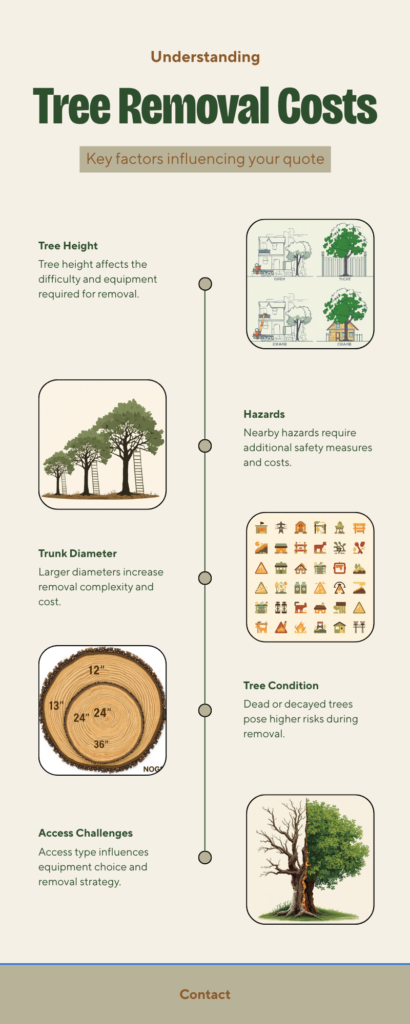
The most common question Tallahassee homeowners ask before a tree comes down is “how much will this cost?” The honest answer is that the quote depends on six variables, not one — height tier is just the headline. Height drives the base, but species, access, permit status, debris haul, and whether the job sits inside a Canopy Road Protection Zone can each move the number meaningfully. Here’s the breakdown the ISA-certified arborists in our network actually use when writing a quote.
The Height Tier — The Headline Variable
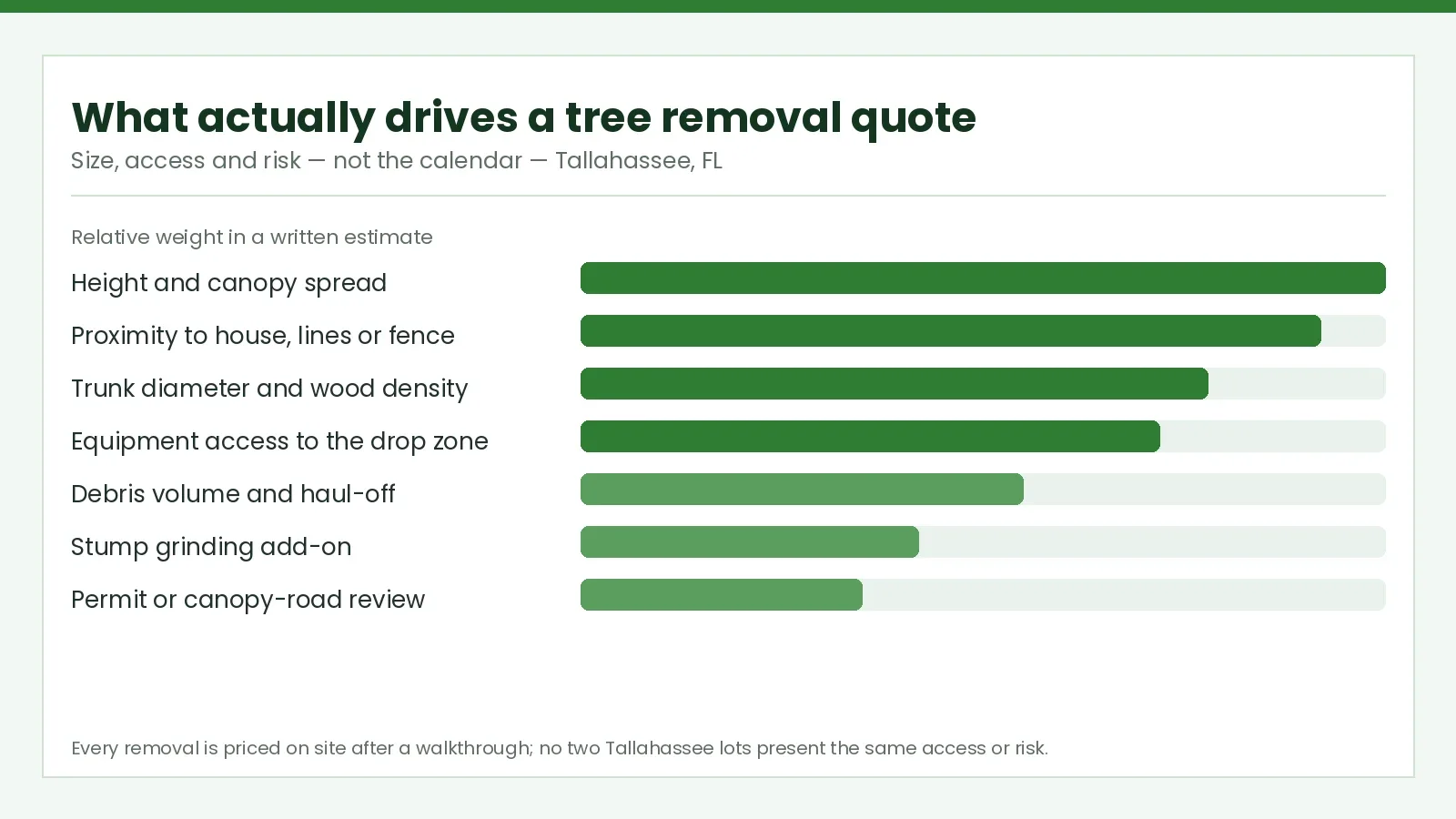
Tallahassee tree removal pricing follows a height-tier curve: the taller the tree, the higher the base, climbing steadily from a small 20-foot tree up to an 80-foot giant. A professional crew bills an hourly rate, and most single-tree removals take a few hours to most of a day depending on access and species. The tier sets the bracket; the other five variables decide where inside it your job lands.
A 60-foot pine in an open Bradfordville yard with truck access sits at the low end of its tier. A 60-foot live oak between a Killearn pool and the house, requiring crane work to lift sections out, sits at the high end of that same tier — or above it. The published tier is the bracket; the specifics close it.
Storm damage or a tree on your house? Call now.
Stay out of rooms under the tree and keep clear of downed lines — report those to the power company first. Then call and we’ll connect you with a local tree crew that handles storm work.
📞 Call (858) 319-0022Free 24/7 dispatch line · availability varies by storm volume
Species Matters More Than You’d Think
Wood density, branching pattern, and decay biology change the labor significantly. Live oak (Quercus virginiana) has dense, hard wood and wide-spreading limbs that require careful rigging — typically the upper end of a tier, and it may require a permit since live oaks are protected over 36 inches DBH in city limits. Laurel oak (Quercus laurifolia) is decay-prone, often hollow, which can either speed the job (lighter wood) or complicate it (unpredictable failure during rigging).
Longleaf and loblolly pine are straight, predictable, and faster to remove — usually the lower end of a tier on standard access. Water oaks on Tallahassee’s karst soils south of the Cody Scarp can have unstable root plates, sometimes making removal safer than it looks — see our water oak removal page. Sabal palms price differently — they’re typically billed per palm rather than by height tier.
Access Is the Hidden Multiplier
Access is what separates the low end and high end of every height tier. Open access — truck or chipper can pull within 30 feet of the trunk — is the baseline. Backyard access through a 6-foot side gate adds time for carrying every cut piece. Pool or screen-enclosure proximity requires section-by-section lowering rather than felling. Power-line proximity requires either utility coordination or a crane, which adds substantially to the base labor.
Crane work is the biggest single multiplier. A 60-foot live oak that is straightforward with truck access can cost considerably more — often well beyond its normal tier — when a crane is required to lift sections over a house or out of a tight Midtown lot. Crane jobs also trigger street-closure coordination with the City of Tallahassee if the crane outrigger blocks a lane.
Permits, Risk Letters, and the Canopy Roads
Permit status doesn’t change the tree-work cost directly, but it changes the total job cost and the timeline. City of Tallahassee §5-83 stand-alone permits carry the City of Tallahassee permit application fee for up to 10 trees (confirm the current amount with City Growth Management), and the application takes days to process. If the tree is genuinely a hazard, an ISA-certified arborist can write a Florida Statute §163.045 risk letter (often included on hazard jobs) that bypasses the permit requirement on eligible single-family residential lots.
Canopy Road Protection Zone parcels — anything within 100 feet of the centerline of one of the nine designated Canopy Roads — trigger Canopy Roads Citizens Committee review. The arborists in our network handle CRCC filings as part of scope. See our Tallahassee tree permit guide for the full §5-83, §163.045, and CRPZ breakdown.
Debris Haul, Stump Grinding, and the Optional Add-Ons
What’s included in the base removal price varies. Most quotes include chipping branches on-site and hauling. Stump grinding is usually optional and quoted separately, typically with a minimum charge plus a rate per inch of stump diameter at grade, ground several inches below grade. See our stump grinding guide.
Logs cut to firewood length, large rounds saved for milling, or specialty disposal (Bradford pear, camphor, Chinese tallow — invasive species that some yard-waste programs won’t accept) can add line items. Storm-damage cleanup jobs are billed differently — see our storm cleanup page.
Emergency Multiplier — When It Costs More
Emergency tree removal in Tallahassee carries a meaningful premium over standard scheduled work, and crane, night-dispatch, or live-line proximity jobs carry the steepest premium of all. The same pine that is routine on a scheduled weekday can cost considerably more as an after-hours emergency, and more still if a crane and utility coordination are required. Florida homeowners insurance typically covers removal only when the tree has hit a covered structure, and usually with a debris-removal sublimit — see our emergency tree service page for the insurance protocol.
Authority reference: the International Society of Arboriculture publishes the ANSI A300 pruning and Z133 safety standards that all the arborists in our network follow.
Want a written quote for tree removal in Tallahassee? Get matched with a licensed arborist Call now code and our 24/7 dispatch line connects you with an ISA-certified, insured arborist in our network serving Tallahassee and Leon County. You get an on-site assessment and a line-item written estimate — no “call for a quote” runaround — with §5-83 permit and §163.045 risk-letter help included. Your quote is between you and the arborist. → Call now to get connected
Frequently Asked Questions
What does tree removal cost in Tallahassee?
It follows a height-tier curve, climbing from a small 20-foot tree up to an 80-foot giant, with most mature-tree jobs landing in the middle of that scale. Access, species, permit status, and add-ons decide where inside the tier your job falls, and crane work, emergency dispatch, or restricted access can push a specific job above its normal tier. Your actual number comes from the arborist who assesses your tree.
Why is the range inside each height tier so wide?
Access, species, permit status, and add-ons close the bracket. An open-yard pine is at the low end; a between-pool-and-house live oak requiring crane work is at the top — or above the tier. The tier is the bracket, not the quote.
Do I need a permit to remove a tree in Tallahassee?
Single-family residential lots inside City of Tallahassee can remove non-patriarch trees up to 36 inches DBH without a permit. Over 36 inches, patriarch trees, Canopy Road Protection Zone parcels, and unincorporated Leon County trees 12 inches DBH or larger (live oak / longleaf pine) all trigger permits.
Is stump grinding included in the removal price?
Usually no — stump grinding is quoted separately, typically with a minimum charge plus a per-inch-of-diameter rate, ground several inches below grade.
How does emergency tree removal pricing compare?
Emergency dispatch carries a premium over standard scheduled rates, and crane, night, or live-line jobs carry the steepest premium. Florida homeowners insurance typically covers removal only when the tree has damaged a covered structure, usually with a debris-removal sublimit. See our main tree removal cost page for the full cost-factors breakdown.
Related TTS Resources
This page is one of many service-specific cost-factor deep-dives on the TTS site. For the complete framework of what drives Tallahassee tree-service costs — removal, trimming, stump, emergency, arborist, crane, cabling, insurance — see the Tallahassee Tree Service Cost Guide. For storm-season planning and post-storm claim playbooks, see the Tallahassee Hurricane Tree Prep Hub.
TallahasseeTreeService.co is a dispatch service. We connect callers with licensed Florida arborists. We are not a licensed tree service company. The disclaimer in our site footer and our 24/7 dispatch caveat apply to this page.