Quick answer: Florida insurers routinely flag limbs that touch or overhang the roof during underwriting and renewal inspections, and they can make clearance a condition of binding or renewing a policy. In Tallahassee the fix is usually a selective clearance prune rather than removal. If the tree is a protected species or sits inside a canopy-road zone, check the City rules first, because a permit may still apply even when the insurer wants fast action.
Every August, Tallahassee homeowners open a renewal letter or inspection report with a line reading something like “trim vegetation away from roof surface” — usually pointed at a live oak that has shaded the house for decades. The instinct is to grab a saw or call whoever answers first. Both are expensive mistakes here, because Tallahassee sits where an aggressive property-insurance market meets one of the stricter municipal tree ordinances in Florida.
Why does my insurance company care about limbs over the roof?
To an underwriter, an overhanging limb is four risks stacked together. Impact: a limb that fails in a thunderstorm has a short, direct path to shingles, decking, then the interior. Abrasion: branches sweeping across a roof in wind grind granules off asphalt shingles, and because that damage is gradual it is often classified as maintenance rather than a covered loss. Moisture retention: dense shade keeps a roof slope damp long after summer storms. Debris load: leaf and needle litter packs valleys and gutters, backing water up under the shingle edge — the slow leaks that surface later as a claim.
Because Florida carriers already scrutinize roof age, anything that shortens roof life gets attention. On an older Tallahassee home, a four-point or wind-mitigation inspection is usually where the tree issue surfaces.
Storm damage or a tree on your house? Call now.
Stay out of rooms under the tree and keep clear of downed lines — report those to the power company first. Then call and we’ll connect you with a local tree crew that handles storm work.
📞 Call (858) 319-0022Free 24/7 dispatch line · availability varies by storm volume
How much roof clearance do insurers actually want?
There is no statewide number, and any page quoting one with confidence is guessing. Requirements are set carrier by carrier and written as a condition on the inspection report. The language falls into three tiers, and it is worth reading your own letter closely enough to know which one you got:
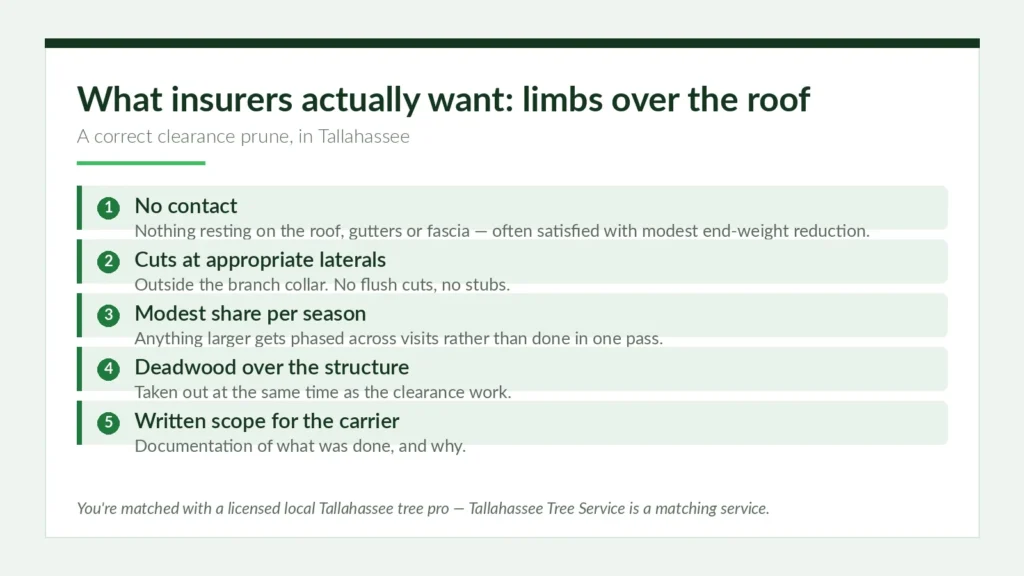
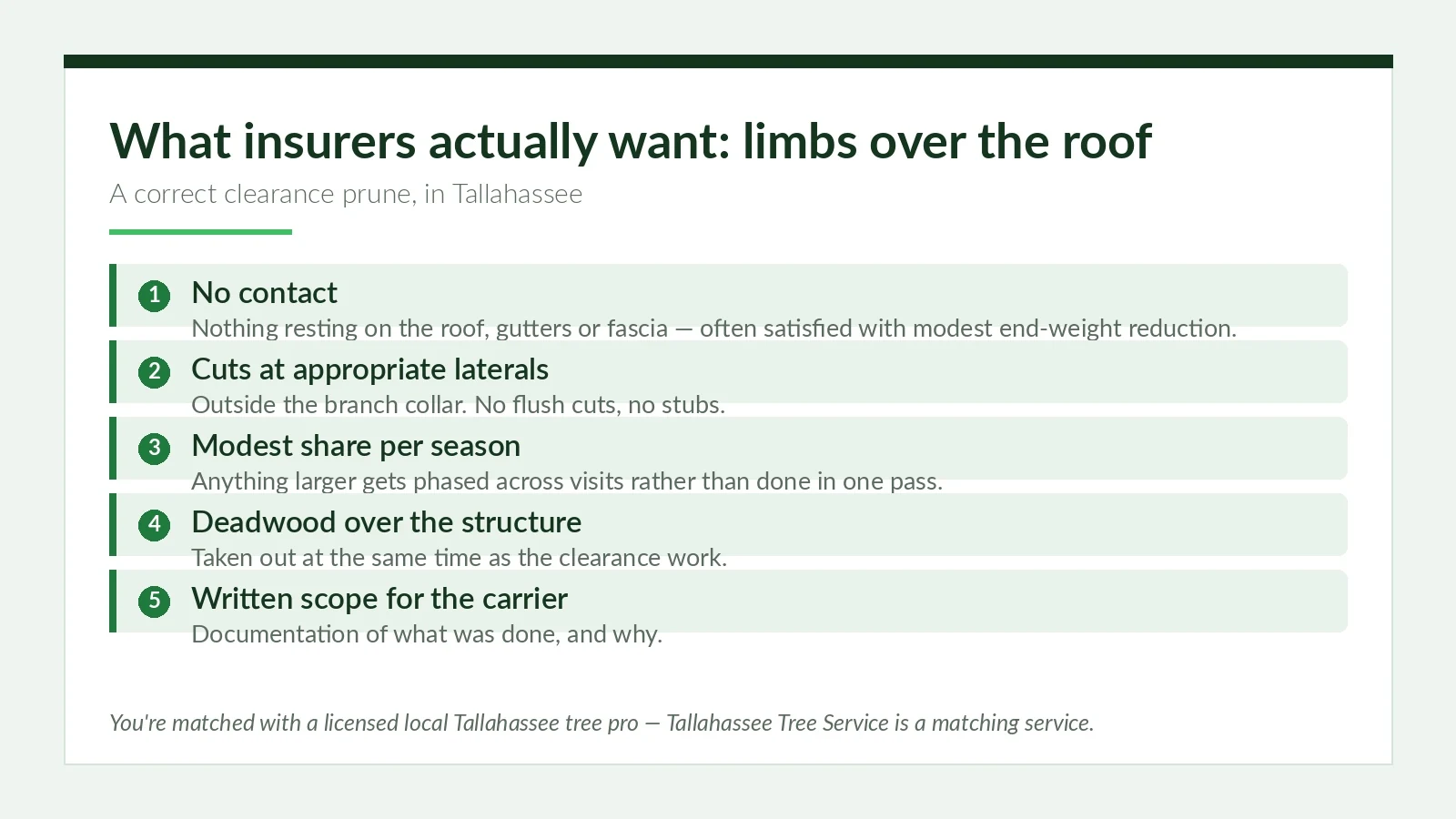
- No contact. Nothing may rest on the roof, gutters, or fascia. Often satisfied with modest end-weight reduction on a few limbs.
- Defined clearance. A specific distance between canopy edge and roof surface — the most common request, and the one that takes real planning on a spreading live oak.
- No overhang. Nothing may extend over the roof plane at all. On a mature Tallahassee oak this is often impossible without structurally wrecking the tree.
That last tier matters. A qualified arborist can document that the requested cut would violate accepted pruning standards, and carriers do sometimes accept a reduced scope plus a written assessment. Getting that in writing before any saw touches the tree is the most useful thing a homeowner can do — as is knowing what your tree service insurance coverage actually pays for.
Is the tree over my roof protected in Tallahassee?
This is the step most homeowners skip, and where the costly surprises live. The City of Tallahassee regulates tree protection through its Land Development Code, and the ordinance reaches beyond removal alone. Protected categories include designated species, unusually large specimen trees, and the protection zones along the City’s canopy roads.
Two things follow. A live oak or southern magnolia over your roof is far more likely to be regulated than a volunteer sweetgum in the same yard. And the line between “pruning” and “removal” is not where most homeowners assume — a reduction severe enough to permanently alter a protected tree’s form can be treated very differently from routine maintenance.
The practical sequence: confirm species and size, confirm whether the parcel sits inside a canopy-road zone, then decide scope. The City’s Growth Management Department is the authority on interpretation, and the ordinance text is public in Section 5-83 of the Tallahassee Land Development Code. The page on City of Tallahassee tree removal permits covers the same process in plain language.
Can Florida’s hazardous-tree law override the permit?
Sometimes — but far less often than homeowners are told, and the distinction matters.
Under Florida Statute 163.045, a local government may not require notice, an application, approval, a permit, a fee, or mitigation for pruning, trimming, or removing a tree on residential property when the owner holds documentation that the tree presents an unacceptable risk to persons or property. That documentation must be signed by an ISA-certified arborist or a Florida licensed landscape architect and based on an onsite assessment following Best Management Practices — Tree Risk Assessment, Second Edition.
Here is the part that gets lost. The statute defines unacceptable risk narrowly: removal has to be the only way to practically bring the risk below moderate. A structurally sound live oak whose limbs extend over a roof almost never meets that bar, because pruning can reduce the risk instead. An insurance letter asking for clearance is not, by itself, grounds to invoke the statute and take the tree down.
Where 163.045 genuinely applies is a different situation: advanced basal decay, a failing union in a codominant stem, root-plate movement, or a defect pruning cannot correct. That call belongs to a certified arborist assessing the tree on site, which is what an ISA-certified tree health assessment is for.
What does a correct clearance prune look like?
Clearance work done well is nearly invisible a season later. Done badly, it is obvious for the next twenty years. The accepted approach is reduction pruning — shortening a limb back to a lateral large enough to assume the terminal role, so the cut heals and growth redirects away from the structure. Cutting limbs to stubs, or heading one whole side of the canopy, triggers dense sprouting from the cut points. Those sprouts are weakly attached, grow back toward the roof faster than the original limb did, and leave the tree more hazardous than before.
Reasonable expectations for properly scoped work on a Tallahassee oak or pine:
- Cuts at appropriate laterals, outside the branch collar, with no flush cuts or stubs.
- No more than a modest share of living canopy removed in one season, with anything larger phased across visits.
- Deadwood over the structure taken out at the same time, plus written documentation of scope for the carrier.
Where a limb is worth keeping but structurally marginal, cabling and bracing is sometimes an alternative to cutting it back hard. Species drives the call: pine tree trimming in Tallahassee follows a different playbook than oak tree trimming in Tallahassee.
When should this be done in Tallahassee?
The ideal window for structural pruning on North Florida hardwoods is the dormant season, roughly late winter. Insurance deadlines arrive in late summer. Separate urgency from optimization: deadwood and limbs actually contacting the roof get addressed whenever found, while larger structural reduction is better scheduled for the dormant window where the deadline allows. If the letter gives you sixty or ninety days in August, ask whether documentation of a scheduled prune satisfies the condition — often it does.
Whatever the timeline, the licensed local tree pro you are matched with through this site should document species, scope, and standard compliance before the first cut, so the work satisfies the carrier without creating a permit problem with the City.
Frequently asked questions
Can my insurer really drop me over tree limbs?
Carriers can and do make clearance a condition of binding or renewing a policy. Whether an unresolved condition leads to non-renewal depends on the carrier and the rest of the risk profile, but ignoring a written condition is not a safe assumption. Respond in writing and keep the correspondence.
Do I need a permit just to trim limbs off my roof?
Routine maintenance pruning on most residential trees generally does not. But protected species, specimen-size trees, and canopy-road zones change the analysis, and severe reduction can be treated differently from light pruning. Confirm species and parcel status with the City first.
A neighbor’s tree overhangs my roof. Who handles it?
In Florida a property owner may generally trim branches back to the property line without harming the tree’s health, but municipal protections still apply to the tree itself. Talk to the neighbor first.
The short version
An insurance letter about limbs over the roof is a maintenance request, not a removal order. Read the exact wording, confirm whether the tree is protected, get an arborist’s assessment if there is a structural question, then scope a reduction prune that satisfies the carrier. For the full picture on canopy care across Leon County, start with the complete Tallahassee tree service guide.