Tree roots near your foundation, sidewalk, or driveway are a common worry for Tallahassee homeowners, especially around mature live oaks and water oaks with broad surface roots. The good news: roots rarely crack a sound foundation on their own. The real damage usually shows up in hardscape — lifted sidewalks, cracked driveways, and clogged sewer lines. The ISA-certified arborists reached through this line diagnose what is actually causing the problem before recommending anything.
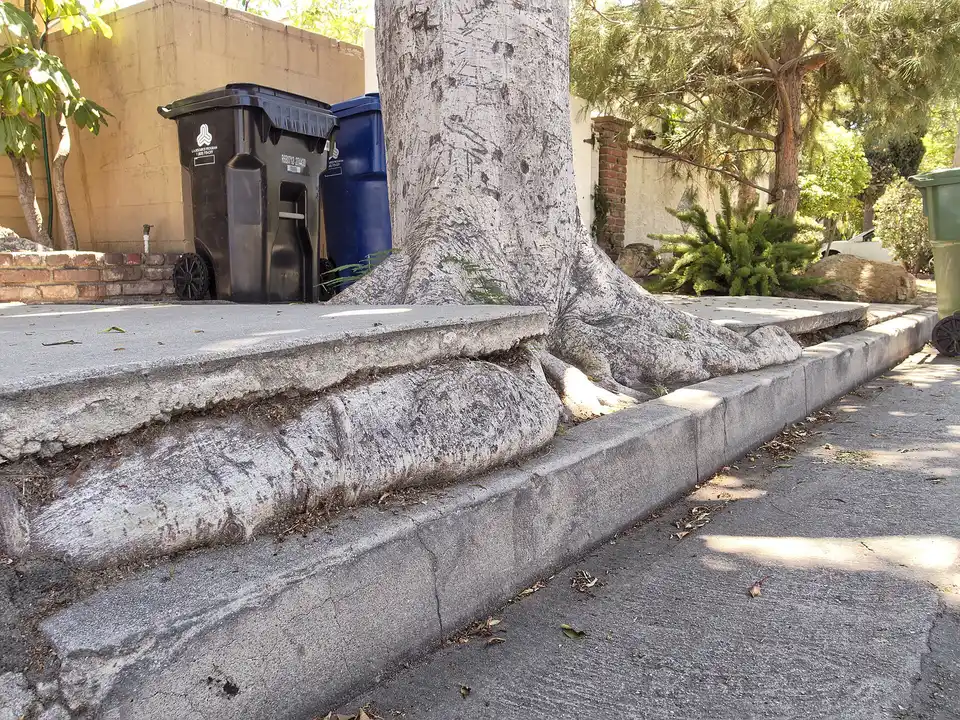
Signs roots may be involved
- A sidewalk slab or driveway section lifted or cracked directly over a large surface root.
- Repeated sewer backups on an older clay or cast-iron lateral (fine feeder roots enter at joints).
- Surface roots raising the lawn or patio near a big oak.
- Foundation cracks — but these are usually a soil-moisture or settlement issue, not the roots themselves.
Foundation cracks: roots or soil?
It is worth being precise here, because the fix is different. In most cases, a large tree affects a foundation indirectly — by drawing moisture out of the soil during dry spells so the soil shrinks, then the soil swells when rain returns. That cycle, not the roots prying against concrete, is what stresses slabs. Cutting major roots to “save” a foundation can actually destabilize the tree and rarely solves the moisture problem. An arborist will look at the crack pattern, the soil, and the root flare before anything is cut, and will tell you honestly when the issue is a job for a foundation engineer rather than a tree crew.
Lifted sidewalks and driveways
This is where roots genuinely do the damage. Options include shaving and re-pouring the slab with a root barrier installed alongside, root pruning at a safe distance from the trunk, or — if the tree is also declining or poorly placed — removal. The key is that root pruning has limits: cut too much, too close, and you create a fall hazard. A good arborist balances the hardscape repair against the tree’s stability and long-term health.
Tallahassee soil and tree notes
Much of Leon County has clay-rich soils that shrink and swell with our wet-dry swings, which is exactly the mechanism behind most near-foundation concerns. Live oaks and water oaks are the usual suspects for surface roots because they are large and shallow-rooted in compacted urban soil. Before removing a protected tree to solve a root issue, check whether a permit applies — see our tree permit guide.
Related Tallahassee Tree Service pages
- Tree Risk Assessment — ISA TRAQ evaluation
- When to Remove a Tree — keep vs. remove framework
- Tree Removal Tallahassee — when removal is the right call
- Live Oak Care — managing big surface-rooted oaks
Frequently asked questions
Can tree roots really crack my foundation?
Rarely on their own. Most near-foundation damage comes from soil shrinking and swelling with moisture changes that a large tree influences, not roots physically breaking concrete.
Should I cut the roots to protect my house?
Be careful. Cutting major roots can make a tree unstable and usually does not fix a soil-moisture problem. Get an arborist assessment before any roots are cut.
How do I stop roots from lifting my sidewalk again?
Re-pouring the slab with a root barrier, or pruning roots at a safe distance, can help. If the tree is also declining or badly placed, removal may be the better long-term answer.
Do roots cause sewer backups?
Fine feeder roots can enter older pipe joints and cause repeated backups. That is a plumbing repair plus, sometimes, addressing the tree.
How do I get a root problem looked at?
Call now for an assessment from ISA-certified arborists serving Tallahassee and Leon County.
Get matched with a local pro — ISA-certified arborists serving Tallahassee & Leon County.