Tree Roots vs. Foundations, Sidewalks & Irrigation Lines in Tallahassee
Tallahassee’s red clay soil holds water close to the surface, which pushes tree roots outward instead of straight down. That’s great for drought tolerance but it’s the main reason so many older neighborhoods here — Betton Hills, Midtown, Los Robles, Waverly Hills — end up with heaved sidewalks, cracked driveway aprons, and irrigation lines that mysteriously stop working every summer. This post walks through how to tell root damage from ordinary settling, which species cause the most trouble, and what your realistic options are.
To get matched with a licensed local tree service for a same-day written estimate on root pruning or an inspection, call now on our homepage to reach Tallahassee Tree Service. We’re a dispatch service that connects you with vetted, independent, licensed and insured crews — we don’t perform the work ourselves.
Storm damage or a tree on your house? Call now.
Stay out of rooms under the tree and keep clear of downed lines — report those to the power company first. Then call and we’ll connect you with a local tree crew that handles storm work.
📞 Call (858) 319-0022Free 24/7 dispatch line · availability varies by storm volume
Why Tallahassee’s Soil Makes Root Problems Worse
Most of Leon County sits on a shallow layer of sandy clay (locally you’ll hear it called “Orangeburg” or “Red Bay” soil series) over limestone karst. Two things follow from that:
- Roots stay shallow. Rather than driving deep to find water, roots spread laterally in the top 12–18 inches of soil, often 2–3 times the width of the canopy. That lateral spread is exactly where sidewalks, driveways, and irrigation trenches sit.
- Clay expands and contracts. Wet-season swelling and dry-season shrinkage already move slabs and pavers on their own. A root growing under a slab accelerates that movement and makes it directional and permanent instead of seasonal and reversible.
Add Tallahassee’s older tree canopy — many neighborhoods have live oaks, water oaks, and laurel oaks planted 40–70 years ago, now with root systems that have long since outgrown the original planting strip — and root-vs-hardscape conflicts are one of the most common calls a local crew gets that isn’t storm-related.
Signs the Damage Is Root-Related (Not Just Settling)
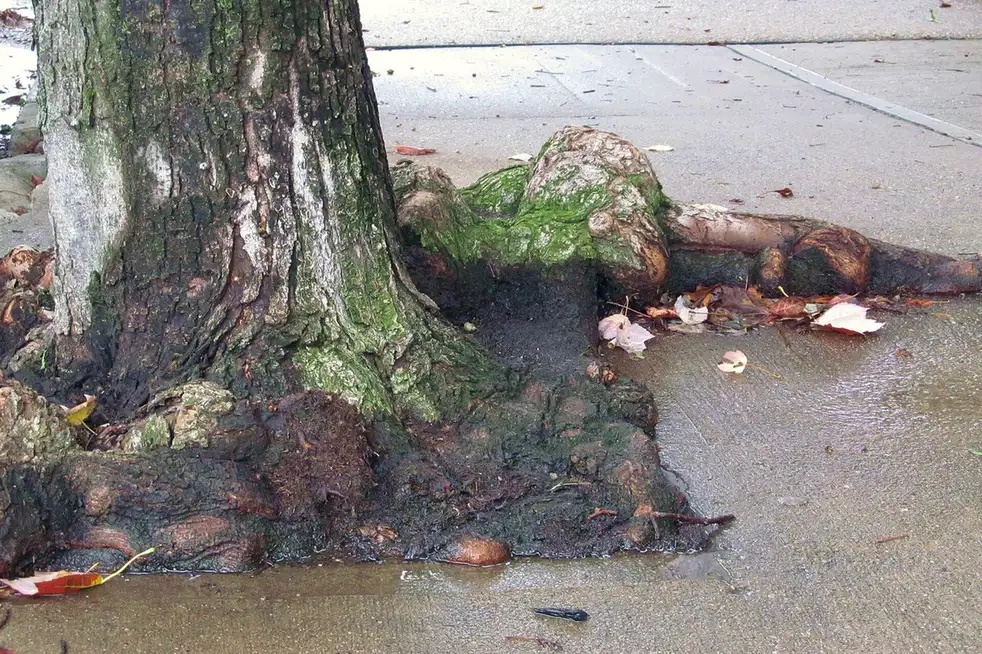
- A visible ridge or hump running toward a nearby tree. Ordinary soil settling tends to create a bowl or sunken area. Root damage creates a raised ridge that points back at the trunk.
- Cracking that follows a curve, not a straight line. Roots grow around obstacles. A crack that arcs rather than running perfectly straight is a strong tell.
- A visible root at the surface near the damage. Sometimes the culprit is standing right there — a root you can see breaking the soil line near the cracked slab.
- Irrigation zones that lose pressure or won’t hold pressure. A root that has grown against or into a poly irrigation line will crush it slowly. You’ll usually notice one zone underperforming while others are normal, or a soggy patch of lawn that wasn’t there last season.
- Damage that’s worse near larger, older trees. If the cracked section of sidewalk lines up with the drip line of a large water oak or live oak, that’s your suspect.
Which Trees Cause the Most Hardscape Damage Locally
Not all species are equal here. In Tallahassee yards, the most frequent offenders are:
- Water oaks — fast-growing, shallow, aggressive root systems, and often planted too close to driveways decades ago.
- Laurel oaks — similar growth habit to water oak, and by the time root damage shows up the tree itself is often already in decline (see our post on signs of a hazardous or dying tree).
- Sweetgum — notorious for surface roots in lawns even without hardscape nearby.
- Sabal palms — generally low risk to foundations since palms have a fibrous, non-woody root mass that doesn’t thicken with age the way oak roots do. Worth knowing if you’re deciding what to plant near a walkway.
Live oaks can absolutely cause damage too, but they tend to do it more slowly and predictably given their size, which sometimes gives homeowners a longer window to plan around it rather than being surprised by it. A tree with significant root damage on one side can also develop a lean over time — if you’re noticing both cracked hardscape and a trunk that seems to be tilting more than it used to, see our page on leaning tree assessment for how to tell whether that’s a stability concern.
What Actually Works: Your Real Options
Root Pruning
A licensed crew can sever and manage specific roots that are causing the conflict, typically leaving a buffer zone from the trunk to avoid destabilizing the tree. This works best when caught early and when the root in question isn’t a primary structural root. Cutting too close to the trunk, or removing too many roots on one side, can affect the tree’s stability in a way that matters most during hurricane season — this is not a DIY cut with a shovel and a Saturday afternoon.
Root Barriers
For new plantings or hardscape being installed near an existing tree, a below-grade root barrier panel redirects growth downward instead of toward the slab. This is a prevention tool, not a fix for existing damage.
Re-Routing Instead of Removing
For irrigation, often the more durable fix is re-routing the line around the root zone rather than repeatedly patching a section that a growing root will just crush again next season. If a tree removal or major canopy thinning already opened up your yard to full sun, our post on picking the right sod and turf after tree work covers what to check with a local turf supplier before you resod around new or rerouted irrigation.
Slab and Sidewalk Releveling
For concrete, mudjacking or panel replacement addresses the surface, but if the root causing it is still there and still growing, expect to revisit it — this is why pairing hardscape repair with a root assessment from a tree professional (not just the concrete contractor) tends to hold up longer.
Removal
When a tree is planted too close to a foundation, is already in decline, or the root causing the damage is a major structural root that can’t be safely cut, removal is sometimes the more honest answer even though it’s the one nobody wants to hear first. Our Tallahassee tree removal cost breakdown covers what drives pricing by tree type and size.
When to Get an Arborist Opinion vs. a Contractor Opinion
A concrete or irrigation contractor can tell you what’s broken. Only a tree professional can tell you whether cutting the root that’s causing it is safe for the tree — and whether the tree is worth saving in the first place. If a large oak’s root system has already been compromised by prior construction, drought stress, or fill soil, an additional root cut could tip a marginal tree into a hazard. That’s the kind of judgment call worth getting matched with a licensed local pro for, rather than guessing.
Get Matched With a Local Crew
Get a same-day written estimate for root pruning, root barrier installation, or a full removal assessment. Call now any day to get connected with a licensed, insured local tree service serving Tallahassee, Leon County, and surrounding areas.
Frequently Asked Questions
Can tree roots actually crack a house foundation? It’s less common than sidewalk or driveway damage, but it happens, usually with large trees planted very close (within 10–15 feet) to slab foundations in expansive or shifting soil. Most foundation movement blamed on trees is really a combination of soil moisture change and root growth together.
How close is too close to plant a tree near a sidewalk? As a rule of thumb, large shade trees like live oak or water oak should be planted at least 8–10 feet from hardscape; smaller ornamentals can go closer. Species with known aggressive surface roots need even more room.
Will cutting a root kill my tree? Not necessarily, but it depends on which root, how large it is, and how many roots on that side of the tree have already been cut or damaged. This is why a professional assessment matters before any root is cut.
My irrigation keeps breaking in the same spot — is it definitely a root? Not always, but a repeat failure in the same zone near a mature tree is the classic pattern. Re-routing around the root zone is often more durable than repeated patching.
Do sabal palms damage foundations or pipes? Generally low risk — palms have fibrous roots that don’t thicken with age the way oak or sweetgum roots do, which is one reason they’re a common choice near walkways and driveways.
Is root damage covered by homeowners insurance? Typically not on its own; most policies treat gradual root-related damage as a maintenance issue rather than a sudden covered loss. Sudden storm-related root failure (like a tree uprooting) is a different situation — see our storm season insurance claim checklist for that scenario.
Should I remove a tree just because a root cracked my driveway? Not automatically. Root pruning, barriers, or re-routing utilities often solve the problem while keeping a healthy, otherwise valuable shade tree. Removal is usually the last option, not the first.