Mushrooms Growing at the Base of a Tree in Tallahassee: When It’s Nothing — and When It’s a Red Flag
Every July, Tallahassee’s near-daily thunderstorms flip a switch in the soil. Within a day or two of a good soaking, mushrooms pop up everywhere — in the lawn, in mulch beds, and, most importantly, around and on the bases of trees. Most of them mean nothing. A specific few mean a great deal: they can be the only above-ground evidence that the root system or lower trunk of a large oak or pine is quietly rotting from the inside. Knowing the difference is one of the highest-value skills a Tallahassee homeowner can have, because root and butt decay is a leading reason big trees fail in storms without warning.
If you’ve found something growing on the trunk or root flare of a large tree near your house, call now on our homepage to get matched with a licensed, insured local tree professional for a written assessment. We’re a dispatch service that connects you with vetted, independent crews — we don’t perform the work ourselves.
Storm damage or a tree on your house? Call now.
Stay out of rooms under the tree and keep clear of downed lines — report those to the power company first. Then call and we’ll connect you with a local tree crew that handles storm work.
📞 Call (858) 319-0022Free 24/7 dispatch line · availability varies by storm volume
First Cut: Where Is It Growing?
Location is the single most useful filter:
In the open lawn or mulch, not touching the tree. Almost always harmless decomposers feeding on buried roots from long-gone trees, old mulch, or organic matter. Fairy rings, little brown mushrooms after rain, stinkhorns in fresh mulch — none of these say anything about your living trees.
On a stump or old grinding site. Normal and expected. Fungi are doing exactly what they should: recycling dead wood.
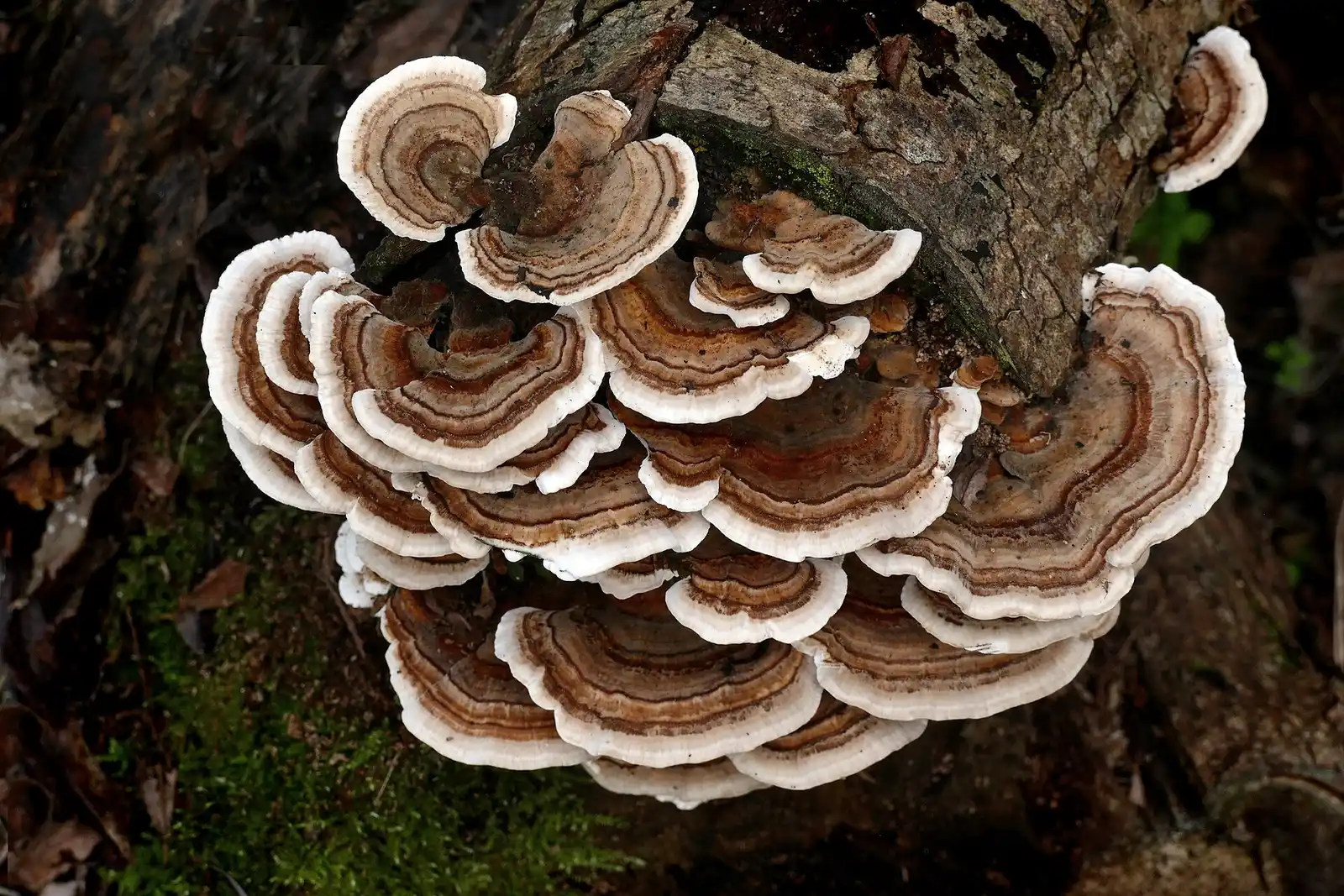
Attached to the trunk, the root flare, or major surface roots of a living tree. This is the category that matters. Fungi that fruit from living wood are usually fruiting because there is already substantial decayed wood inside to feed on. The mushroom is the fruit; the “plant” is a web of fungus that may have been working inside the tree for years.
The Three Base-of-Tree Fungi Tallahassee Homeowners Should Know
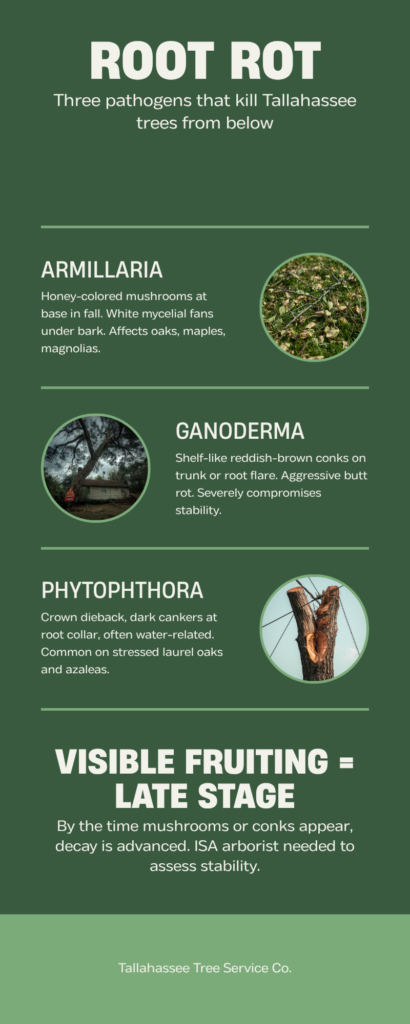
Ganoderma (Butt Rot Conks)
A hard, shelf-like conk at the base of the trunk — often reddish-brown with a white edge when fresh, sometimes looking like it was varnished. On oaks and other hardwoods, a Ganoderma conk on the lower trunk or root flare signals advanced internal decay in the very part of the tree that anchors everything above it. There is no spray or injection that reverses it. Once conks appear on a large tree standing within reach of a house, driveway, or play area, a professional risk evaluation is urgent.
Armillaria (Honey Fungus / Mushroom Root Rot)
Clusters of honey-colored, ordinary-looking mushrooms sprouting at the base in fall — but in Tallahassee’s long warm season they can show after any prolonged wet spell. The confirming sign is under the bark at the soil line: white, fan-shaped sheets of fungus with a mushroom smell. Armillaria is extremely common on stressed laurel oaks and water oaks across older neighborhoods like Betton Hills and Indianhead Acres, and on trees whose roots were cut or compacted during construction.
Laetiporus (Sulfur Shelf / Chicken-of-the-Woods)
Bright orange-and-yellow shelving brackets, usually on the lower trunk of old oaks. Spectacular to look at — and an indicator of brown rot, which makes wood brittle and prone to snapping rather than bending. A big sulfur shelf on a mature oak over your roof is not a photo op to ignore.
Why Summer Rain Makes Them Appear All at Once
The fungus doesn’t arrive with the rain — it’s been inside the wood, often for years. Moisture simply triggers fruiting. That’s why knocking the mushroom off changes nothing: you’ve removed the apple, not the orchard. It also means the absence of mushrooms doesn’t prove a tree is sound; fruiting is intermittent. But the presence of conks on living wood is meaningful evidence, and it should be documented, not destroyed, before a professional sees it.
What to Do This Week
Photograph the growth in place, from several angles, with something for scale. Note whether it’s attached to wood or just near it. Then step back and look up: is the canopy thinning? Deadwood? Smaller-than-normal leaves? Those symptoms plus a basal conk strengthen the case that decay is advanced — our guide to the signs of a hazardous or dying tree walks through the full checklist. Don’t excavate, don’t hit the trunk with anything, and don’t assume a green canopy means a sound base — trees with serious butt rot often look fine from the street until the year they don’t.
What a Professional Evaluation Looks Like
An experienced assessor will identify the fungus, sound the lower trunk, probe the root flare, and map how much sound wood remains relative to the tree’s size and what it could hit. Outcomes range from monitoring, to canopy weight reduction, to removal when the numbers don’t work — a tree health inspection is the starting point, and if decay is confirmed and the target is a bedroom or a neighbor’s garage, diseased tree removal may be the responsible endpoint. With hurricane season running through November, mid-summer is exactly the right time to settle the question rather than gamble on one more storm.
Frequently Asked Questions
Are mushrooms in my lawn bad for my trees? Almost never. Lawn and mulch mushrooms are decomposers feeding on dead organic matter in the soil. The ones that matter are those physically attached to the trunk, root flare, or major roots of a living tree.
Should I remove a conk from my tree’s trunk? No. Removing it doesn’t slow the decay inside and destroys the evidence a professional needs for identification. Photograph it and leave it in place until the tree has been evaluated.
Can a tree with root or butt rot be saved? Sometimes, depending on how much sound wood remains and what the tree could hit if it failed. Options range from monitoring and reducing canopy weight to removal. What doesn’t exist is a treatment that restores already-decayed wood.
Do mushrooms at the base mean the whole tree is rotten? Not necessarily — but fruiting bodies on living wood usually indicate the fungus has enough decayed material inside to support reproduction, which is why they warrant an evaluation rather than a wait-and-see approach.
Why did mushrooms appear right after the rain? Moisture triggers fruiting from fungus that was already established. The mushrooms are new; the decay generally is not.
Is a mushroom-covered stump a threat to nearby trees? Usually not, though Armillaria can spread from old root systems to stressed neighbors. Healthy, unstressed trees resist it well — another reason to protect roots from compaction and construction damage.
Tallahassee Tree Service Co. is a dispatch and matching service. We connect homeowners with independent, licensed and insured tree professionals — we do not perform tree work ourselves. The independent operator who takes on the job provides the written estimate after seeing the tree.