
SouthWood, Tallahassee, FL
SouthWood holds its residents to a lawn standard most of Tallahassee doesn’t — the master-planned community’s covenants expect turf that matches the streetscape, and nothing fights that standard like a stump. The neighborhood generates a steady supply of them, too: the pines St. Joe left when the community was carved from timberland keep coming down as they age or stress out, and every removal leaves a grind job behind. Here’s how stump grinding works on SouthWood’s lots, what “gone” actually means, and how to get the lawn seamless again.
Who grinds stumps in SouthWood?
Licensed operators covering the SouthWood–Capital Circle SE corridor with machines from backyard-gate size up: pine and hardwood stumps ground 8–12 inches below grade, surface roots chased, chips managed, and the spot ready for St. Augustine or centipede sod.
Got a stump (or a row of them) waiting on the lawn plan? Call (858) 319-0022 to reach the licensed local operator you’re matched with — multi-stump visits price meaningfully better than one-at-a-time.
Storm damage or a tree on your house? Call now.
Stay out of rooms under the tree and keep clear of downed lines — report those to the power company first. Then call and we’ll connect you with a local tree crew that handles storm work.
📞 Call (858) 319-0022Free 24/7 dispatch line · availability varies by storm volume
What does grinding actually leave behind?
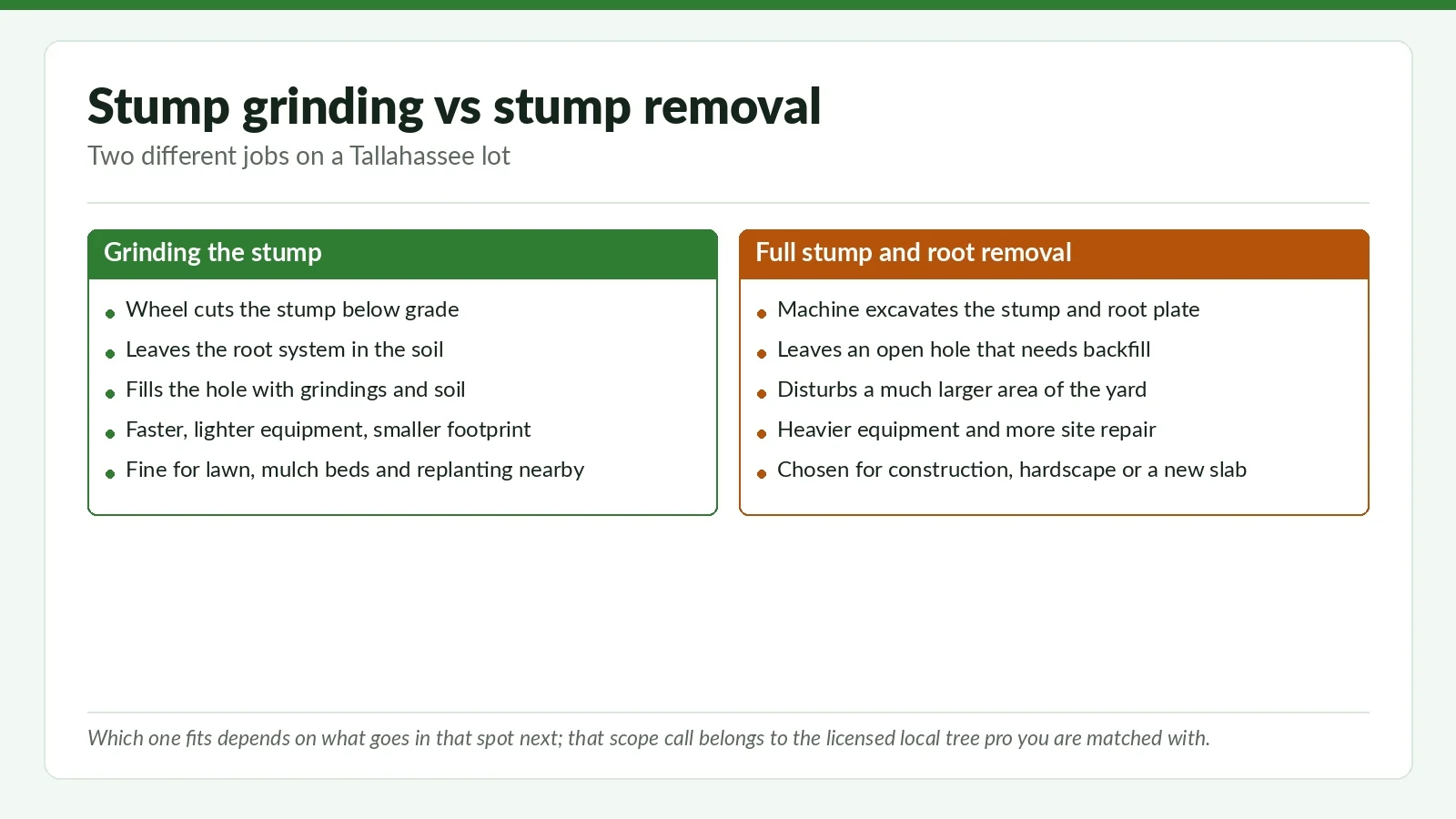
A grinder chews the stump into chips to a chosen depth — the honest spec for a lawn restoration is 8 to 12 inches below grade, deeper if you’ll replant a tree in the spot. What remains is a chip-filled crater and the lateral roots beyond the grind radius, which stay and rot over several years. That matters in SouthWood for two reasons. First, pine chips are acidic and nitrogen-hungry as they decompose — backfill the crater with chips alone and your new sod square yellows for two seasons, which the covenants committee will notice before you do. The fix is cheap: excavate most chips, backfill with soil, then sod. Second, surface roots from the old pines run long and shallow; a good operator chases the big ones so the mower stops finding them. The grinding-versus-full-removal decision is covered in grinding vs removal.
SouthWood’s stump specifics
- Pine stumps — the neighborhood staple: wide flares, long laterals, fast grinds, big chip volume. Plan the chip haul, not just the grind.
- Builder leftovers — some lots still hide ground-flush stumps from construction that sink and dish the lawn years later; regrinding and refilling fixes the dip for good.
- Irrigation everywhere — SouthWood lawns run zoned irrigation; heads and laterals get flagged before the machine rolls. Know roughly where your lines run — it’s the first dispatch question.
- Sod matching — most of the neighborhood runs St. Augustine or centipede; the sod-after-tree-work guide covers matching and establishment.
- Replanting spots — the community’s canopy standards encourage replacement trees; grind deep and wide if a new tree goes back in the same hole. See the replanting guide.
Utilities first, always
SouthWood’s lots carry more buried infrastructure than older neighborhoods — irrigation, low-voltage lighting, fiber, and shallow utility laterals on the newer phases. The non-negotiable sequence: locate call (811) for anything near easements, homeowner flags the irrigation, operator probes the grind zone. A grinder finding a fiber drop is an expensive afternoon; ten minutes of flagging prevents it. Operators who work the community weekly do this by default.
What drives the price of a grind?
Stump diameter (measured at the widest flare, not the cut face), depth spec, count, and access — a backyard stump behind a 36-inch gate needs a compact machine and more time than a front-yard grind off the drive. Chip handling is the quiet variable: leaving chips raked into beds is cheapest, hauling them off costs more but keeps the covenants happy. Multi-stump pricing is where SouthWood wins — mobilization dominates small jobs, so grinding four stumps in one visit costs far less than four visits. Full pricing logic: what affects stump grinding cost.
SouthWood stump FAQs
How soon after grinding can sod go down?
Same week, if the crater is backfilled with soil rather than chips. Chips-only backfill settles and starves the sod — excavate, fill with soil, compact lightly, then sod.
Will the ground spot sink later?
Only if it was chip-filled. Soil-backfilled grinds hold grade; check it after the first heavy rain and top up once if needed.
Can a grinder get into my fenced backyard?
Compact grinders fit standard 36-inch gates; larger stumps behind fences take longer with the small machine but get done. Give gate width at dispatch.
Do I need HOA approval to grind a stump?
No — grinding is restoration, not removal. The tree that made the stump may have needed sign-off, but the grind itself just needs the utilities flagged.
What nearby areas do you cover?
All of southeast Tallahassee: SouthWood, SouthWood trimming, the Capital Circle SE corridor, and the wider Tallahassee stump grinding service area.
Serving SouthWood and southeast Tallahassee, FL. Content reviewed August 2026. Tallahassee Tree Service connects homeowners with independent licensed tree professionals and does not perform tree work directly.
Tallahassee Tree Service is a free referral service. Tallahassee Tree Service is not a licensed tree service provider and does not directly provide tree care services. All work is performed by independent, licensed and insured third-party providers in your area. Calls and form submissions placed through this site may be connected with a participating provider, and you may be contacted by that provider regarding your request. Same-day, emergency, and 24/7 availability are not guaranteed and depend on provider schedules, location, and demand. Service availability, pricing, licensing, and final response times are determined solely by the providers. It is the responsibility of the homeowner to verify that the hired contractor furnishes the necessary license and insurance required for the work being performed. All persons depicted in a photo or video are actors or models and not contractors listed on Tallahassee Tree Service.