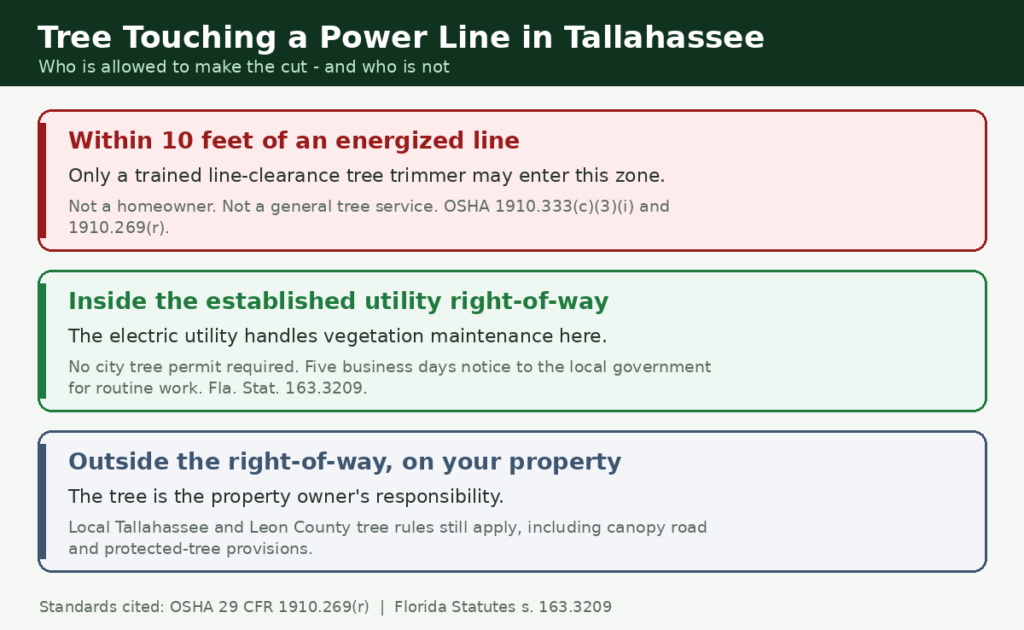
If a limb is touching or growing into an overhead power line in Tallahassee, the electric utility is the party that handles it inside its established right-of-way — and under Florida law it does not need a city tree permit to do that work. Nobody else should touch it. Federal safety rules keep untrained people and general tree services at least 10 feet away from energized conductors. Report it to your electric provider first, then have the rest of the tree assessed.
Late-summer storm season is when Leon County homeowners start noticing it: a water oak limb resting on the wire above the driveway, or a sweetgum grown up through the lines along the back easement. The instinct is to call somebody with a saw. That is the one thing you should not do — and the reason has less to do with liability than with the fact that the tree in the wires may not be yours to cut.
Who is responsible for trimming a tree near a power line in Tallahassee?
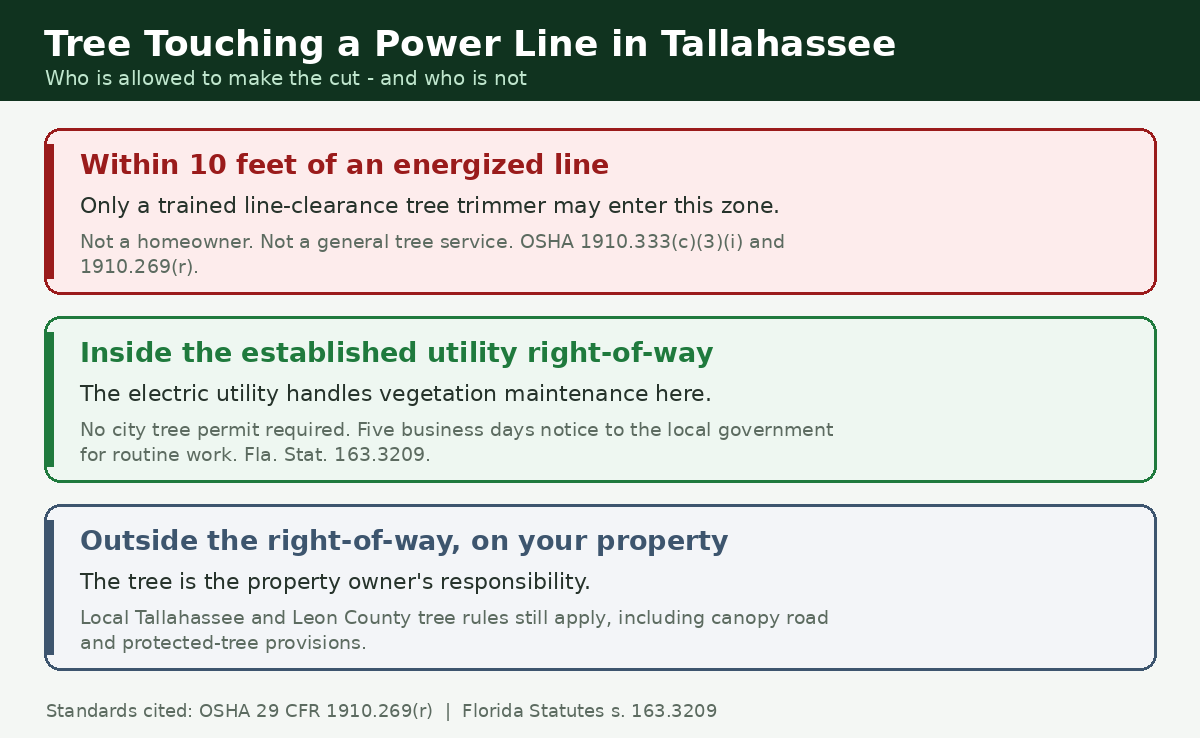
It depends entirely on where the tree is standing relative to the utility’s right-of-way, not on who planted it or who mows around it.
Inside an established electric transmission or distribution right-of-way, vegetation maintenance belongs to the electric utility. In this area that is the City of Tallahassee’s electric utility inside much of the city, and Talquin Electric Cooperative across large parts of Leon, Gadsden, Wakulla and Liberty counties. The correct first call is to whichever provider serves your address, using their outage or vegetation reporting channel.
Outside the right-of-way, the tree is the property owner’s. That includes the trunk and canopy of a tree that happens to lean toward the lines but is rooted on private ground. Florida’s statute on right-of-way maintenance is explicit that it “does not include the removal of trees outside the right-of-way, which may be allowed in compliance with applicable local ordinances.” So a single tree can genuinely have two custodians: the utility clears the part reaching into its corridor, and the property owner remains responsible for everything else.
Storm damage or a tree on your house? Call now.
Stay out of rooms under the tree and keep clear of downed lines — report those to the power company first. Then call and we’ll connect you with a local tree crew that handles storm work.
📞 Call (858) 319-0022Free 24/7 dispatch line · availability varies by storm volume
Why does the utility not need a City of Tallahassee tree permit?
This surprises a lot of homeowners who have been through the city’s own permitting process for a protected tree. Under Florida Statutes section 163.3209, once an electric right-of-way has been established and constructed, “no local government shall require or apply any permits or other approvals or code provisions for or related to vegetation maintenance and tree pruning or trimming within the established right-of-way.”
The statute is not a blank check, though, and the guardrails inside it are worth knowing:
- For scheduled routine work, the utility must give the local government’s designated official at least five business days’ advance notice. That notice requirement is waived when the trimming is needed to restore service, to head off an imminent vegetation-caused outage, or when the adjacent property owner requested it.
- The work must conform to the ANSI A300 pruning standards and the ANSI Z133.1 safety requirements — the same arboricultural standards a reputable private tree service follows.
- It must be supervised by qualified utility personnel, trained licensed contractors, or arborists certified through the International Society of Arboriculture.
- It does not override local rules protecting specimen trees, historical trees, or trees inside designated canopied protection areas.
That last carve-out matters more in Tallahassee than almost anywhere else in the state, because of the canopy road corridors. If your tree sits in one of those zones, the local protections are still live even where lines run nearby — a wrinkle worth reading up on in our breakdown of canopy road tree work and the 100-foot protection zone.
What is the 10-foot rule, and why does it apply to your yard?
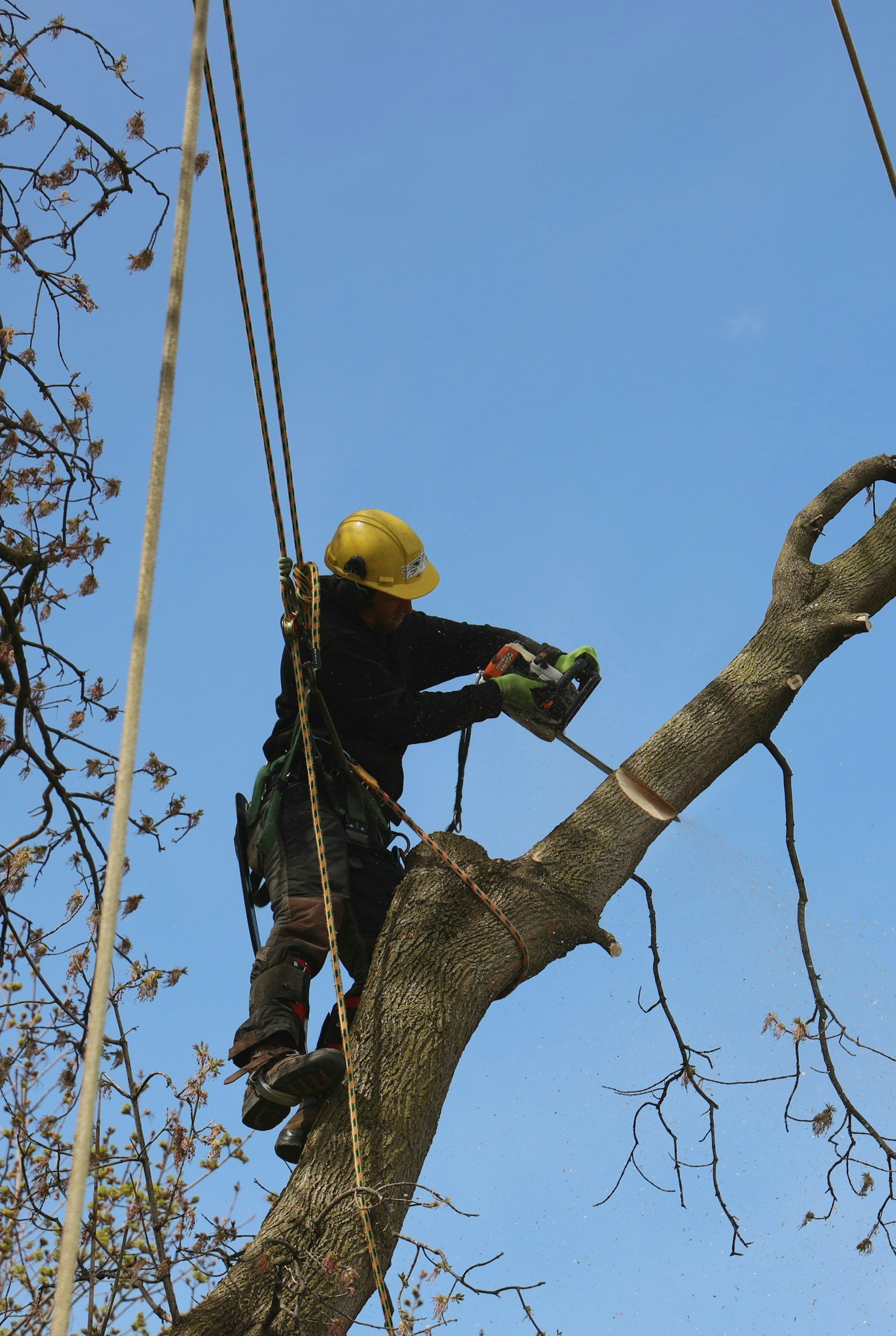
Federal workplace safety rules draw a hard line around energized conductors. Under OSHA’s standards, workers who are not electrically qualified must keep a minimum approach distance of at least 10 feet from overhead power lines at 50 kV and below, with that distance growing for higher-voltage transmission lines. Only a specially trained line-clearance tree trimmer is permitted to work inside that zone, using insulated tools, after confirming the voltage of every line in play.
Read that as a homeowner and it says something blunt: the ladder, the pole saw, and the extended reach of whatever you are holding all count toward that 10 feet. So does the boom of a bucket truck belonging to a tree service that does not hold line-clearance qualifications. A crew can be excellent at removals and still be the wrong crew for a limb resting on a primary conductor.
What about the service drop running to your own house?
The wire crossing your yard to the weatherhead on your house is a different animal from the primary line on the poles out front, and utilities treat it differently. Some providers will clear vegetation off a residential service drop on request; others treat portions of it as the homeowner’s equipment. Because that boundary varies by provider and by how the connection was built, the honest answer is to ask your own electric utility where their responsibility ends before anyone climbs.
What should a Tallahassee homeowner do instead?
- Report the contact to your electric provider. Describe the location, the type of line, and whether you are seeing sparking, smoke, or a sagging conductor. Treat any downed line as energized.
- Keep people and equipment back. Ten feet minimum, further in wind. Do not move a fallen limb that is lying across a wire, even a small one.
- Get the rest of the tree looked at separately. Once the utility has cleared its corridor, the remaining structure is often lopsided — a tree pruned hard on one side to protect a line carries more failure risk in a storm than it did before. A licensed local arborist you are matched with can assess whether the balance of the canopy needs corrective work or whether the tree has become a removal candidate.
- Plan the replacement with the wire in mind. Florida law bars local governments from requiring a tree that will exceed 14 feet in an established electric right-of-way, which is a useful ceiling to borrow when you are choosing what to plant back.
If the tree in question is a mature live oak or water oak, the corrective pruning question is rarely a small one. Our guide to oak tree trimming in Tallahassee covers what good structural work looks like on those species, and the broader Tallahassee tree service overview walks through how matching to a licensed local pro works.
Limb resting on a line, or a tree left lopsided after utility trimming? Report the line contact to your electric provider first, then get matched with a licensed, insured local arborist for the rest of the tree.
FAQ
Who do I call about a tree touching a power line in Tallahassee?
Your electric provider — the City of Tallahassee’s utility inside much of the city, or Talquin Electric Cooperative in many surrounding areas. Report it through their outage or vegetation channel and keep everyone at least 10 feet back until they respond.
Can I trim a branch off a power line myself?
No. OSHA requires anyone who is not a trained line-clearance tree trimmer to stay at least 10 feet from energized overhead lines, and that distance includes ladders, saws, and anything else you are holding.
Does the utility need a permit to trim my tree in Tallahassee?
Not for vegetation maintenance inside an established right-of-way. Florida Statutes section 163.3209 bars local governments from requiring permits for that work, though it does not override local protections for specimen trees, historical trees, or designated canopied protection areas.
Do I have to pay for utility line-clearance trimming?
Right-of-way vegetation maintenance is handled by the electric utility as part of its system upkeep, and Florida law treats those vegetation maintenance costs as recoverable utility costs. Work on the rest of your tree, outside the corridor, remains a property owner responsibility.
My tree looks unbalanced after the utility trimmed it. Is that a problem?
It can be. Heavy one-sided clearance shifts a canopy’s weight distribution, which matters in hurricane season. Having a certified arborist evaluate the remaining structure is a reasonable next step.
This article is general information about Florida right-of-way and electrical safety rules and is not legal or engineering advice. Tallahassee Tree Service is a free referral and dispatch service; we are not a licensed tree service provider or an electric utility, and do not perform tree work ourselves. All work is performed by independent, licensed and insured third-party arborists in our network. Report any contact between vegetation and an energized line to your electric utility.