Why Tallahassee Trees Drop Leaves in Mid-Summer Heat — and When It’s a Warning Sign
It catches homeowners off guard every July: a live oak or water oak that should be at peak canopy starts shedding leaves onto the driveway like it’s October. No storm, no obvious damage — just a steady rain of green and yellow leaves in the middle of the hottest, greenest month of the year. In most cases this is a tree managing its own water budget during Tallahassee’s classic mid-summer pattern of blazing afternoons and inconsistent rain. In a smaller number of cases, it’s the first visible sign of root stress, disease, or damage that’s been building underground for months.
If a tree in your yard has dropped a noticeable amount of leaves in the past couple of weeks, call now on our homepage to get matched with a licensed, insured local tree professional for a written assessment. We’re a dispatch service that connects you with vetted, independent crews — we don’t perform the work ourselves.
Storm damage or a tree on your house? Call now.
Stay out of rooms under the tree and keep clear of downed lines — report those to the power company first. Then call and we’ll connect you with a local tree crew that handles storm work.
📞 Call (858) 319-0022Free 24/7 dispatch line · availability varies by storm volume
Normal Mid-Summer Leaf Drop vs. Something Else
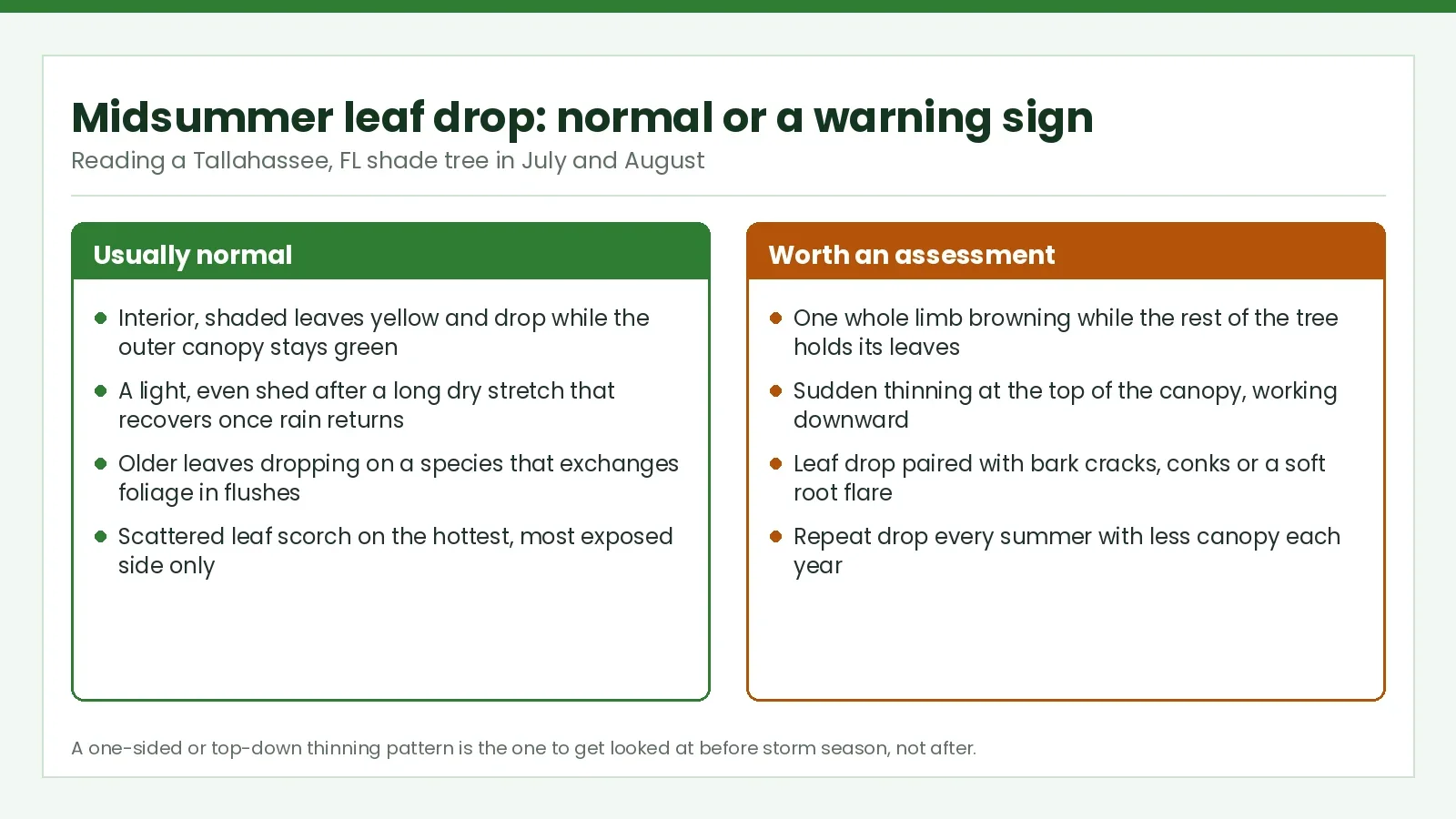
Trees regulate water loss through their leaves, and when the ground dries out faster than roots can keep up — which happens constantly in Tallahassee’s stretch of scattered, uneven afternoon storms — a tree will shed a percentage of its own leaves on purpose. It’s a survival move, not a symptom. Normal heat-stress drop tends to be scattered across the whole canopy, includes leaves that are still mostly green or just slightly yellowed, and slows down once a good rain soaks the root zone. Drop that’s concentrated on one side of the tree, includes browned or curled leaves, or continues for weeks regardless of rainfall is a different story.
Heat and Drought Stress: The Most Common Cause
Water oaks and laurel oaks — both common across older Tallahassee neighborhoods — are especially quick to self-thin in a dry stretch, more so than live oaks, which tend to hold their leaves longer under the same stress. Newly planted trees and anything within the last two or three growing seasons of installation are the most vulnerable, since their root systems haven’t spread far enough to find deeper soil moisture yet. Our guide to summer drought watering for Tallahassee live oaks and mature trees covers how much water a stressed tree actually needs and how to deliver it without wasting it on surface runoff.
Compacted or Damaged Roots
A tree that drops leaves every summer, worse each year, is often telling you something about what’s happening below the mulch line rather than in the sky above it. Root compaction from repeated mower and vehicle traffic, grade changes from a driveway or patio project, or trenching for irrigation and utility lines all reduce a tree’s ability to pull water even when the soil around it is wet. Karst limestone pockets common across parts of Leon County can also create root zones with far less usable soil volume than the canopy above would suggest, which shows up first as summer leaf thinning long before any visible lean or dieback.
Disease and Insect Pressure Riding Along With Heat Stress
A tree already running a water deficit has less energy to defend itself, which is exactly when opportunistic problems take hold — root rot fungi, boring insects, and canker diseases all disproportionately affect trees that are already stressed. This is why professionals treat unusual mid-summer leaf drop as a prompt to look closer rather than a problem in itself: the leaf drop is often the visible tip of an underlying issue that started weeks or months earlier.
What Actually Warrants a Closer Look
A few patterns separate ordinary heat response from something that needs a professional eye: drop concentrated on one limb or one side of the crown rather than spread evenly; leaves that are brown, curled, or spotted rather than simply pale; drop that continues unchanged after a heavy rain has clearly soaked the root zone; and drop paired with any deadwood, bark splitting, or fungal growth at the base. Any one of those on its own is worth documenting with photos; two or more together justify a professional inspection sooner rather than later.
What a Professional Assessment Looks Like
An arborist evaluating unusual leaf drop will check soil moisture at multiple depths, look for compaction and grade changes near the root zone, inspect the trunk and root flare for decay or pest entry, and compare the pattern against what’s normal for that species and this specific summer’s rainfall. A tree health inspection is the right starting point whenever the pattern doesn’t match ordinary heat stress, and it’s far cheaper to catch a root or disease problem in its early, leaf-drop stage than after canopy dieback sets in.
Frequently Asked Questions
Is it normal for trees to drop leaves in July in Tallahassee? Yes, in moderation. Many species shed a percentage of leaves during hot, dry stretches as a water-conservation response, and the drop typically eases after a good soaking rain.
Which Tallahassee trees drop leaves first under heat stress? Water oaks and laurel oaks tend to self-thin earlier and more visibly than live oaks under the same drought conditions, which is normal for those species rather than a sign something is uniquely wrong with that particular tree.
Should I water a tree that’s dropping leaves? Usually yes, with a slow, deep soak at the drip line rather than frequent shallow watering. Newly planted and young trees benefit most, since their root systems haven’t reached deeper, more stable soil moisture yet.
When does leaf drop mean the tree is dying? When it’s concentrated on one side, involves browned or curled leaves rather than pale green ones, continues after rain has soaked the ground, or comes with deadwood, bark damage, or fungal growth at the base.
Can construction near a tree cause summer leaf drop? Yes. Grade changes, trenching, and soil compaction from equipment traffic all reduce root function, and the first visible sign is often heavier-than-normal leaf drop the following summer.
Will a stressed tree recover on its own? Many do once watering and soil conditions improve, but recovery depends on how much root and canopy function was lost. A professional assessment is the only reliable way to tell a temporary stress response from a tree in decline.
Tallahassee Tree Service Co. is a dispatch and matching service. We connect homeowners with independent, licensed and insured tree professionals — we do not perform tree work ourselves. The independent operator who takes on the job provides the written estimate after seeing the tree.