Species Guide — Tallahassee, FL
Ask a Big Bend tree crew which species they least trust in a storm and hackberry makes every list. Sugarberry — the southern hackberry that grows all over Tallahassee’s older neighborhoods and fence lines — is a fast, scrappy native that shades a yard in fifteen years and then spends the next thirty shedding limbs onto whatever’s below. Weak wood, weak unions, quick decay, and a root flare that heaves sidewalks: it’s the tree that looks fine on Tuesday and drops a scaffold on Thursday’s thunderstorm. Here’s the honest hackberry guide for Tallahassee yards.
Are hackberry trees worth keeping in Tallahassee?
Away from targets, yes — they’re bird magnets and honest shade. Over houses, drives, and patios, the species’ brittle wood and fast decay make mature hackberries the neighborhood’s most frequent limb-drop offenders, and removal-before-failure is often the rational call.
If your hackberry has started dropping limbs on calm days, call (858) 319-0022 to reach the licensed local arborist you’re matched with — that’s the species announcing its schedule.
Storm damage or a tree on your house? Call now.
Stay out of rooms under the tree and keep clear of downed lines — report those to the power company first. Then call and we’ll connect you with a local tree crew that handles storm work.
📞 Call (858) 319-0022Free 24/7 dispatch line · availability varies by storm volume
Why do crews distrust hackberry in wind?
Three compounding traits. The wood itself tests weak — sugarberry’s bending and breaking strength runs well below the oaks it grows beside, closer to boxelder than to live oak. The architecture is worse: hackberries fork early and often into upright co-dominant stems with included bark, the union type that splits under load. And the species compartmentalizes poorly — every lost limb becomes a decay column within a few seasons, so a middle-aged hackberry is typically carrying several soft spots under an intact-looking crown. Put those together in a Tallahassee thunderstorm season and you get the pattern every older neighborhood knows: the hackberry is the tree that keeps the roofer’s number on the fridge. Storm after storm — from routine July cells to Idalia and Helene — the species is overrepresented in the debris piles relative to how many stand.
Keep, manage, or remove
- Keep — back-corner and fence-line hackberries with nothing under them: leave them for the mockingbirds and cedar waxwings, which strip the sugarberries all winter. No tree feeds more birds per square foot of yard.
- Manage — mid-yard trees: aggressive deadwooding on a short cycle, reduction of the longest horizontals, and honest expectations — pruning slows the limb-shedding, it doesn’t stop it. See pruning standards.
- Remove — mature hackberries over structures, driveways, patios, and play areas, especially once limb-drop begins or mushrooms appear on old wounds. A planned removal of a 60-foot hackberry is routine; the unplanned version arrives through the roof. See hazardous tree removal.
The witches’ broom and the nipple galls
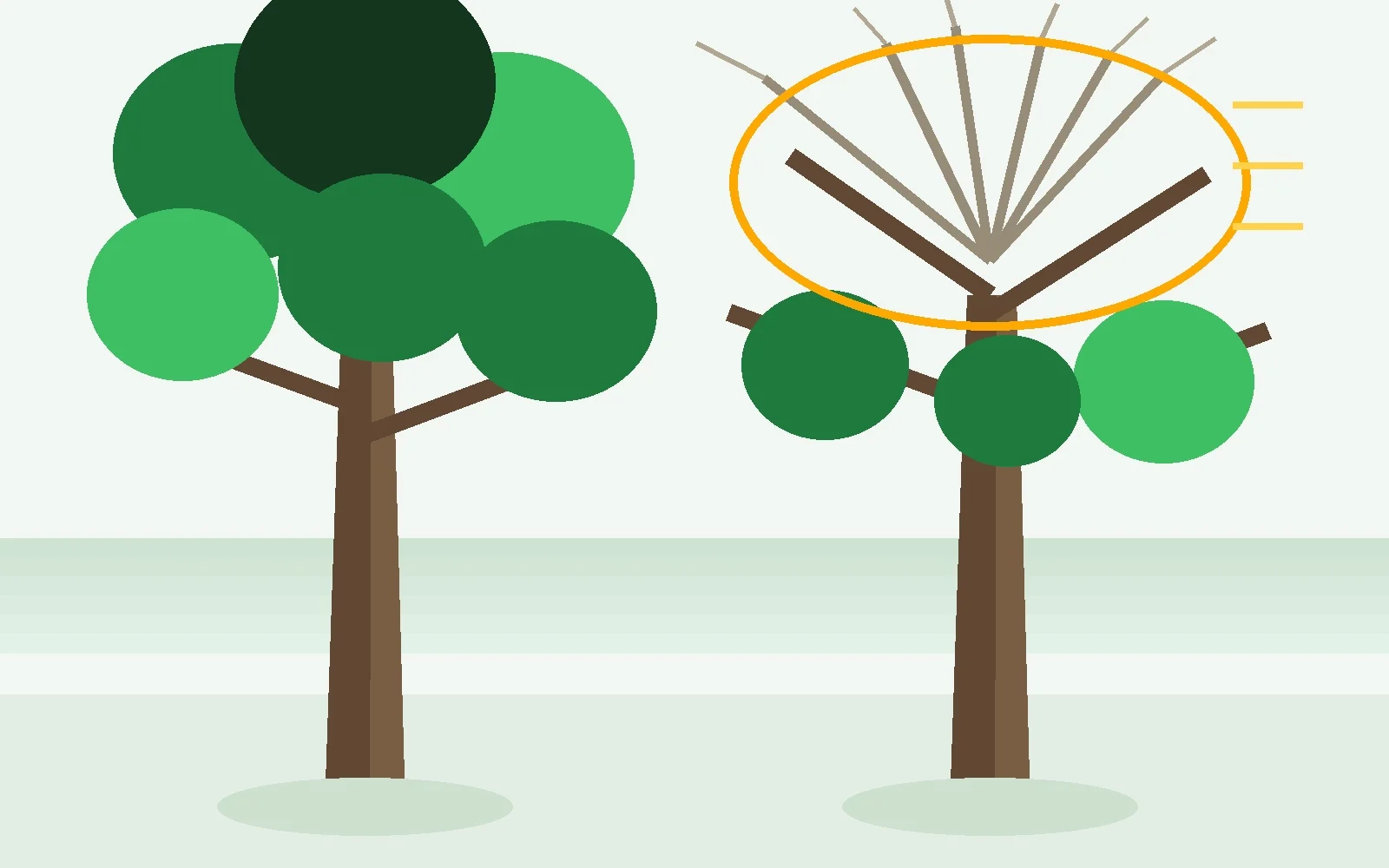
Two cosmetic hackberry signatures worry owners unnecessarily. Witches’ broom — dense twig clusters at branch tips, caused by a mite-and-mildew duo — disfigures most older sugarberries but doesn’t meaningfully weaken them. Nipple galls — the bumps carpeting the leaf undersides — are psyllid insects with zero structural consequence. Neither is a removal reason. What is: fruiting fungus on the trunk, cavities at old limb wounds, cracks at the big forks, and any lean over a target. The assessment reads the difference.
What does hackberry removal involve?
Caution disproportionate to size. Climbers treat mature hackberries the way they treat known-decayed trees: weight tested before trusted, rigging points backed up, and the big forks never loaded directly because the included-bark unions can’t be read from outside. Where decay is confirmed or the tree is dead, it becomes bucket or crane work entirely — dead hackberry goes punky faster than nearly any local hardwood, and a two-years-dead one is unclimbable. The consolation: the wood is light, the stumps grind easily, and jobs finish fast. Root flares that heaved the sidewalk get ground with the stump — see stump grinding — and pricing follows the standard drivers in the removal cost guide.
Hackberry FAQs
How do I identify a hackberry?
Gray bark studded with distinctive corky warts and ridges — no other local tree has it — plus lopsided-based leaves and small orange-to-purple berries the birds mob in fall. Older trunks often carry witches’ broom twig clusters in the crown.
My hackberry dropped a big limb with green leaves on it. Why?
That’s the species — brittle wood plus hidden decay at the limb base means green limbs let go in modest wind or none. One green-limb failure is the standard signal to assess everything else over targets.
Is the witches’ broom disease killing it?
No — the broom is cosmetic. Hackberries carry it for decades. Judge the tree on its trunk, unions, and wounds, not its twig clusters.
Do I need a permit to remove a big hackberry in Tallahassee?
Over the ordinance size threshold, the permit conversation applies like any hardwood — and hackberry’s documented failure record makes hazard cases straightforward. See the permit guide.
What should replace a removed hackberry?
If the draw was the birds: yaupon holly and American beautyberry feed them without the falling limbs. For replacement shade: nuttall oak or winged elm — comparable growth, far better wood. See the replanting guide.
Serving Tallahassee, Leon County, and the Big Bend. Content reviewed August 2026. Tallahassee Tree Service connects homeowners with independent licensed tree professionals and does not perform tree work directly.
Tallahassee Tree Service is a free referral service. Tallahassee Tree Service is not a licensed tree service provider and does not directly provide tree care services. All work is performed by independent, licensed and insured third-party providers in your area. Calls and form submissions placed through this site may be connected with a participating provider, and you may be contacted by that provider regarding your request. Same-day, emergency, and 24/7 availability are not guaranteed and depend on provider schedules, location, and demand. Service availability, pricing, licensing, and final response times are determined solely by the providers. It is the responsibility of the homeowner to verify that the hired contractor furnishes the necessary license and insurance required for the work being performed. All persons depicted in a photo or video are actors or models and not contractors listed on Tallahassee Tree Service.