Lightning-Damaged Tree in Tallahassee? Don’t Trust What You See From the Ground
A tree that took a direct hit yesterday and looks fine today can be the most dangerous thing on the property. Call now and we’ll connect you with an ISA-certified local arborist for a post-strike assessment — before the 0-to-90-day failure window decides for you.
📞 Call Now — (858) 319-0022Tree already down on a structure? That’s an emergency — head to emergency tree service.Tallahassee sits in the highest lightning-strike-density region in the United States — Florida lightning climatology puts North Florida in the top tier of the country for cloud-to-ground strikes per square mile, and the June-through-September thunderstorm pattern that defines summer here is the reason. Lightning-damaged trees are routine in this town. What’s dangerous is the assumption that a green canopy means the tree is fine.
What lightning actually does to a tree
The visible damage — a blown-off bark strip, scorched branches — is only the surface story. The strike channel runs through the cambium, the living tissue layer just under the bark, vaporizing water as it goes. That vapor blast is what strips the bark. But the current also travels down the trunk into the root system, cooking living tissue the whole way. The roots can be partially or completely destroyed with nothing visible above grade.
Arborists classify post-strike damage into four scenarios:
- Superficial bark strip, minor cambium damage. The tree often survives if the strike path covers less than half the trunk circumference. The plan is mostly observation.
- Deep cambium damage, partial root damage. The tree may hold on for one to three years with declining vigor, then become a hazard tree. The honest plan is monitoring with a removal scheduled before structural failure schedules itself.
- Severe trunk damage, major root cooking. Functionally dead — it just hasn’t dropped its leaves yet. Structural integrity is gone, and the next serious weather event finds it.
- Internal explosion. A strike on a moisture-saturated tree can burst the trunk from internal steam pressure. These trees are compromised at a level no ground-level look can see, and the removal conversation is urgent.
None of the four are diagnosable by appearance alone. The pros use bark probes, root-crown excavation, and — on borderline calls — resistograph readings that map internal wood density.
The critical window: 0 to 90 days after the strike
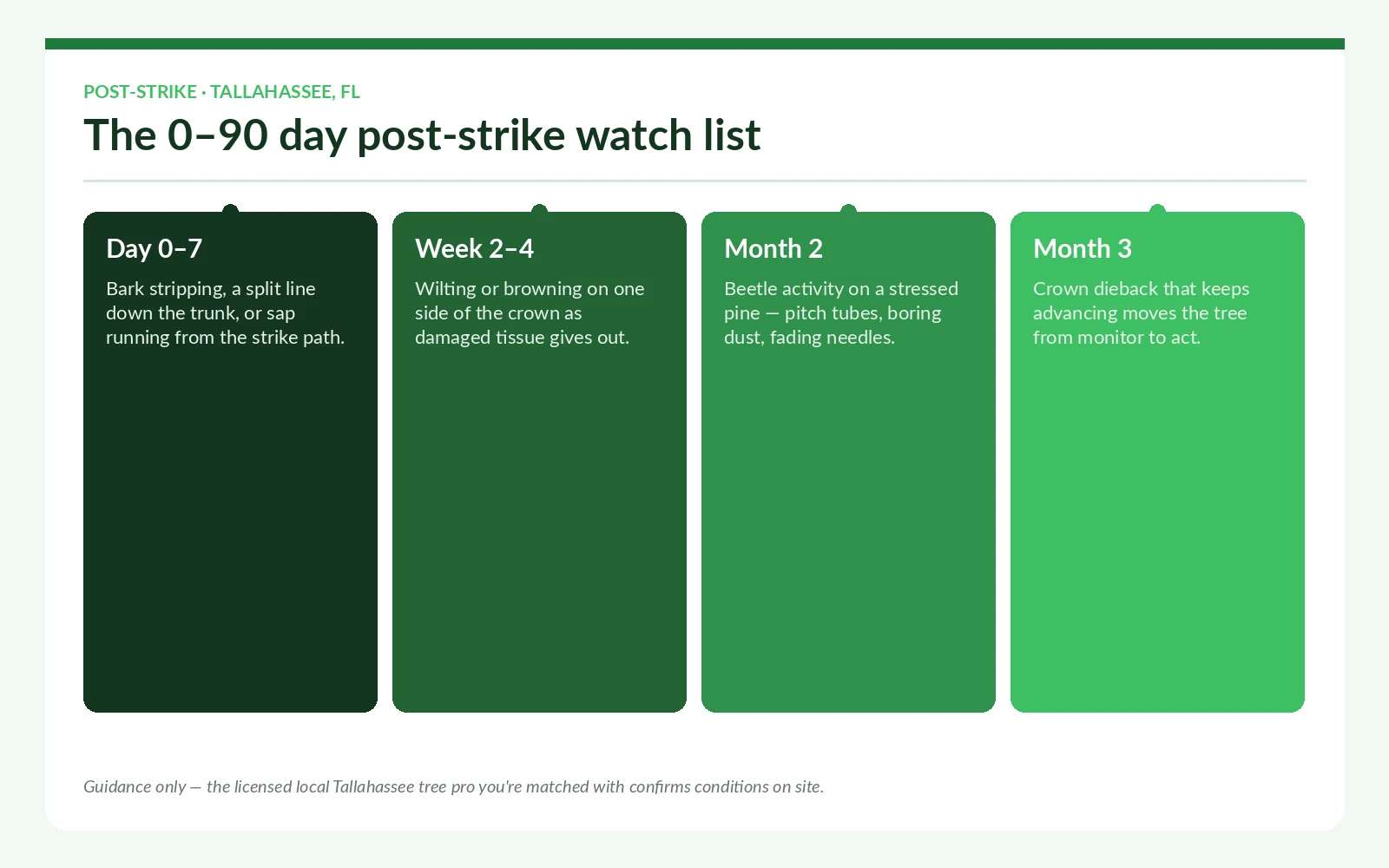
Most post-strike failures happen inside the first three months. The vascular system is compromised, summer heat keeps stressing the canopy, and any follow-up storm stacks wind load on the strike defects. What the assessment tracks through that window:
- Canopy dieback — bare upper-crown branches at 14–30 days signal vascular failure in progress.
- Bark separation spreading beyond the original strike path — the cambium damage is still moving.
- Sap bleeding from non-strike points — internal vascular rupture.
- Root-collar instability — if the tree rocks at the base, the root system is going.
- New mushrooms at the base — decay fungi colonize cooked root tissue fast.
The longer-horizon recovery playbook — feeding, watering, and multi-season monitoring for survivable strikes — is covered in lightning-damaged tree recovery. This page is about the immediate post-strike call.
Struck this week? The earlier the assessment, the more options you have — and the stronger your insurance documentation gets.
📞 Call Now — (858) 319-0022Vetted local pros — availability depends on independent provider schedules and demand.*What happens during a post-strike assessment
- Walk-around with you. When the strike happened, what the weather was doing, whether anyone heard the hit — it all helps localize the strike path.
- Bark probe along the strike path at multiple heights to map cambium damage depth.
- Root-crown check. If the current ran to ground, mulch and soil come back from the flare to inspect for root damage.
- Resistograph reading when indicated — a fine drill that maps wood density and finds internal cavities.
- Written classification. Which of the four scenarios, the recommended action, and the time horizon — in writing, which is exactly what an insurance claim wants.
If the verdict is scenario 3 or 4, the same pro can scope and quote the removal on the spot — timing and pricing are between you and them. For scenarios 1 and 2, ask about follow-up checks at 30 and 90 days; most pros will propose a monitoring plan as part of the assessment.
Lightning and pines: the Tallahassee pattern
Pines take more strikes than anything else here for a simple reason — they’re the tallest thing in most yards, and lightning takes the shortest path to ground. A 60-foot slash pine standing 20 feet above the roofline is a rod with needles. Pine strikes also run more severe: higher resin content means more violent internal pressure, and pine trunks can shatter their full length with bark thrown 50 feet. Many are functionally dead at impact — and a dead pine in this climate becomes a beetle nursery fast, which is its own countdown; see the southern pine beetle guide and pine tree removal.
The insurance documentation question
Lightning is a covered peril in most Florida homeowner policies. Three things make the claim smooth:
- Date and time of the strike — if nobody witnessed it, National Lightning Detection Network data can often confirm a strike at a specific location and time.
- Photos — the bark strip, scorched limbs, anything the tree hit.
- A written ISA-certified assessment — the document that establishes removal as “reasonable and necessary,” which is the phrase carriers pay on.
The broader claims workflow — what adjusters ask for and in what order — is in tree insurance claims after Tallahassee storms.
How getting matched works
What shapes the quote if removal is the verdict
- Structural trust: a strike-shattered trunk can’t always be climbed — crane or lift work changes the whole job plan.
- Size and targets: struck trees are usually the tallest on the lot, and what’s under them is usually the house.
- Access: backyard giants behind fences mean rigging, not dropping.
- Urgency class: a scenario-4 burst trunk is a priority mobilization; a scenario-2 monitor-then-remove books on a normal calendar.
- Debris and stump: shattered pine generates real tonnage, and the stump grind closes out the beetle question. See the removal cost-factor guide for the full breakdown.
Frequently asked questions
My tree got struck by lightning and looks fine. Is it actually fine?
Possibly — roughly half of bark-strip-only strikes recover. The other half develop progressive vascular damage that shows up over 30–90 days. An ISA-certified assessment sorts which half yours is in before the failure does.
How soon should a struck tree be looked at?
Inside the first couple of weeks if you can — early baseline readings make the 30- and 90-day comparisons meaningful, and early documentation strengthens an insurance claim. Scheduling itself is between you and the pro you’re matched with.
Will homeowner’s insurance cover lightning-damaged tree removal?
Lightning is a covered peril in most Florida policies. What carriers pay for is removal that’s “reasonable and necessary” — and the arborist’s written assessment is the document that establishes it.
What drives the cost of removing a lightning-struck tree?
Size, access, and above all structural trust — a shattered trunk that can’t hold a climber means crane work. The strike itself isn’t a line item; the condition it left the tree in is. The quote is between you and the pro.
Can a lightning-struck tree recover?
Yes, in the lower-severity scenarios. Good signs: the canopy holds through 90 days, bark starts closing at the strike path, and dieback doesn’t progress. Water support through the first summer helps — the protocol is in the recovery guide.
Should I put a lightning protection system on my big oak?
For a high-value heritage oak standing above the roofline, a professionally installed lightning protection system is a real option — it’s specialist work worth raising during the assessment walk-through.
Related Tallahassee tree services
Emergency Tree Service
Storm-Damaged Trees
Pine Tree Removal
Southern Pine Beetle
Tree Risk Assessment
Removal Cost Factors
Dead Tree Removal
Hazardous Tree Removal
The strike already happened. The failure hasn’t — yet.
Call now and we’ll connect you with a vetted, ISA-certified Tallahassee arborist for a post-strike assessment and written documentation. Free to use, no obligation, no sign-up.
📞 Call Now — (858) 319-0022Tallahassee Tree Service is a free referral service. Tallahassee Tree Service is not a licensed tree service provider and does not directly provide tree care services. All work is performed by independent, licensed and insured third-party providers in your area. Calls and form submissions placed through this site may be connected with a participating provider, and you may be contacted by that provider regarding your request. Same-day, emergency, and 24/7 availability are not guaranteed and depend on provider schedules, location, and demand. Service availability, pricing, licensing, and final response times are determined solely by the providers. It is the responsibility of the homeowner to verify that the hired contractor furnishes the necessary license and insurance required for the work being performed. All persons depicted in a photo or video are actors or models and not contractors listed on Tallahassee Tree Service.