Species Guide — Tallahassee, FL
The sycamore is the tree Tallahassee homeowners plant for shade and regret for scale. American sycamore is the fastest-growing big tree that thrives here — ten feet a year when young, a hundred feet at maturity, with white-mottled upper limbs you can spot across town. Planted 20 feet from a 1980s house, that vigor becomes the problem: roots in the sewer lateral, limbs over two roofs, summer leaf-blight mess, and a trunk diameter that doubles the removal quote every decade it waits. Here’s the honest sycamore guide for Tallahassee lots — keep, manage, or remove.
When should a Tallahassee sycamore be removed?
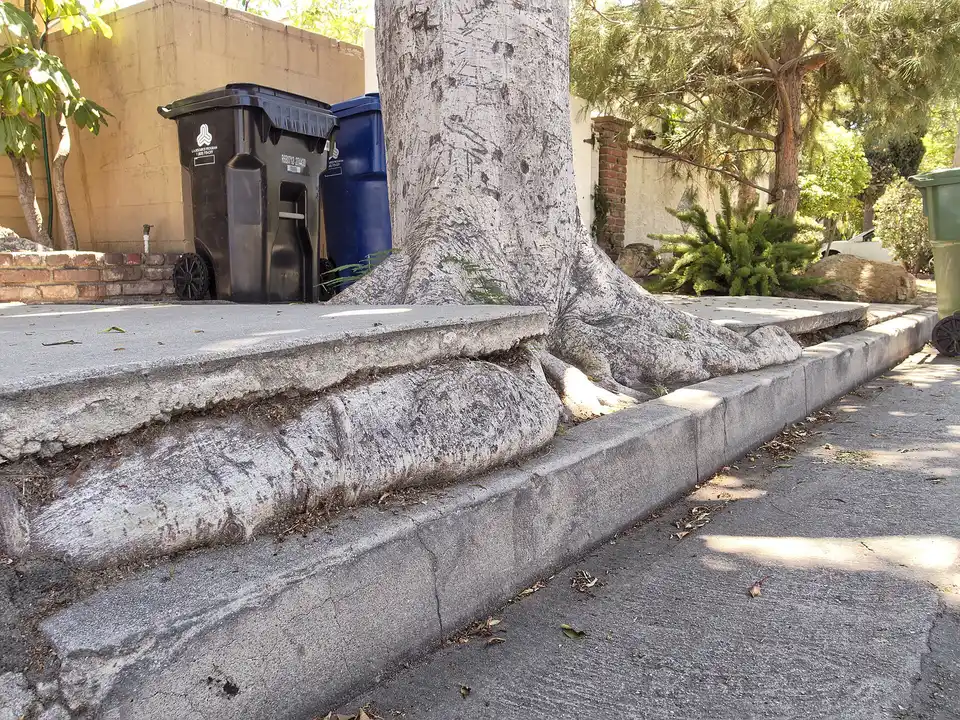
When scale beats site: roots working into pipes and slabs, major limbs over structures on a tree still adding size, or storm-cracked leaders in the brittle upper crown. A sycamore with room — big lot, away from hardscape — is a keeper; a sycamore planted close to a house is a countdown.
If your sycamore’s roots have found the sewer line or its limbs own the roof, call (858) 319-0022 to reach the licensed local arborist you’re matched with — sycamore quotes only grow with the tree.
Storm damage or a tree on your house? Call now.
Stay out of rooms under the tree and keep clear of downed lines — report those to the power company first. Then call and we’ll connect you with a local tree crew that handles storm work.
📞 Call (858) 319-0022Free 24/7 dispatch line · availability varies by storm volume
What does a sycamore do to a Tallahassee lot?
Everything fast. In the Red Hills clay and along Tallahassee’s wet bottoms — the species’ natural habitat is creek banks, which is why it loves compacted subdivisions with poor drainage — a sycamore reaches working size in 15 years and keeps going for a century. The root system is the first collision: shallow, aggressive, moisture-seeking mains that lift sidewalks and driveways and famously find the joints in old clay sewer laterals (the “roots in the line again” plumber visit is a sycamore signature in older neighborhoods). The crown is the second: massive horizontal limbs of moderately brittle wood — stronger than laurel oak, weaker than live oak — that shed in summer storms once the tree overtops everything around it. And the annual mess is real: sycamore anthracnose (a leaf blight the species gets here almost every humid spring) browns and drops half the canopy in early summer, seed balls follow, and the exfoliating bark sheets pile up year-round. None of it kills the tree; all of it lands on your lawn.
Keep, manage, or remove — the decision
- Keep — big-lot sycamores 40-plus feet from structures with roots running toward open ground: superb shade, fast canopy, honest 100-year tree. Deadwood every few years and enjoy it.
- Manage — mid-distance trees: reduction pruning on the limbs over the roof, root management at the hardscape line, and pipe-sleeve or lateral-replacement fixes on the plumbing side. Works for years, not forever — the tree keeps growing.
- Remove — close-planted sycamores whose next decade of growth has nowhere to go, storm-cracked leaders, and trees already inside the foundation drip line. The earlier the call, the cheaper: a 24-inch trunk is a routine day, a 48-inch trunk is a crane event. See large tree removal.
Anthracnose isn’t the emergency it looks like
Every May-June, sycamore owners see half the canopy brown out and call it dying. It’s almost always sycamore anthracnose — a cool-wet-spring fungus that kills the first flush of leaves and twigs, after which the tree releafs by July like nothing happened. No spray is practical at yard-tree height and none is needed; rake the fallen leaves rather than mulching them in place to cut next year’s spore load. The removal conversation is about scale and placement — not about the blight. The distinction is covered in disease identification.
What does sycamore removal involve?
Size is the whole story. Mature Tallahassee sycamores routinely carry 30-plus-inch trunks and hundred-foot crowns, so removals near structures are crane-or-big-rigging jobs: leaders sectioned, horizontal limbs walked back, trunk blocked in heavy rounds — sycamore wood is wet and heavy off the saw. The stump is wide and shallow-rooted; grinding is straightforward but covers more square footage than an oak of equal diameter, and the surface roots across the lawn deserve chasing while the machine is there. Cost tracks diameter, crane time, and haul volume — sycamores produce enormous chip and wood tonnage; the frame is in the removal cost guide, and the written number comes on-site from the pro you’re matched with.
Sycamore FAQs
My sycamore browned out in June. Is it dying?
Almost certainly anthracnose, not death — the species’ annual spring blight here. Watch for the July releaf; if the new flush doesn’t come, then get an assessment.
Can pruning keep a close-planted sycamore safe long-term?
It buys real time — a good reduction takes seasons of risk off the roof limbs — but the growth rate means re-pruning every 3-4 years, forever. Compare a decade of that against one removal and replant; sometimes the pruning wins, often it doesn’t.
Are the roots actually breaking my pipes, or just finding existing cracks?
Mostly the latter — roots exploit joints and cracks in old clay and cast-iron laterals rather than crushing sound PVC. That’s cold comfort with a 1970s lateral; the fix pairs pipe repair with root management or removal.
Do I need a permit to remove a big sycamore?
Mature sycamores are usually over Tallahassee’s ordinance threshold, so yes — the permit conversation applies, with hardscape and plumbing damage documentation supporting the case. See the permit guide.
What should replace a removed sycamore?
If you loved the scale, plant it where it fits: nuttall oak or bald cypress 40 feet out. For close-to-house shade, go smaller-mature — fringetree, little gem magnolia. The best trees guide matches species to setbacks.
Serving Tallahassee, Leon County, and the Big Bend. Content reviewed August 2026. Tallahassee Tree Service connects homeowners with independent licensed tree professionals and does not perform tree work directly.
Tallahassee Tree Service is a free referral service. Tallahassee Tree Service is not a licensed tree service provider and does not directly provide tree care services. All work is performed by independent, licensed and insured third-party providers in your area. Calls and form submissions placed through this site may be connected with a participating provider, and you may be contacted by that provider regarding your request. Same-day, emergency, and 24/7 availability are not guaranteed and depend on provider schedules, location, and demand. Service availability, pricing, licensing, and final response times are determined solely by the providers. It is the responsibility of the homeowner to verify that the hired contractor furnishes the necessary license and insurance required for the work being performed. All persons depicted in a photo or video are actors or models and not contractors listed on Tallahassee Tree Service.